
OBLIVION: Observing Black hole LIght Via Intensity cOrrelatioN
Jeff Nosanov
Orbital Velocity, LLC
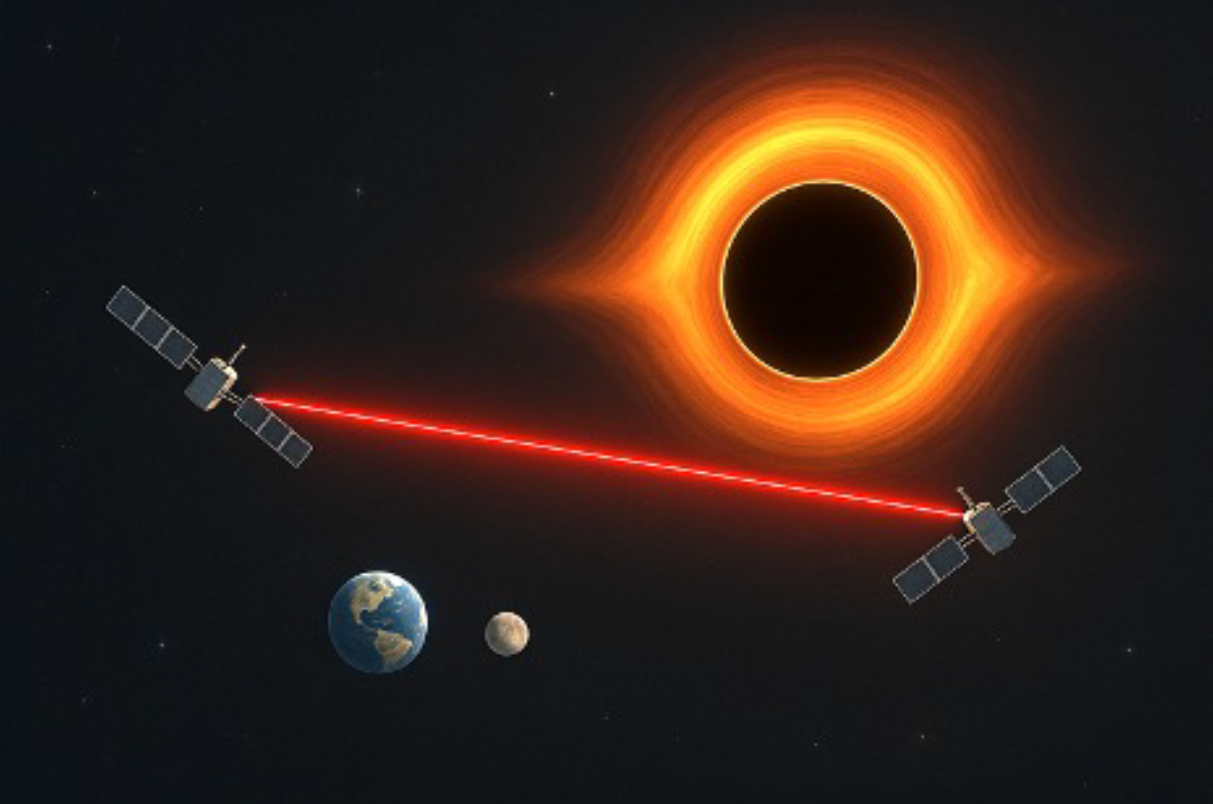
The OBLIVION Phase I study will assess the feasibility of a novel, intensity-only interferometer architecture for direct geometric measurement of a supermassive black hole’s photon ring at gigaparsec distance. We will use Hanbury Brown–Twiss intensity correlations at 1 cm wavelength, flying two identical spacecraft in a 1.1 AU heliocentric orbit trailing Earth by 20°. At that baseline the first null of the second-order intensity coherence curve for a ring subtending ~1 prad can be located to ±0.002 prad, yielding black-hole mass determinations to 3 %–ten times more precise than current reverberation mapping–and providing an independent strong-field gravity test at cosmological scales.
We will translate this top-level science objective into a formal Requirements Traceability Matrix. Detector timing-jitter budgets will be set to ≤ 50 ps; photon-count simulations will define null-detection SNR ≥ 10^4 against sky and dark-count backgrounds; two-way optical time-transfer protocols will secure relative-separation knowledge to ≤ 0.3 m; and attitude-control allocations will ensure pointing precision ≤ 1 nrad. Each requirement will map directly to formation geometry, metrology procedures, detector performance margins and ground-segment operations.
We will carry out mission-architecture trades between direct insertion into the 1.1 AU Earth-trailing orbit and trajectories employing lunar or Earth gravity assists. We will model ΔV budgets, coast-phase propellant margins and launch-injection tolerances; simulate baseline growth under solar radiation pressure, thermal flexure and third-body perturbations; and compare passive drift against continuous micro-propulsion control loops to maintain formation within derived margins–all through analytic evaluation without hardware prototyping. We will develop a unified CONOPS that sequences launch-vehicle separation, membrane-reflector deployment, detector activation, laser-ranging calibration, synchronized observation campaigns with baseline-adjustment maneuvers, and end-of-mission decommissioning into a continuous, time-tagged operational flow. We will draft command-sequence scripts, ground-station contact schedules, telemetry-downlink plans and two-way timing-exchange protocols tied to orbital geometry. Embedded anomaly-detection algorithms and recovery routines will preserve data integrity during metrology-link dropouts or formation drift, all within analytic study scope.
We will execute high-fidelity, end-to-end simulations coupling intensity-interferometry performance models with realistic noise and error sources–including detector dark counts, sky background flux, platform jitter and clock drift–to generate error-covariance matrices, sensitivity maps and Monte Carlo risk-assessment frameworks. A comprehensive risk register will catalog architecture-level hazards, rank them by likelihood and consequence, and propose mitigation strategies fully contained within analytic tasks.
At Phase I closeout we will deliver the validated Traceability Matrix; a mission-architecture report with detailed trajectory analyses, ΔV summaries and baseline-growth profiles; a complete CONOPS document with event-flow diagrams, command scripts and ground-segment interface definitions; and a comprehensive simulation and risk-assessment compendium with sensitivity maps and Monte Carlo reports. A development roadmap will link each requirement and identified risk to technology-readiness targets and simulation milestones. By focusing exclusively on science requirements, architecture evaluation, operations concepts and systems-level modeling–without hardware development–OBLIVION Phase I will determine whether intensity-only interferometry can deliver transformational black-hole science at gigaparsec scales and prepare the way for a Phase II design effort.
2026 Selections
Full text from nasa.gov (public domain).