
SpaceRocket
Home
Launches
ArticlesNewsEventsStatisticsModelsLinks
Home
Rocket Library500+ launch vehiclesFamily TreeBy country & familyEnginesEngine family treeCompareSide-by-side specsReuseBooster flight records
Launches
StationsISS & Tiangong trackerSatellites3D satellite mapAsteroid WatchNear-Earth objectsNASA APODPicture of the day
ArticlesNewsEventsStatisticsModelsLinks
🚀SpaceRocket

Exploring the cosmos through data. Track rockets, events, and space missions in real time.

Quick Links

  • Home
  • Rockets
  • Launches
  • Events
  • Articles
  • News
  • Statistics
  • Links

Legal

  • About Us
  • Privacy Policy
  • Terms of Service
  • Contact Us

Data Sources

Launch & event data: Launch Library 2. News: SNAPI. APOD & imagery: NASA. Background research: Wikipedia (CC BY-SA 4.0).

© 2026 SpaceRocket. All rights reserved.

Data from TheSpaceDevs, SNAPI & NASA

← Back to NewsRead Original
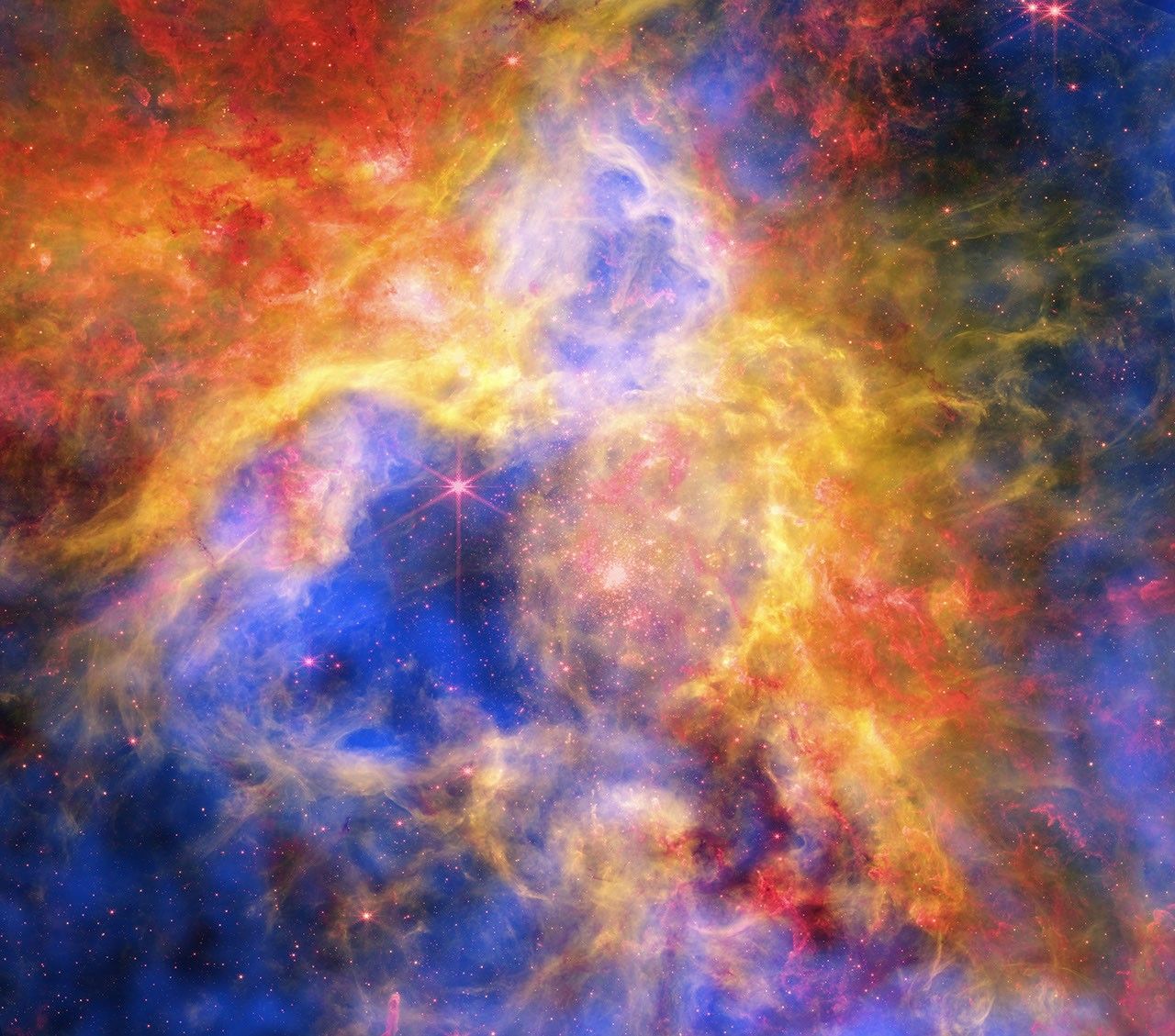
Colorful Collage of Tarantula Nebula
NASAAugust 17, 2026

Colorful Collage of Tarantula Nebula

Data from NASA’s Chandra X-ray Observatory, NASA’s James Webb Space Telescope, and NASA’s Hubble Space Telescope combine to reveal a vibrant view of 30 Doradus, or the Tarantula Nebula, in this Aug. 11, 2026, image. Located in the Large Magellanic Cloud, a small neighbor galaxy to the Milky Way about 160,000 light-years from Earth, the Tarantula has thousands of young stars embedded in a vibrant honeycomb-like structure of gas and dust.

By studying the data from Chandra, Hubble, and Webb, combined with data from the agency’s retired Spitzer Space Telescope, astronomers determined that the Tarantula may be losing energy from several sources, including hot gas escaping from the nebula.

Learn more about this image.

Image credit: X-ray: NASA/CXC/Ohio State Univ./J. Rodriguez et al; Infrared: NASA/ESA/CSA/STScI; Optical: NASA/ESA/STScI; Image Processing: NASA/CXC/SAO/P. Edmonds

Full text from nasa.gov (public domain).