
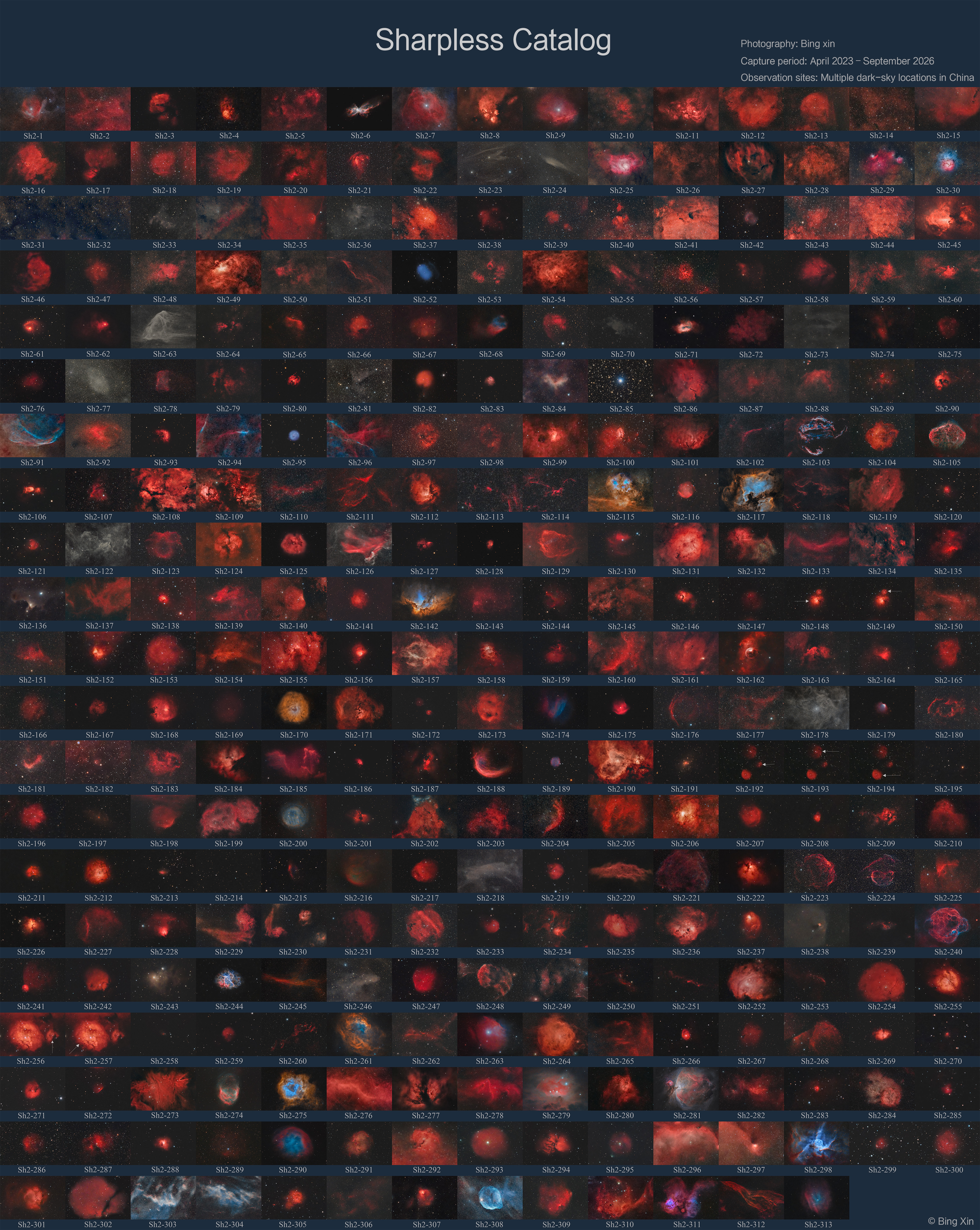
APOD: 2026 October 2 – The Complete Sharpless Catalog: 313 Nebulas
APOD
Astronomy Picture of the Day
Discover the cosmos! Each day a different image or photograph of our fascinating universe is featured, along with a brief explanation written by a professional astronomer.
Explanation: What does it take to image hundreds of nebulas? Today’s image contains the entire Sharpless Catalog of H II Regions, totaling 313 objects. Zoom in and explore! You may spot fan favorites like the Eagle (Sh2-49), Heart (Sh2-190), and Orion (Sh2-281) Nebulas. Despite its name, this catalog contains more than the glow of ionized hydrogen that makes up H II regions. There are planetary nebulas (the Medusa Nebula, Sh2-274) and supernova remnants (the Spaghetti Nebula, Sh2-240) as well. Astrophotographer Bing Xin traversed the dark skies of Eastern China and Inner Mongolia to catch them all. Narrowband filters that primarily capture light from ionized hydrogen and oxygen as well as red-green-blue filters were used. Each object took 2 to 6 hours to capture, with the entire catalog taking around 800 hours to complete! Which object is your favorite?APOD's email for image submissions has changed. Please see: APOD SubmissionsTomorrow's picture: just Curiosity
Full text from nasa.gov (public domain).