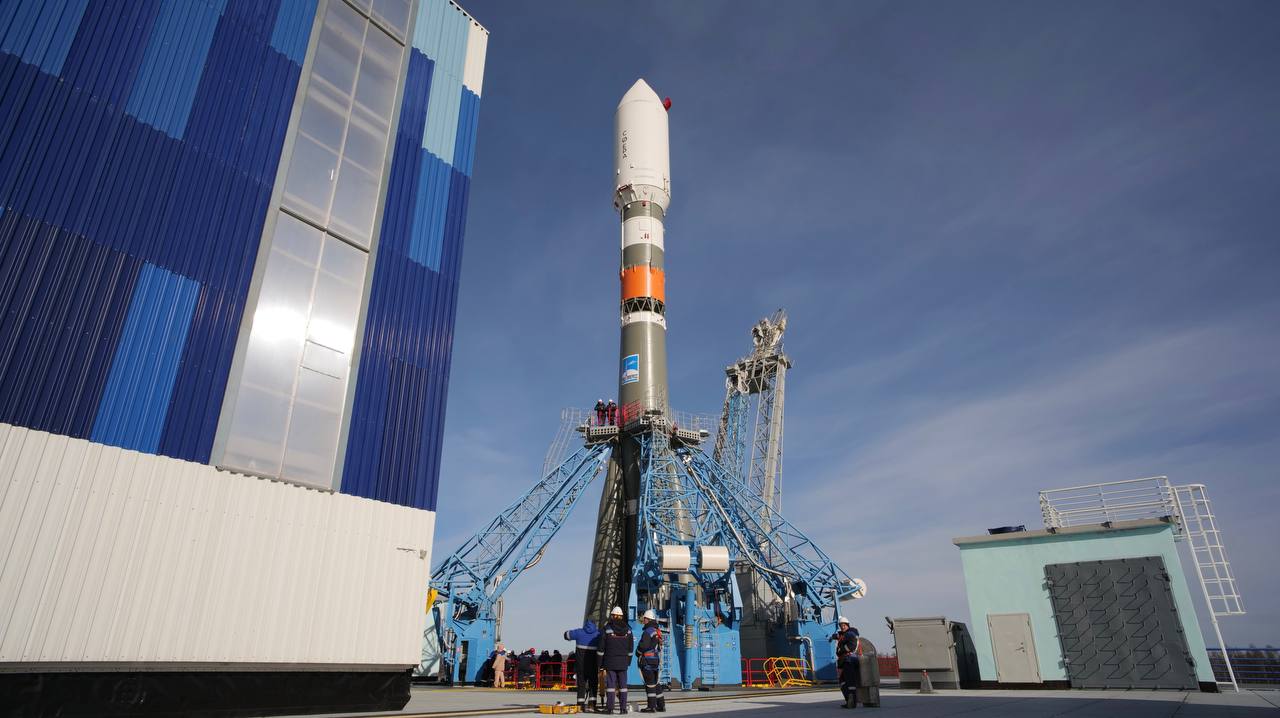
Soyuz-2, GRAU index 14A14, is the collective designation for the 21st-century version of the Russian Soyuz rocket. In its basic form, it is a three-stage carrier rocket for placing payloads into low Earth orbit. The first-stage boosters and two core stages feature uprated engines with improved injection systems, compared to the previous versions of the Soyuz. Digital flight control and telemetry systems allow the rocket to be launched from a fixed launch platform, whereas the launch platforms for earlier Soyuz rockets had to be rotated as the rocket could not perform a roll to change its heading in flight.
The Soyuz 2.1b/Fregat-M is a Russian launch vehicle manufactured by the Progress Rocket Space Center, the company known for producing Soyuz launch vehicles. It belongs to the Soyuz 2 family, which carries the GRAU index 14A14 and serves as the collective designation for the 21st-century version of the long-running Soyuz rocket line. Compared with earlier Soyuz versions, the Soyuz 2 features uprated engines with improved injection systems on its first-stage boosters and two core stages. It also introduced digital flight control and telemetry systems, allowing the vehicle to be launched from a fixed launch platform; earlier Soyuz rockets could not roll to change heading in flight and therefore required rotating launch platforms. The Fregat-M designation identifies this configuration's upper stage variant. The vehicle remains active, and its maiden flight took place on 26 July 2008.
In its basic form, the Soyuz 2.1b is a three-stage carrier rocket intended for placing payloads into low Earth orbit, and the Fregat-M upper stage extends its reach to higher-energy destinations. The vehicle stands 46.3 meters tall with a diameter of 10.3 meters and has a launch mass of 313 tonnes. According to SpaceRocket's database, it can deliver up to 8,200 kilograms to low Earth orbit and 3,250 kilograms to geostationary transfer orbit. The rocket is fully expendable: no part of the vehicle is designed for recovery, and no landing attempts of any kind have been recorded for it. Its first-stage boosters and two core stages use uprated engines with improved injection systems relative to previous Soyuz versions, while digital flight control and telemetry systems manage the ascent from a fixed launch platform.
The Soyuz 2.1b/Fregat-M conducted its maiden flight on 26 July 2008. SpaceRocket's database records 35 launches of this configuration, all of which were successful, with no failures logged; the site's own launch record lists the tracked missions under a successful outcome. Consistent with its expendable design, the vehicle has no recorded landing attempts, successful or otherwise. On the numbers alone, the configuration presents an unbroken streak of successful missions across its operational history to date, giving it a perfect success rate within the dataset. That record spans a period beginning in 2008 and reflects a vehicle that has flown regularly in Russian service. As with any statistical summary, the figures represent only the launches tracked in the database, but within that scope the Soyuz 2.1b/Fregat-M stands as one of the more reliable configurations in the Soyuz 2 family.
Sources: Launch Library 2 (TheSpaceDevs) · Wikipedia (CC BY-SA 4.0)