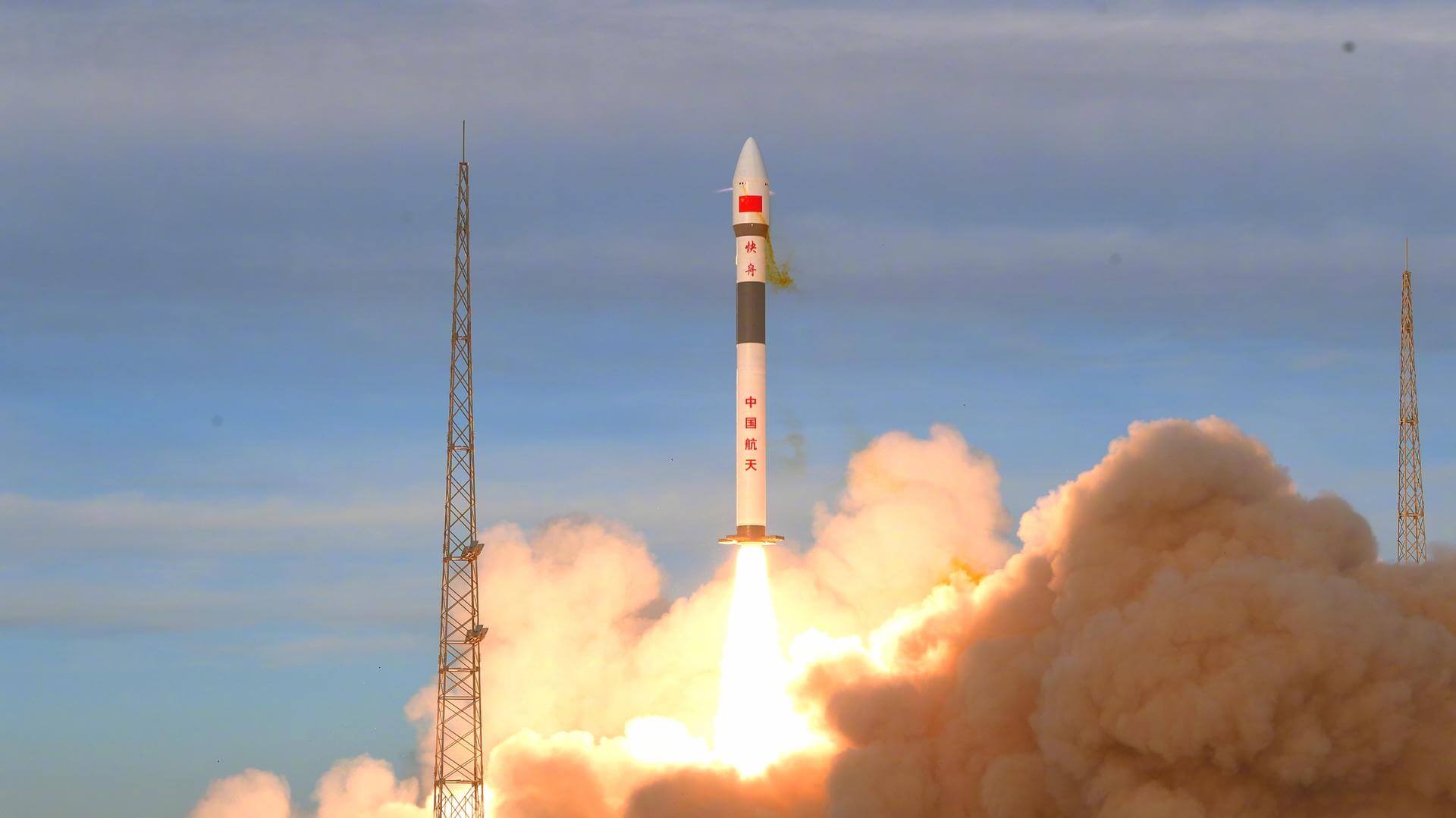
Kuaizhou is a family of Chinese "quick-reaction" orbital launch vehicles. Flying since 2013, Kuaizhou 1 and 1A consist of three solid-fueled rocket stages, with a liquid-fueled fourth stage as part of the satellite system.
The Kuaizhou 1A is a Chinese orbital launch vehicle developed by ExPace. It belongs to the Kuaizhou family of launchers, which are described as "quick-reaction" vehicles, a concept centered on the ability to prepare and conduct launches on short notice. The wider Kuaizhou family, comprising the Kuaizhou 1 and the Kuaizhou 1A, has been flying since 2013, while the 1A variant itself conducted its maiden flight on January 9, 2017. The rocket remains active in service. As a member of this family, the Kuaizhou 1A shares the overall architecture of three solid-fueled rocket stages supplemented by a liquid-fueled fourth stage that forms part of the satellite system, an arrangement that distinguishes the design from conventional all-solid small launchers.
The Kuaizhou 1A is a compact vehicle measuring 19.4 meters in length with a diameter of 1.4 meters and a launch mass of 30 tonnes. Its propulsion arrangement consists of three solid-fueled stages, with a liquid-fueled fourth stage integrated as part of the satellite system rather than as a conventional upper stage of the launcher itself. In terms of payload performance, the vehicle is rated to carry 300 kilograms to low Earth orbit, placing it in the small-lift category of launch vehicles. No geostationary transfer orbit capacity is listed for the rocket in SpaceRocket's database. The Kuaizhou 1A is expendable: it is not designed for reuse, and no landing attempts have been recorded for the vehicle. Its modest dimensions and mass are consistent with the quick-reaction role described for the Kuaizhou family, in which a small, manageable vehicle can be readied for launch with limited preparation.
Since its maiden flight on January 9, 2017, the Kuaizhou 1A has accumulated a substantial operational record for a small launch vehicle. According to SpaceRocket's database, the rocket has flown 31 missions, of which 28 were successful and 3 ended in failure, corresponding to a success rate of roughly 90 percent. Because the vehicle is expendable, no landing attempts, successful or otherwise, are recorded. This record indicates that the Kuaizhou 1A has matured into a regularly flown launcher with a generally reliable service history, although the three failures on its tally show that its dependability has not been absolute. The vehicle's continued active status suggests that it remains an operational part of China's small-satellite launch landscape, serving missions that match its 300-kilogram low-Earth-orbit payload class. Overall, the available statistics portray a small, expendable quick-reaction launcher with a well-established flight history and a reliability profile typical of an operational rather than experimental system.
Sources: Launch Library 2 (TheSpaceDevs) · Wikipedia (CC BY-SA 4.0)