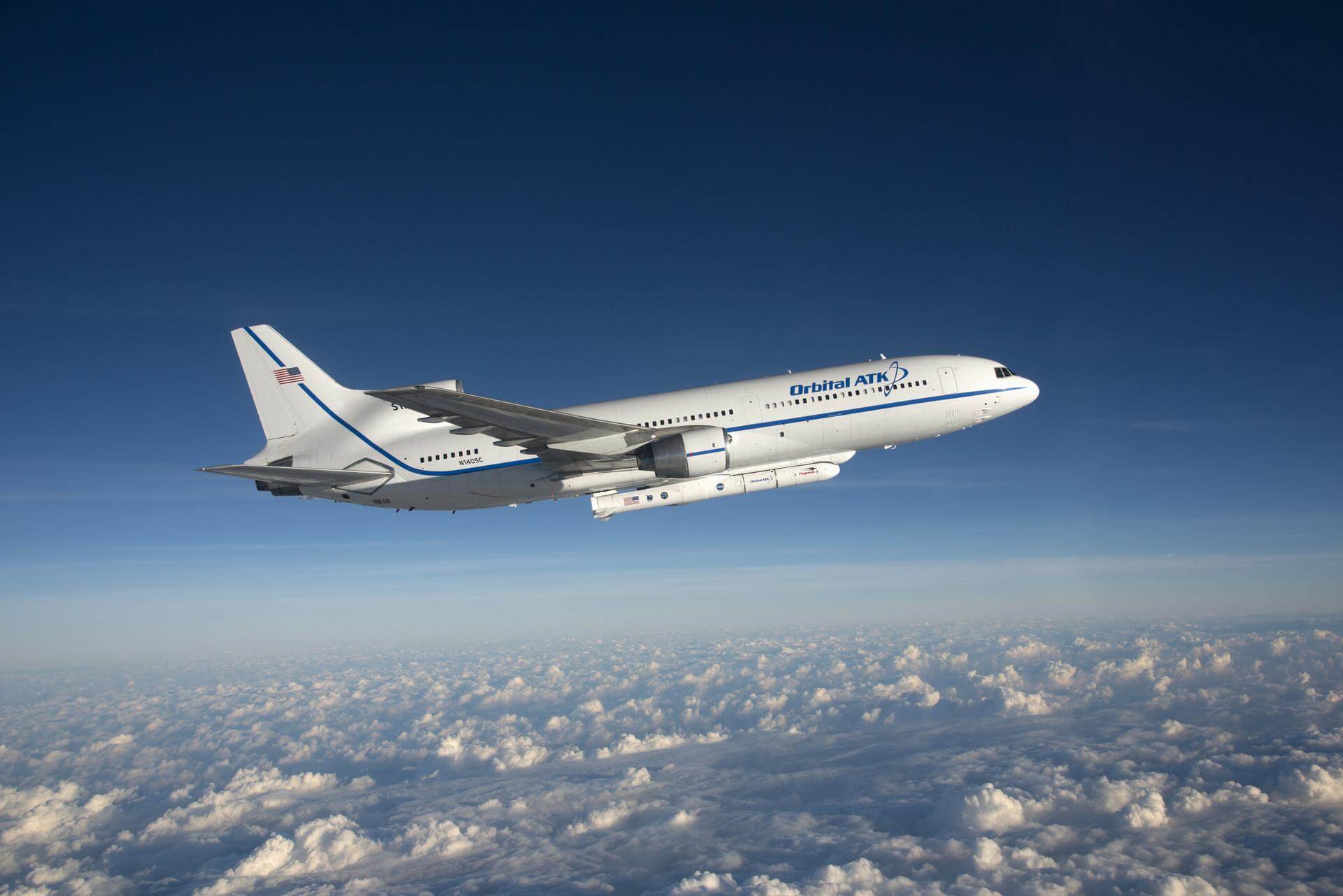
The Pegasus is an air-launched rocket developed by Orbital Sciences Corporation (now part of Northrop Grumman Innovation Systems). Capable of carrying small payloads of up to 443 kilograms (977 lb) into low Earth orbit, the vehicle consists of three solid propellant stages and an optional monopropellant fourth stage. Pegasus is released from its carrier aircraft at approximately 40,000 ft (12,000 m), and its first stage has a wing and a tail to provide lift and attitude control while in the atmosphere.
The Pegasus XL is an American air-launched small-lift rocket developed by Orbital Sciences Corporation, a company later absorbed into Northrop Grumman Innovation Systems. It belongs to the Pegasus family and represents the XL variant listed in SpaceRocket's database under Orbital Sciences Corporation as manufacturer. The concept behind the vehicle is to place small payloads into low Earth orbit after release from a carrier aircraft, rather than launching vertically from a fixed pad. In the data provided, the Pegasus XL remains listed as active, but it is not reusable and no landing attempts are associated with it.
The vehicle is 17.6 m long, has a diameter of 1.27 m, and a listed launch mass of 23 t. Its low Earth orbit payload capacity is given as 443 kg, while no geostationary transfer orbit capacity is listed. The supplied description states that the rocket uses three solid-propellant stages and can carry an optional monopropellant fourth stage. It is released from its carrier aircraft at approximately 40,000 ft (12,000 m), after which the first stage uses a wing and a tail to provide lift and attitude control while still in the atmosphere. These features define Pegasus XL as an air-launched, winged first-stage system rather than a conventional ground-launched booster, and the database lists no reusability or landing capability for the configuration.
According to SpaceRocket's database, the Pegasus XL made its maiden flight on 27 June 1994 and has accumulated 32 launches, with 29 recorded as successful and 3 as failures. No successful or failed landings are listed, which is consistent with the vehicle being marked non-reusable. The available launch record summary in the provided data shows only a grouped successful outcome, so the fuller totals from the rocket data are the appropriate basis for assessment. On those figures, the Pegasus XL has a mature but not spotless record: most flights succeeded, while three failures are part of its history. The numbers support a measured conclusion that it has been a workable small-payload option within its niche, without implying performance beyond what the statistics show.
Sources: Launch Library 2 (TheSpaceDevs) · Wikipedia (CC BY-SA 4.0)