Proton-M Briz-M
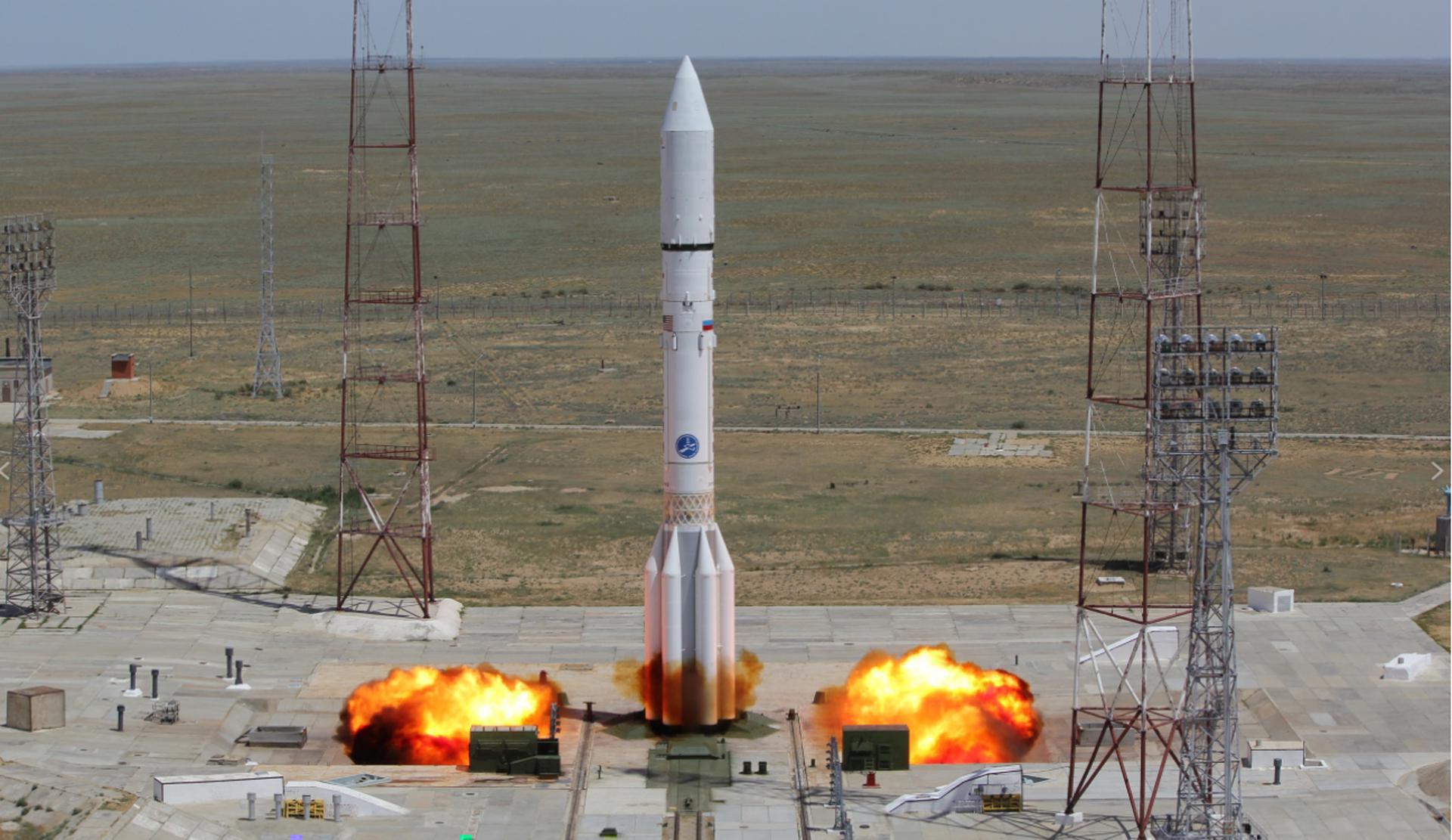
The Proton-M Briz-M is a Russian launch vehicle developed and manufactured by the Khrunichev State Research and Production Space Center, a Moscow-based producer of spacecraft and space-launch systems. It belongs to the Proton / UR-500 rocket family, a long-running series whose maiden flight dates to 10 March 1967 and which has accumulated 430 launches across all variants. Khrunichev, a government-type agency founded in 1916, is also known for the Rokot rocket and has been developing the Angara rocket family. The Proton-M Briz-M variant itself first flew on 7 April 2001, representing a modernized configuration of the Proton line paired with the Briz-M upper stage. The vehicle remains listed as active.
The Proton-M Briz-M is an expendable, non-reusable launch vehicle standing 53 meters tall with a diameter of 7.4 meters and a launch mass of 712 tonnes. Its configuration spans between one and four stages depending on the mission profile, with the Briz-M upper stage completing the stack. In terms of payload performance, the vehicle is rated to carry up to 21,000 kilograms to low Earth orbit and up to 4,500 kilograms to geostationary transfer orbit. These figures place it in the heavy-lift category among operational launch vehicles. No landing or recovery attempts are associated with the design, consistent with its expendable architecture, and no launch cost figures are recorded in the available data.
According to SpaceRocket's database, the Proton-M Briz-M has flown 68 times since its maiden flight on 7 April 2001, with 62 successful launches and 6 failures, corresponding to a success rate of roughly 91 percent. The vehicle has also achieved 19 consecutive successful launches, and no landing attempts have been made or recorded, which is expected for an expendable system. It should be noted that no individual launches of this vehicle are recorded in SpaceRocket's database yet, so the aggregate statistics above cannot be cross-checked against a per-flight history here. On the numbers available, the record indicates a mature vehicle with a substantial operational history, though the six failures show that reliability, while considerable, has not been uniform across its career.
Sources: Launch Library 2 (TheSpaceDevs) · Wikipedia (CC BY-SA 4.0)