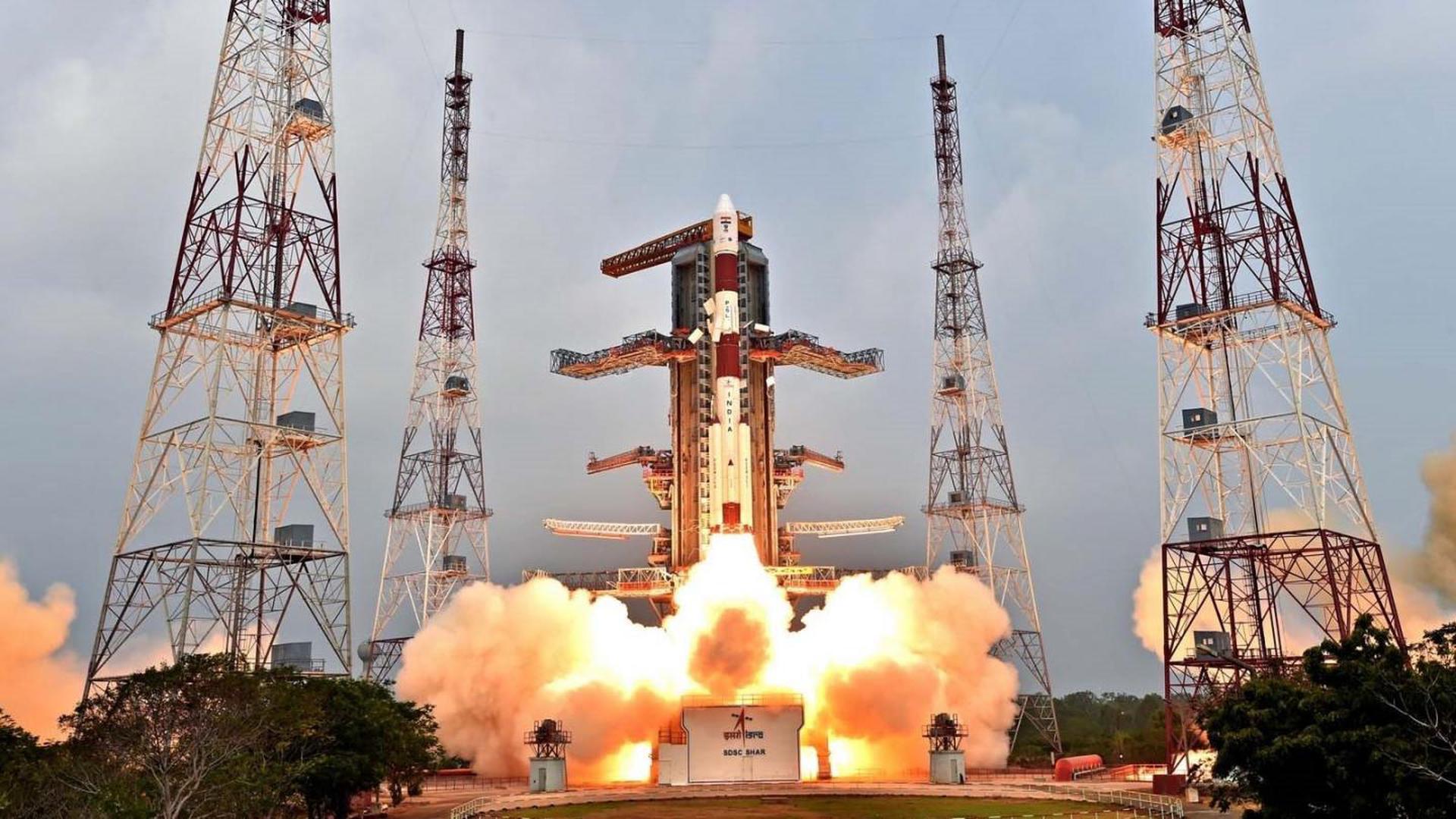
PSLV-XL is the upgraded version of Polar Satellite Launch Vehicle in its standard configuration boosted by more powerful, stretched strap-on boosters with 12 tonne propellant load. Weighing 320t at lift-off, the vehicle uses larger strap-on motors (PSOM-XL or S12) to achieve higher payload capability. On 29 December 2005, ISRO successfully tested the improved version of strap-on booster for the PSLV. The first use of PSLV-XL was the launch of Chandrayaan-1 by PSLV C11. The payload capability for this variant is 1,800 kg to SSO.
The PSLV-XL is an upgraded variant of the Polar Satellite Launch Vehicle developed by the Indian Space Research Organization (ISRO), the space agency of the Government of India headquartered in Bangalore. ISRO was founded in 1969 with the stated vision of harnessing space technology for national development while pursuing space science research and planetary exploration, and the PSLV has been one of its principal launch vehicles alongside the GSLV family. The XL variant emerged from work on improved strap-on booster technology: on 29 December 2005, ISRO successfully tested an improved version of the strap-on booster used by the PSLV. The first operational use of the PSLV-XL configuration came with the launch of Chandrayaan-1 aboard flight PSLV C11, and the variant's maiden flight is recorded on 22 October 2008. The vehicle remains active in ISRO's launcher fleet.
The PSLV-XL retains the standard configuration of the Polar Satellite Launch Vehicle but is boosted by more powerful, stretched strap-on boosters carrying a 12-tonne propellant load. These larger strap-on motors, designated PSOM-XL or S12, give the vehicle a higher payload capability than the baseline version. The vehicle stands 44 metres tall with a diameter of 2.8 metres and weighs 320 tonnes at lift-off. It is a four-stage rocket, and according to the available data its payload capability is 1,800 kg to sun-synchronous orbit (SSO). Figures for low Earth orbit and geostationary transfer orbit capacity are not listed in SpaceRocket's database for this variant. The PSLV-XL is not reusable: it is an expendable launch vehicle, and no landing attempts have been made with it, consistent with the PSLV family's conventional expendable design.
According to SpaceRocket's database, the PSLV-XL has flown 27 times since its maiden flight on 22 October 2008, with 25 successful launches and 2 failures. This corresponds to a success rate of roughly 93 percent across its operational history. One further launch is listed with a status yet to be determined. As an expendable vehicle, the PSLV-XL has recorded no landing attempts, successful or otherwise, and recovery statistics are therefore not applicable to this variant. The two failures against 25 successes indicate a generally reliable record, though not an unbroken one, and the configuration has been entrusted with notable missions beginning with Chandrayaan-1, India's first lunar probe. With the variant still active and additional flights pending, the PSLV-XL continues to serve as the higher-performance member of the PSLV family within ISRO's launch program.
Sources: Launch Library 2 (TheSpaceDevs) · Wikipedia (CC BY-SA 4.0)