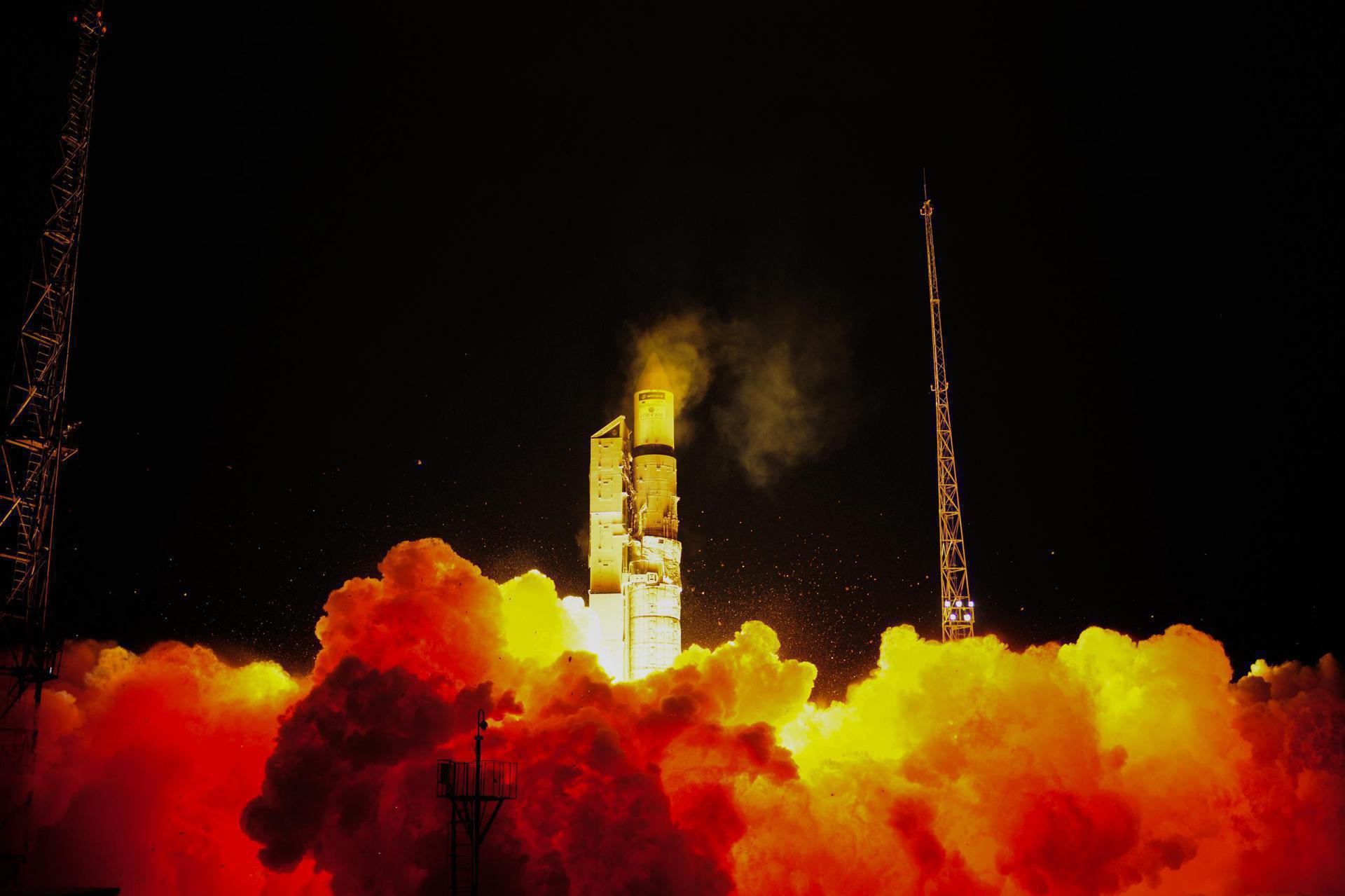
The Rokot/Briz-KM is a Russian launch vehicle associated with the Russian Aerospace Defence Forces (VKO), the government body listed as its manufacturer. It belongs to the Rokot family, whose maiden flight dates to 26 December 1994, while the Briz-KM variant itself first flew on 16 May 2000. The vehicle remains listed as active. The Rokot family as a whole has accumulated 32 launches, of which 29 were successful and three ended in failure. The available data does not describe the program's origins, development contractors, or design heritage beyond these points, so no further background can be stated here.
The Rokot/Briz-KM is an expendable vehicle; it is not designed for reuse, and no landing attempts of any kind are recorded for it. The vehicle stands 29 metres tall with a diameter of 2.5 metres and a launch mass of 107 tonnes. Depending on configuration it comprises between one and three stages, with the Briz-KM designation referring to the variant's upper stage. Liftoff thrust is listed at 1,870 kilonewtons. Its payload capacity to low Earth orbit is 1,850 kilograms, while no capacity to geostationary transfer orbit is listed. An apogee figure of 1,500 kilometres is recorded for the vehicle. No launch cost figures are available in the data.
No launches of this vehicle are recorded in SpaceRocket's database yet. Aggregate figures compiled for the configuration credit the Rokot/Briz-KM with 31 launches between its maiden flight on 16 May 2000 and the present, of which 28 were successful and three ended in failure, corresponding to a success rate of roughly 90 percent. The vehicle's most recent run of consecutive successful launches stands at 14, and its fastest recorded turnaround between flights was 32 days, 12 hours, 29 minutes, and 26 seconds. Consistent with its expendable design, there have been no attempted, successful, or failed landings. On these numbers, the Rokot/Briz-KM appears as a small, moderately flown vehicle with a solid but not flawless reliability record; the three failures in 31 flights indicate that losses have been infrequent yet recurring across its service life, and its low Earth orbit capacity places it firmly in the light-lift category.
Sources: Launch Library 2 (TheSpaceDevs) · Wikipedia (CC BY-SA 4.0)