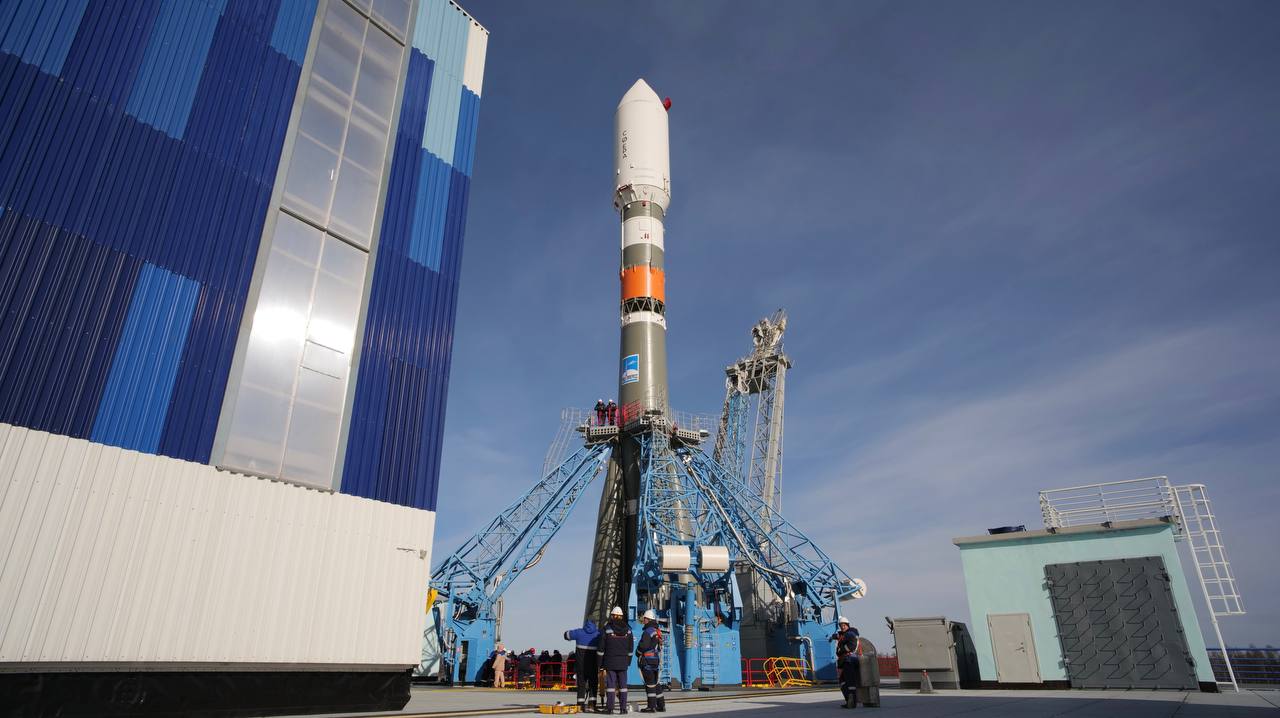
Soyuz-2, GRAU index 14A14, is the collective designation for the 21st-century version of the Russian Soyuz rocket. In its basic form, it is a three-stage carrier rocket for placing payloads into low Earth orbit. The first-stage boosters and two core stages feature uprated engines with improved injection systems, compared to the previous versions of the Soyuz. Digital flight control and telemetry systems allow the rocket to be launched from a fixed launch platform, whereas the launch platforms for earlier Soyuz rockets had to be rotated as the rocket could not perform a roll to change its heading in flight. The Soyuz 2.1b represents the latest development stage of the proven rocket. It uses the new RD-0124 engines in the first three stages, coupled with an improved injection system that significantly boosts the performance of the Soyuz. Furthermore, she wears a new, digital startup control system. This will allow the Soyuz 2.1b to carry around 1.2 tonnes more payload into low earth orbit compared to its predecessor.
The Soyuz 2.1b/Fregat is a Russian launch vehicle manufactured by the Progress Rocket Space Center, formerly known as TsSKB-Progress, a company recognized for producing Soyuz launch vehicles and satellites. The vehicle belongs to the wider Soyuz family, whose origins date to a maiden flight in December 1965, and more specifically to the Soyuz 2 branch, which first flew in November 2004. Soyuz-2, carrying the GRAU index 14A14, is the collective designation for the 21st-century version of the Russian Soyuz rocket. Compared to earlier versions, the first-stage boosters and core stages received uprated engines with improved injection systems, and digital flight control and telemetry systems were introduced. These systems allow the rocket to be launched from a fixed launch platform, whereas earlier Soyuz rockets required their launch platforms to be rotated because the vehicle could not perform a roll to change its heading in flight. The Soyuz 2.1b represents the latest development stage of this lineage, and the Fregat variant pairs the three-stage core vehicle with a Fregat upper stage.
In its basic form, the Soyuz-2 is a three-stage carrier rocket designed for placing payloads into low Earth orbit. The Soyuz 2.1b variant uses RD-0124 engines coupled with an improved injection system, a combination that significantly boosts the performance of the vehicle compared to its predecessors. It also features a new digital startup control system. According to the program data, these changes allow the Soyuz 2.1b to carry roughly 1.2 tonnes more payload into low Earth orbit than its predecessor. The Soyuz 2.1b/Fregat stands 46.3 metres tall with a diameter of 2.95 metres and has a launch mass of 312 tonnes. Its stated payload capacity is 8,200 kilograms to low Earth orbit and 3,250 kilograms to geostationary transfer orbit. The vehicle is expendable, with no reusability provisions, and it remains in active service.
The Soyuz 2.1b/Fregat conducted its maiden flight on 27 December 2006. According to SpaceRocket's database, the configuration has flown 25 times, recording 23 successful launches and 2 failures. No landing attempts have been made with this vehicle, consistent with its expendable design. These figures yield a success rate of approximately 92 percent, indicating a largely reliable operational history tempered by a small number of failures over nearly two decades of service. The two losses stand against a substantially larger tally of successful missions, and the vehicle's continued active status suggests that it remains a regular part of Russia's launch operations. Within the broader Soyuz 2 family, which has accumulated more than 200 flights with a high overall success rate, the 2.1b/Fregat configuration occupies a modest but established role, serving missions that benefit from the added capability of the Fregat upper stage.
Sources: Launch Library 2 (TheSpaceDevs) · Wikipedia (CC BY-SA 4.0)