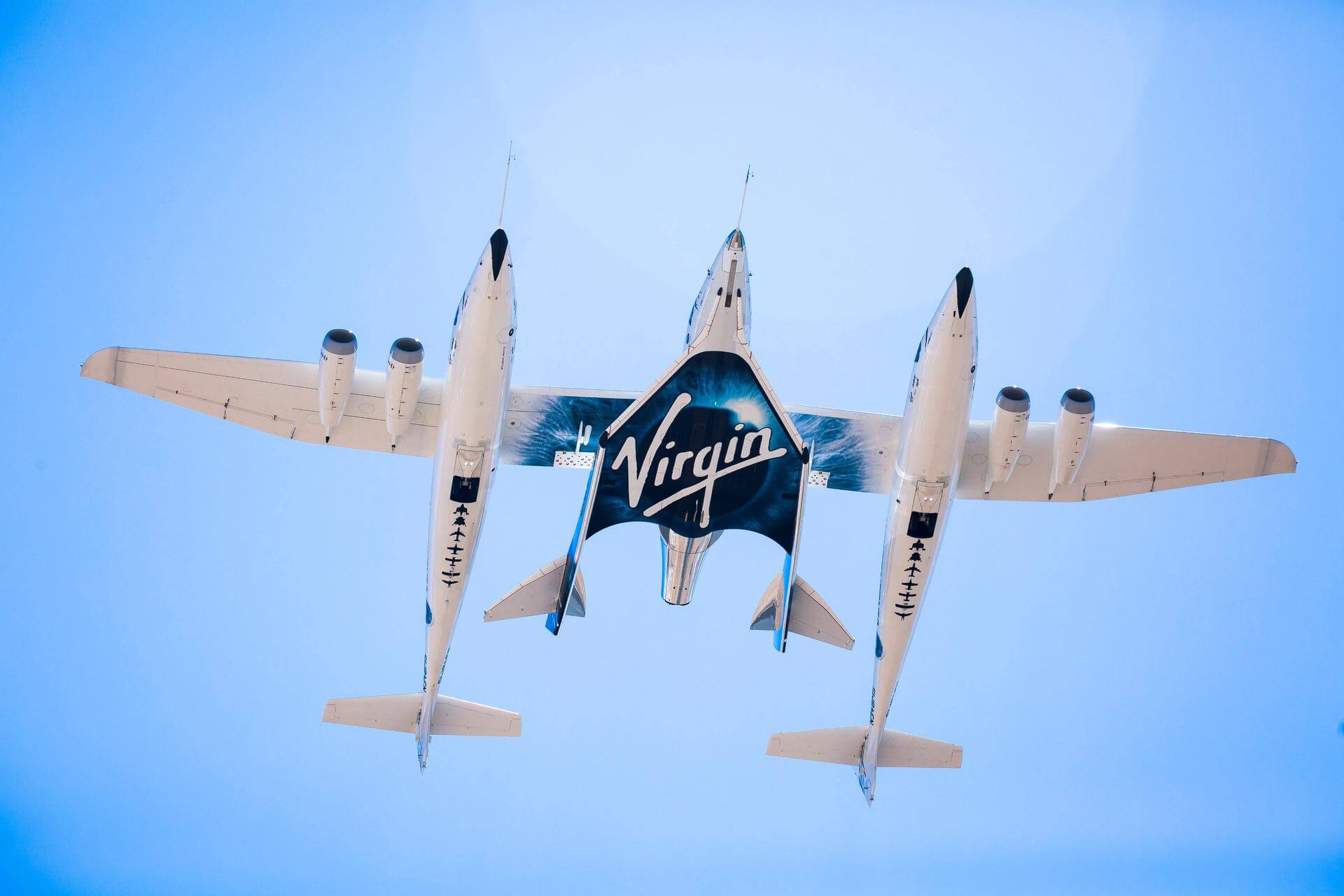
The Scaled Composites Model 339 SpaceShipTwo (SS2) is an air-launched suborbital spaceplane type designed for space tourism. It is manufactured by The Spaceship Company, a California-based company owned by Virgin Galactic.
SpaceShipTwo, formally the Scaled Composites Model 339 SpaceShipTwo (SS2), is an air-launched suborbital spaceplane type designed for space tourism. It is manufactured by The Spaceship Company, a California-based company owned by Virgin Galactic, an American private spaceflight company within the Virgin Group. Virgin Galactic was founded in 2004 by Richard Branson with the aim of developing commercial spacecraft and providing suborbital spaceflights to space tourists. Under this concept, SpaceShipTwo vehicles are carried aloft and released from beneath a carrier airplane known as White Knight Two, of which VMS Eve is the operational example. The SpaceShipTwo vehicles associated with the program include VSS Enterprise and VSS Unity. The type's maiden flight took place on 10 October 2010, and the vehicle remains listed as active.
SpaceShipTwo is a single-configuration, air-launched design rather than a conventional vertically launched rocket. It measures 18 meters in length with a diameter of 8.2 meters and has a launch mass of 9 tonnes. Its launch configuration produces 310 kN of thrust, and the type is designed to reach an apogee of approximately 110 kilometers, placing it in the suborbital regime rather than orbital flight. Consistent with that role, its payload capacities to low Earth orbit and to geostationary transfer orbit are both listed as zero: the vehicle is intended to carry people on brief suborbital trajectories, not to deliver satellites to orbit. The design is reusable, with the spaceplane intended to return to a runway-style landing after each flight and fly again; the recorded fastest turnaround between flights is one day.
According to SpaceRocket's database, SpaceShipTwo has accumulated 67 launches, of which 62 were successful and 5 ended in failure, a success rate of roughly 92.5 percent. The vehicle is currently on a streak of 11 consecutive successful launches, with one further launch pending. No booster landings have been attempted, which reflects the air-launched spaceplane architecture rather than any shortcoming; separately, 66 successful spacecraft landings are recorded out of 66 attempts. It should be noted that no individual launches of this vehicle are recorded in SpaceRocket's database yet, so these figures rest solely on the aggregate statistics. On that basis, the record depicts a mature suborbital tourism vehicle with a substantial number of flights and a recent run of uninterrupted successes, though the five failures in its history underline that crewed suborbital spaceflight remains a demanding undertaking.
Sources: Launch Library 2 (TheSpaceDevs) · Wikipedia (CC BY-SA 4.0)