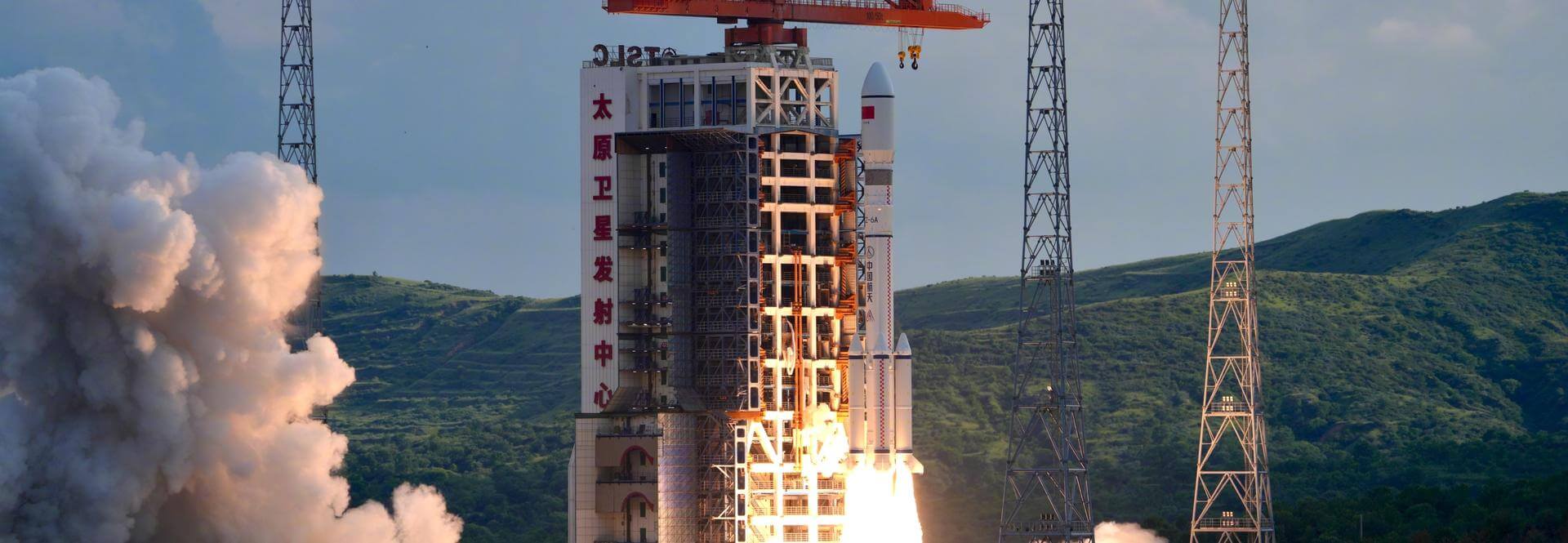
The Long March 6A is a Chinese launch vehicle of the Long March family, which was developed by the China Aerospace Science and Technology Corporation (CASC) and the Shanghai Academy of Spaceflight Technology (SAST). The vehicle is a further development of the Long March 6, with 2 YF-100 engines on the first stage as opposed to 1 on the Long March 6, augmented by 4 solid rocket boosters. The Long March 6A is China's first rocket with solid rocket boosters. The maiden launch of the Long March 6A took place 29 March 2022, successfully reaching orbit. It was also the first launch from the newly built launch complex 9A in Taiyuan.
The Long March 6A is a Chinese launch vehicle in the Long March family, developed by the China Aerospace Science and Technology Corporation (CASC) and the Shanghai Academy of Spaceflight Technology (SAST). It is described as a further development of the Long March 6, retaining the same basic lineage while increasing first-stage thrust and adding strap-on boosters. The type is listed as active and remains part of China’s state-run launch vehicle program under CASC, the main contractor for the Chinese space program. Its maiden launch took place on 29 March 2022 and successfully reached orbit; that flight was also the first launch from the newly built launch complex 9A at Taiyuan.
The Long March 6A differs from the Long March 6 principally in its first stage and booster arrangement: it uses two YF-100 engines on the first stage rather than the single engine used on the Long March 6, and it is augmented by four solid rocket boosters. The data describe it as China’s first rocket with solid rocket boosters. The vehicle is listed at 50 m in length, 3.35 m in diameter, and 530 t at launch. Payload capacities for low Earth orbit and geostationary transfer orbit are not provided in the available data, so they are omitted here. The rocket is expendable rather than reusable, and the database records no successful or failed landings for the configuration.
According to SpaceRocket's database, the Long March 6A is listed with 26 total launches, 26 successful launches, and no failed launches; the grouped outcome record supplied here shows 12 successful launches and no failure entries. There are no landing attempts to assess because the vehicle is not reusable and the landing counters are zero. The maiden flight on 29 March 2022 reached orbit, and the subsequent record in the database is uniformly successful. On those numbers alone, the Long March 6A presents a consistent operational record to date, although the absence of recorded failures in this dataset is not by itself proof of long-term reliability beyond the launches counted.
Sources: Launch Library 2 (TheSpaceDevs) · Wikipedia (CC BY-SA 4.0)