Long March 3B/E
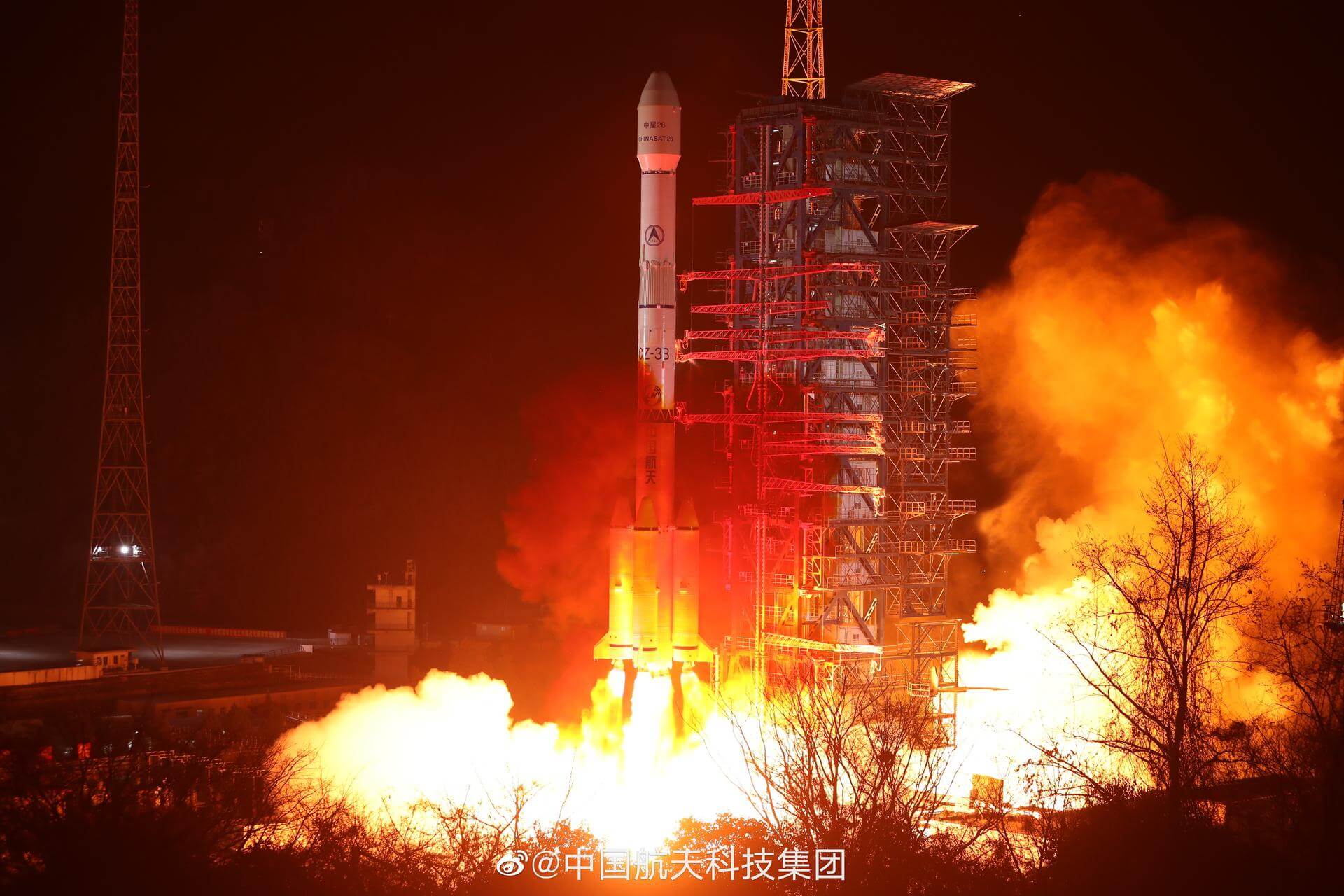
The Long March 3B / E (G2) (CZ-3B / E) is one of the most successful medium-range launchers and the strongest variant of the CZ-3 series. It was specially developed for the transport of heavy communications satellites into a geostationary transfer orbit. The additional designation "E" stands for a higher payload fairing, stretched boosters and extended fuel tanks at the first stage, over the CZ-3B.
The Long March 3B/E, also designated CZ-3B/E, is a Chinese medium-range launch vehicle developed by the China Aerospace Science and Technology Corporation (CASC). It is the strongest variant of the Long March 3 (CZ-3) series and was developed specifically to transport heavy communications satellites into geostationary transfer orbit. The additional "E" designation distinguishes it from the baseline Long March 3B and denotes a number of structural changes: a taller payload fairing, stretched strap-on boosters, and extended propellant tanks on the first stage. Within the CZ-3 series, the 3B/E is regarded as one of the most successful medium-range launchers, and it remains in active service.
The Long March 3B/E stands 56.3 meters tall, has a diameter of 3.35 meters, and has a launch mass of 456 tonnes. It can deliver payloads of up to 12,000 kilograms to low Earth orbit and up to 5,500 kilograms to geostationary transfer orbit, the latter being its primary mission profile. Compared with the standard Long March 3B, the E variant features an enlarged payload fairing, lengthened boosters, and extended first-stage fuel tanks, modifications intended to increase lift capability for heavy communications satellites. The vehicle is fully expendable: no stage or component is designed for recovery or reuse, and no landing attempts are part of its operational concept.
The Long March 3B/E conducted its maiden flight on 13 May 2007. According to SpaceRocket's database, the vehicle has since flown 78 missions, of which 76 were successful and 2 ended in failure, corresponding to a success rate of roughly 97 percent. Consistent with its expendable design, no booster landings have been attempted or achieved. These figures place the 3B/E among the most frequently flown members of the Long March 3 series and indicate a mature launch system with a strong reliability record. Its long operational history since 2007 and its sustained focus on geostationary transfer missions underline its established role in China's commercial and institutional satellite launch activities.
Sources: Launch Library 2 (TheSpaceDevs) · Wikipedia (CC BY-SA 4.0)