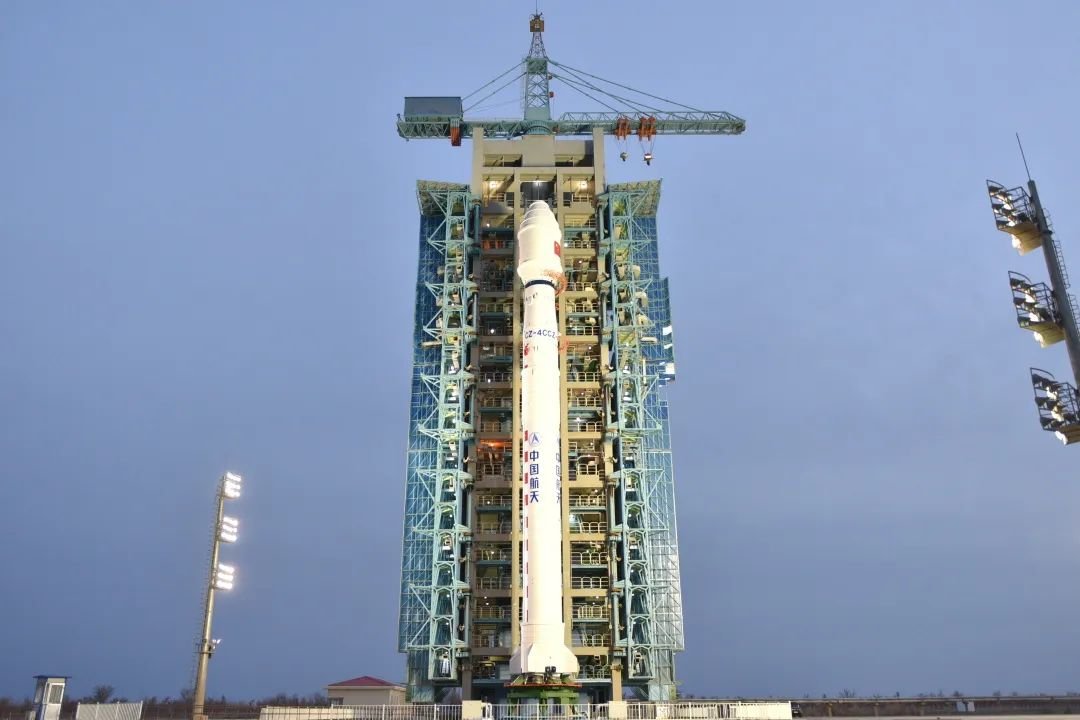
The Long March 4C, also known as the Chang Zheng 4C, CZ-4C and LM-4C, previously designated Long March 4B-II, is a Chinese orbital carrier rocket. It is launched from the Jiuquan, Taiyuan Satellite Launch Centre and Xichangs, and consists of 3 stages. Long March 4C vehicles have been used to launch the Yaogan-1, Yaogan-3 SAR satellites and the Fengyun-3A polar orbiting meteorological satellite. On December 15, 2009 a Long March 4C was used to launch Yaogan 8.
The Long March 4C, also known as the Chang Zheng 4C, CZ-4C, and LM-4C, is a Chinese orbital carrier rocket developed by the China Aerospace Science and Technology Corporation (CASC), the state-owned main contractor for the Chinese space program. The vehicle was previously designated the Long March 4B-II and belongs to the Long March rocket family, whose flight history dates back to 1970. The Long March 4C remains in active service. Its maiden flight took place on April 26, 2006. The rocket has been used to launch a number of Chinese satellites, including the Yaogan-1 and Yaogan-3 SAR satellites and the Fengyun-3A polar-orbiting meteorological satellite. On December 15, 2009, a Long March 4C was used to launch Yaogan 8. These payloads indicate a role centered on Earth-observation and meteorological missions for Chinese government programs.
The Long March 4C is a three-stage, expendable orbital carrier rocket; it is not designed for reusability, and no landing attempts are associated with the type in the available data. The vehicle is launched from three Chinese spaceports: the Jiuquan Satellite Launch Center, the Taiyuan Satellite Launch Center, and the Xichang Satellite Launch Center. Detailed dimensional and performance figures for the rocket, including its overall length, diameter, launch mass, and payload capacities to low Earth orbit and geostationary transfer orbit, are not recorded in SpaceRocket's database for this configuration and are therefore not presented here. The documented use of the vehicle for polar-orbiting meteorological satellites such as Fengyun-3A, together with its launches from sites oriented toward sun-synchronous trajectories, is consistent with a primary mission profile focused on Earth-observation payloads rather than geostationary missions.
The Long March 4C flew for the first time on April 26, 2006, and has since accumulated a substantial operational history. According to SpaceRocket's database, the rocket has conducted 60 launches in total, of which 58 were successful and 2 ended in failure. This corresponds to a success rate of approximately 96.7 percent across its career. No landing attempts, successful or otherwise, are recorded for the type, which is consistent with its expendable design. Within SpaceRocket's own launch record coverage, the tracked missions for this vehicle are listed as successful. Taken at face value, these figures describe a mature and generally reliable launcher that has flown regularly over a period spanning close to two decades since its introduction. The two recorded failures represent a small fraction of its overall flight history, and the vehicle's continued active status suggests ongoing confidence in the design on the part of its operator. As with any statistics drawn from a single database, the totals reflect the launches tracked in that record and may be revised as the database is updated.
Sources: Launch Library 2 (TheSpaceDevs) · Wikipedia (CC BY-SA 4.0)