Proton-M Briz-M Enhanced
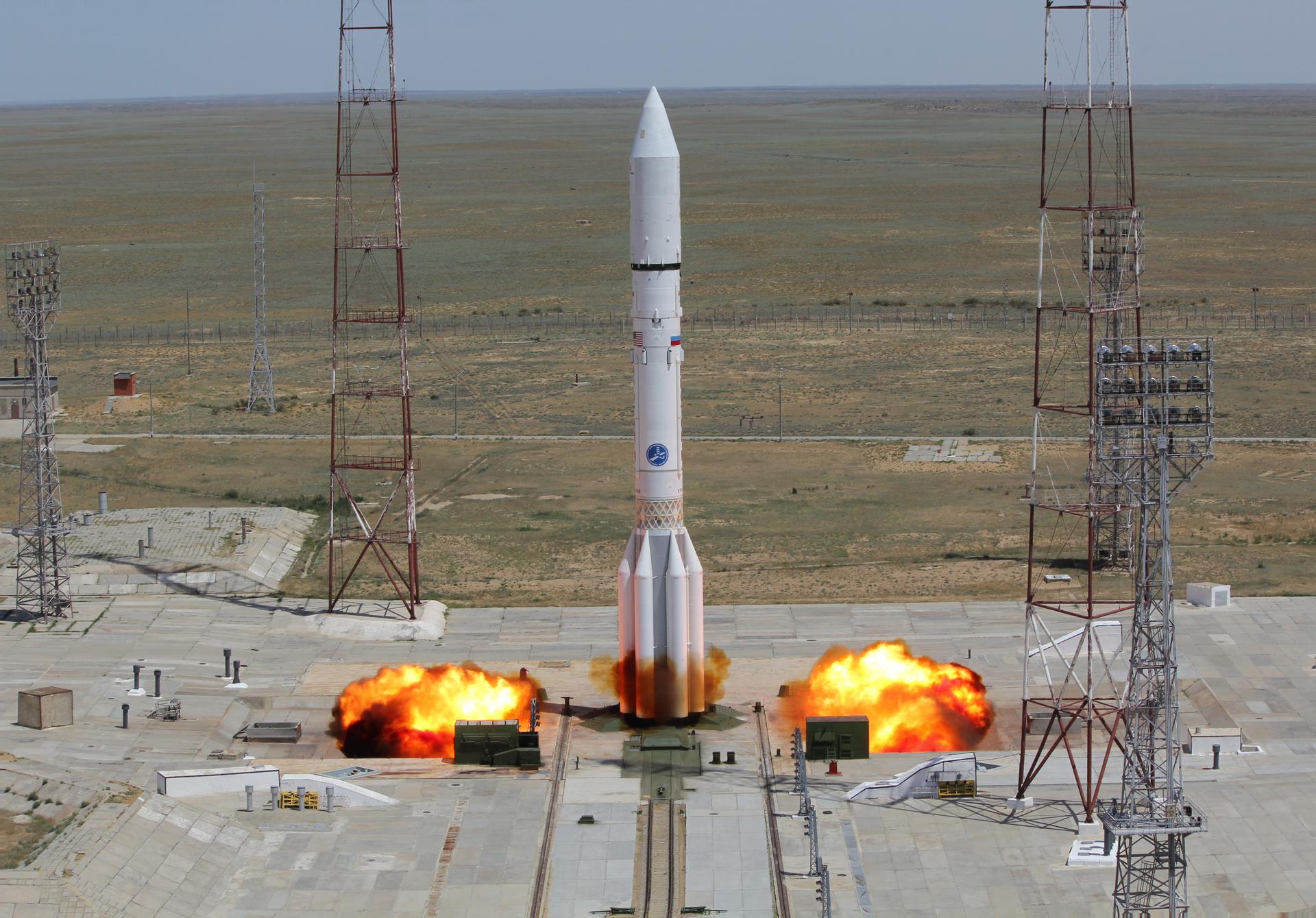
The Proton-M, formally designated Proton-M Briz-M Enhanced, is a Russian expendable launch vehicle developed and produced by the Khrunichev State Research and Production Space Center, a government-owned enterprise headquartered in Moscow whose history dates back to its founding in 1916. Khrunichev is known as the producer of the Proton and Rokot launch systems, and it has also been developing the Angara rocket family. The Proton-M belongs to the long-running Proton / UR-500 family, whose first flight took place in March 1967, decades before the Proton-M variant itself entered service. As a modernized member of that family, the Proton-M flies with the Briz-M Enhanced upper stage, reflected in its full designation. The vehicle remains listed as active in current launch service records.
The Proton-M is configured as a non-reusable vehicle, with no provision for recovering or reflighting any of its stages. Its defining configuration element, as captured in its designation, is the pairing of the Proton-M booster with the Briz-M Enhanced upper stage, which handles the final delivery of payloads to their target orbits. Detailed dimensional and performance figures — including overall length, diameter, launch mass, and payload capacities to low Earth orbit or geostationary transfer orbit — are not recorded in the available data for this configuration, and accordingly are not stated here. What the data does establish is the vehicle's operational character: a conventional, single-use heavy-lift launcher in the Russian fleet, manufactured by Khrunichev and operated as part of the Proton lineage that has been a mainstay of Russian spaceflight since the 1960s.
The Proton-M conducted its maiden flight on 15 March 2004. According to SpaceRocket's database, the vehicle has accumulated 33 launches in total, of which 30 were successful and 3 ended in failure. Consistent with its expendable design, it has made no landing attempts, successful or otherwise. No launches of this vehicle are recorded in SpaceRocket's database yet in terms of individual flight entries; the figures cited here come from the vehicle's aggregate statistics. Measured purely on these numbers, the Proton-M presents a success rate of roughly 91 percent across its career to date — a record that reflects both a generally reliable workhorse and a small but notable number of failures. With the broader Proton / UR-500 family behind it and the vehicle still listed as active, the Proton-M occupies the role of a mature, established launcher whose statistical record allows for a grounded, if unglamorous, assessment of dependable service with occasional setbacks.
Sources: Launch Library 2 (TheSpaceDevs) · Wikipedia (CC BY-SA 4.0)