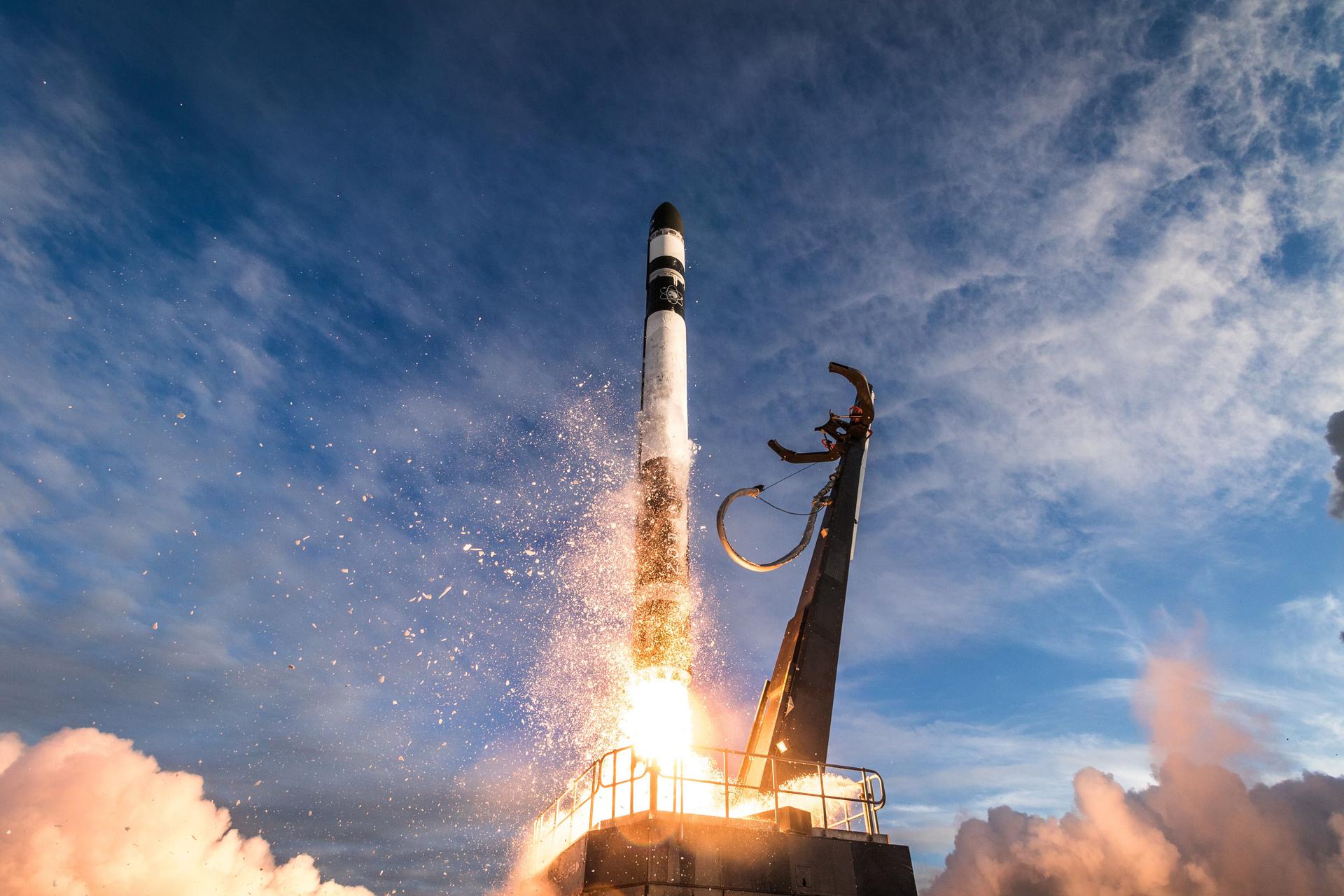
Electron is a two-stage orbital expendable launch vehicle (with an optional third stage) developed by the American aerospace company Rocket Lab. Electron is a small-lift launch vehicle designed to launch small satellites and cubesats to sun-synchronous orbit and low earth orbit. The Electron is the first orbital class rocket to use electric-pump-fed engines, powered by the 9 Rutherford engines on the first stage. It is also used as a suborbital testbed (called HASTE) for hypersonics research.
Electron is a small-lift orbital launch vehicle developed by Rocket Lab, an American aerospace company. The vehicle was conceived as a dedicated launcher for small satellites and cubesats, a class of payloads that historically relied on rideshare opportunities aboard larger rockets. Electron is designed to deliver these payloads to sun-synchronous orbit and low Earth orbit. The rocket holds a notable place in launch vehicle history as the first orbital-class rocket to use electric-pump-fed engines. Beyond its primary orbital role, a suborbital variant of the vehicle, designated HASTE, is used as a testbed for hypersonics research. Rocket Lab remains the vehicle's manufacturer and operator, and Electron is currently in active service.
Electron is a two-stage expendable launch vehicle, with an optional third stage available for certain missions. The rocket stands 18 meters tall with a diameter of 1.2 meters and has a launch mass of 13 tonnes, placing it firmly in the small-lift category. Its first stage is powered by nine Rutherford engines, which use electric pumps to feed propellant — the feature that made Electron the first orbital rocket to employ this engine cycle. The vehicle can carry up to 300 kilograms to low Earth orbit. Although Electron is officially classified as non-reusable, recovery attempts of the first stage have been conducted: according to SpaceRocket's database, nine landing attempts have been made, of which seven were successful and two failed, indicating an ongoing effort to recover boosters despite the vehicle's expendable baseline design.
Electron flew for the first time on 25 May 2017. Since that maiden flight, the vehicle has accumulated a substantial operational record for a rocket of its class. SpaceRocket's database records 91 total launches for Electron, of which 87 were successful and four ended in failure, corresponding to a success rate of roughly 96 percent. The database's launch listing also shows a significant number of upcoming or scheduled missions, consistent with the vehicle's continued active status. The four failures are spread across a record of more than ninety flights, and the overall tally of successes makes Electron one of the most frequently flown small-lift launch vehicles in its database category. Combined with the seven successful booster recoveries out of nine attempts, the record depicts a mature, operational launcher with an established flight cadence, while the expendable design and modest payload capacity define its role as a dedicated small-satellite vehicle rather than a competitor in heavier lift classes.
Sources: Launch Library 2 (TheSpaceDevs) · Wikipedia (CC BY-SA 4.0)

.jpg%3Fwidth%3D640)