
From Turbine to Detonation: The Race for Combined-Cycle Propulsion
August 6, 2026
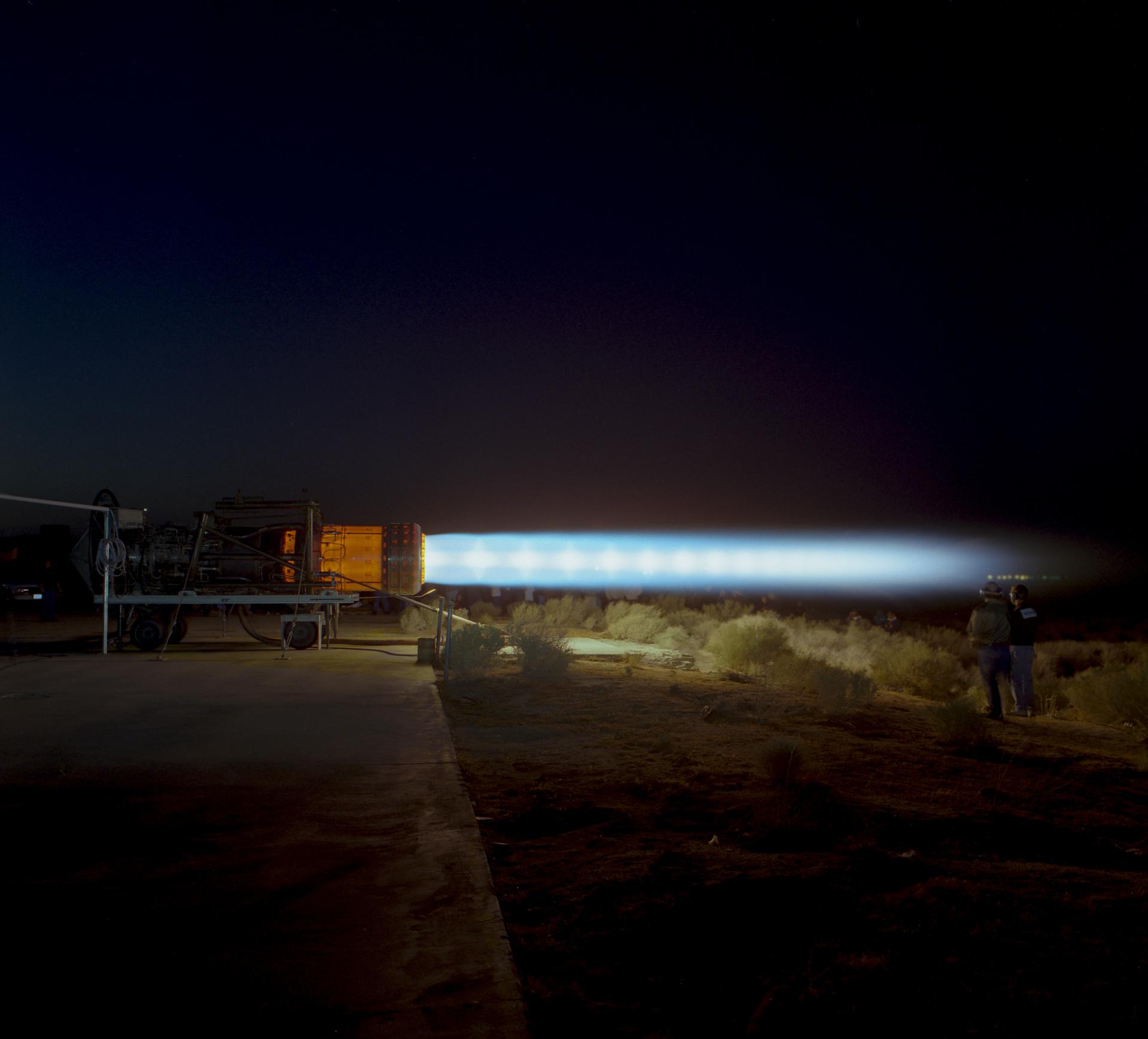
A turbine engine is a masterpiece with a speed limit. Compressor blades, turbine inlet temperatures and fixed geometry pin every jet to one optimal point on the map — yet a vehicle that hopes to fly from a runway to orbit must cross regimes where the air itself becomes the enemy: above Mach 3 the compressor is redundant, above Mach 5 the inlet air arrives hotter than 1,000 °C, and at the edge of space there is no air at all. The engine that does the whole trip cannot be one engine. It has to change what it is along the way.
I. The First Shape-Shifter: The SR-71's J58
The first practical variable-cycle engine flew in the 1960s inside the SR-71 Blackbird. At subsonic speed the Pratt & Whitney J58 behaved like a normal afterburning turbojet; at Mach 3.2, bypass ducts routed air from the compressor's fourth stage straight into the afterburner, and the J58 became in large part a ramjet — gaining about 20% thrust while protecting its turbine. It was brilliant, mechanical, and temperamental: a binary switch rather than a true continuum. Modern three-stream designs like the GE XA100 and Pratt & Whitney XA101 (ground-tested from 2022, promising roughly 25% better fuel efficiency and 10% more thrust) aim to make that transformation smooth — but as of 2026 neither has entered production.
II. Throw Away the Compressor: Ramjets and Scramjets
Beyond Mach 3, the incoming air rams itself to useful pressure and the spinning machinery can be deleted entirely — that is the ramjet. Let the combustion happen while the airflow is still supersonic and you have a scramjet, the only known air-breathing path beyond Mach 5. The physics is unforgiving: lighting and holding a flame in a supersonic stream is, in the classic phrase, like keeping a match lit in a hurricane. The US X-43A hit Mach 9.6 for about ten seconds in 2004; the X-51A sustained Mach 5.1 for roughly three and a half minutes in 2013. China announced its own scramjet flight test in 2015 and has since reported a steady drumbeat of combined-cycle milestones — including an oblique-detonation prototype test announced in 2022 and rotating-detonation ramjet runs at Northwestern Polytechnical University in 2024 — backed by the JF-12 and JF-22 shock tunnels, arguably the world's best ground-test infrastructure for hypersonic combustion.


III. Engines by Speed Regime
| Engine type | Speed range | Carries oxidizer? | Key limitation | Status |
|---|---|---|---|---|
| Turbojet / turbofan | 0 – Mach 2.5 | No | Fixed optimal point; turbine inlet temperature | Mature |
| Variable cycle (three-stream) | 0 – Mach 3+ | No | Mechanical complexity, weight | Ground-tested (XA100/XA101) |
| Ramjet | Mach 3 – 5 | No | Needs boost to start; subsonic combustion only | Mature (missiles) |
| Scramjet | Mach 5 – 10+ | No | Flame-holding in supersonic flow; thermal load | Flight-demonstrated (X-43A/X-51A) |
| Rocket | Any — vacuum included | Yes | Hauls all oxidizer; chemical Isp ceiling | Mature |
| Combined cycle (TBCC/RBCC/SABRE) | Runway to orbit | Partially | Mode transition; inlet integration | Component testing |
IV. The Romantic Detour: SABRE and the Precooler
Britain's Reaction Engines spent 35 years on the most elegant answer: SABRE, an engine that breathes air up to about Mach 5 and then closes its intake and becomes a pure rocket. Its magic trick was the precooler — thousands of hair-thin nickel-alloy micro-tubes that chilled 1,000 °C inlet air to −150 °C in a hundredth of a second without icing. The precooler passed ground tests in 2012 and full Mach-5-equivalent validation in 2019. But elegance couldn't pay the bills: Reaction Engines entered administration on October 31, 2024, its IP sold off by administrators in 2026, with BAE Systems and UK defense programs expected to carry pieces of the technology forward. Skylon — the runway-to-orbit spaceplane SABRE was meant to power — remains a dream.

V. Detonation: Combustion at Shock-Wave Speed
Every engine above burns fuel by deflagration — subsonic combustion at nearly constant pressure. A rotating detonation engine (RDE) instead sustains a detonation wave circling an annular chamber at kilometers per second, squeezing out 10–20% more thermal efficiency from a dramatically smaller package. The idea is old; the hardware is suddenly real. NASA and partners hot-fired a 3D-printed rotating detonation rocket engine in 2023; Pratt & Whitney ran an RDE for over four minutes; DARPA's Gambit program is building an RDE missile. China has been at least as busy: a long-duration LOX/methane rotating-detonation rocket test by CASC in 2024, and reports in early 2025 of a combined rotating-detonation ramjet/scramjet run stable across a wide speed range. If those reports hold, detonation combustion has moved from laboratory curiosity to the front of the propulsion race.

Milestones on the road to combined-cycle flight
Whittle and von Ohain's turbojets; the SR-71's J58 flies the first variable cycle (1960s).
—
SABRE/Skylon concept proposed by Alan Bond (1989).
Russia's Kholod: among the first scramjet flight tests, Mach 5.6–6.5 (1991–98).
X-43A Mach 9.6 (2004); X-51A Mach 5.1 for ~210 s (2013).
JF-12 shock tunnel operational (2012).
SABRE precooler validated at Mach-5 conditions (2019).
China announces a successful scramjet flight test (2015).
XA100 ground tests (2022); NASA/P&W rotating-detonation runs (2023); Reaction Engines enters administration (Oct 2024).
CASIC announces an oblique-detonation prototype test (2022); NWPU rotating-detonation ramjet runs and CASC's long-duration LOX/methane RDE (2024).
DARPA Gambit RDE missile in development; Hermeus Quarterhorse targets Mach 5.
Reported hybrid RDRE/scramjet tests (2025); Tengyun spaceplane combined-cycle flight verification targeted around 2028–30.
VI. Who Is Actually Ahead?
The honest answer depends on which lap you score. The US holds the deepest scramjet flight-test database, the only operational variable-cycle heritage (J58), and the strongest production engineering — GE and P&W's three-stream engines have no production peer. China holds the momentum in the newest disciplines: more reported rotating-detonation milestones, more teams working in parallel (NWPU, NUDT, CASC, CASIC), and ground-test facilities without equal. Russia retains air-breathing weapons (the scramjet-powered Zircon is in service) but little civil combined-cycle work. The finish line — a practical runway-to-orbit engine — is still over the horizon for everyone. What is certain is that the winner will need the whole cycle, from turbine to detonation. Follow the vehicles these engines will power in our rocket directory and the engine evolution series.
FAQ
- Q: What is a combined-cycle engine?
- A: An engine that changes operating mode with speed — typically a turbine for takeoff and low supersonic flight, a ramjet/scramjet for hypersonic cruise, and a rocket for the final push to orbit. TBCC (turbine-based) and RBCC (rocket-based) are the two main families.
- Q: What made the SABRE engine special?
- A: Its precooler: thousands of micro-tubes that cooled 1,000 °C intake air to −150 °C in 0.01 seconds, letting a turbine-based engine breathe air up to about Mach 5 before switching to pure rocket mode. The technology worked; the company ran out of money in 2024.
- Q: Why is rotating detonation more efficient?
- A: Conventional engines burn fuel at nearly constant pressure (deflagration). A detonation wave compresses and burns the mixture almost instantly, extracting more work from the same propellant — 10–20% better thermal efficiency in a much smaller chamber.
- Q: Has any scramjet flown for more than a few minutes?
- A: No. The record is the X-51A's ~210-second burn at Mach 5.1 in 2013. Sustained hypersonic cruise — tens of minutes — remains the unsolved problem, which is why combined-cycle and detonation research is so heavily funded.