
Long March 10B Rocket Recovery: A Milestone Breakthrough for China's Commercial Space
July 12, 2026
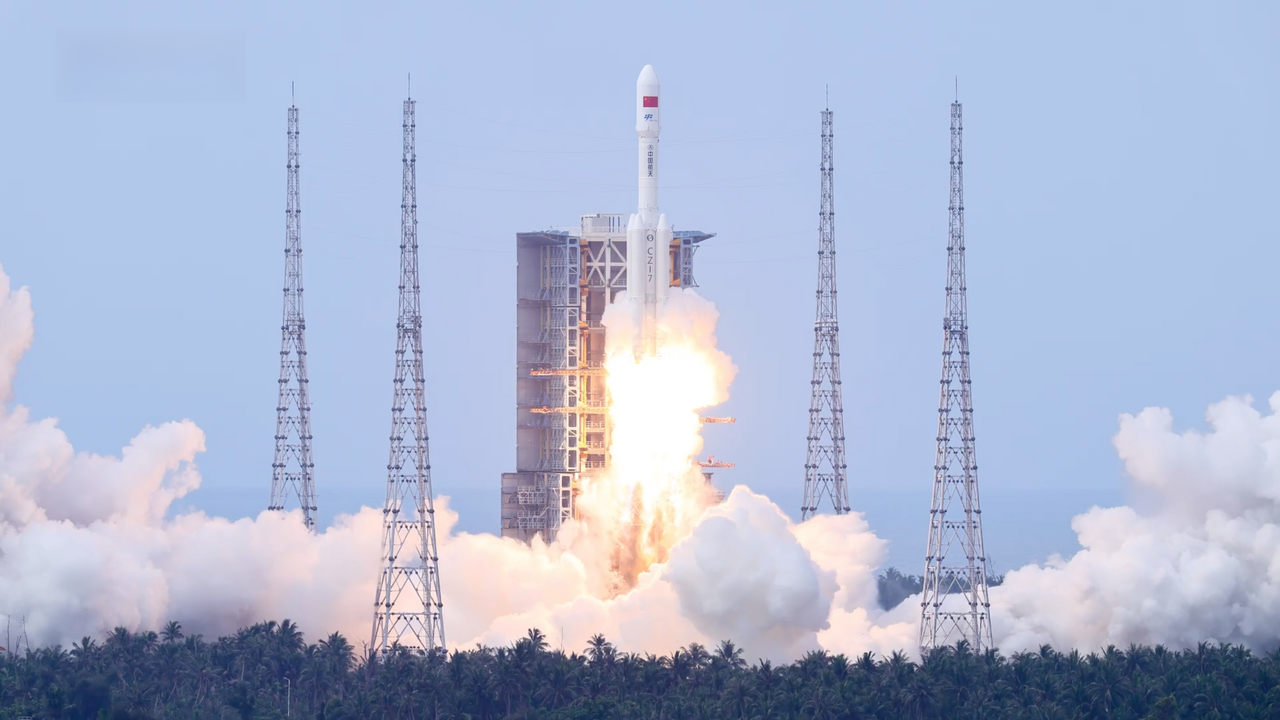
At 12:15 on July 10, 2026, the Hainan Commercial Space Launch Site witnessed a landmark moment in Chinese space history—the Long March 10B launch vehicle ignited and lifted off, successfully delivering a satellite into its designated orbit. Approximately six minutes after first and second stage separation, the first stage returned vertically and landed firmly in the flexible buffer net deployed from the sea platform. This marks China's first successful controlled recovery of a launch vehicle first stage, and also the world's first net-based recovery of a launch vehicle.
I. LM-10B: The Flagship Rocket of China's Commercial Space
The Long March 10B is a two-stage reusable launch vehicle developed specifically for the commercial space market, with the First Academy of China Aerospace Science and Technology Corporation (CASC) serving as the prime developer. The rocket is a large liquid launch vehicle with a 5-meter diameter two-stage serial configuration. The first stage inherits the design of the Long March 10A's first stage, using LOX/kerosene propellant, while the second stage uses LOX/methane propellant. The full rocket has a liftoff thrust of approximately 890 tons, a liftoff weight of approximately 760 tons, and a total length of approximately 63 meters for the first flight.
| Parameter | Specification |
|---|---|
| Total rocket length | ~63 m |
| Liftoff thrust | ~890 t |
| Liftoff weight | ~760 t |
| First stage propellant | LOX/Kerosene |
| Second stage propellant | LOX/Methane |
| Payload in reusable mode | 16 t to LEO |
| Mission type | Commercial space launch |
II. Innovative Sea-Based Net Recovery Technology
Unlike SpaceX's Falcon 9, which uses engine reverse thrust for landing, the Long March 10B follows a completely original technical path—sea-based net recovery. After the rocket's first stage completes attitude control and deceleration flight, it does not rely on engines for precise soft landing in the final phase. Instead, it is captured by a large net system at sea, achieving complete recovery of the rocket body. This innovative solution effectively reduces the rocket's weight and eliminates the complex landing leg system, but places higher demands on the net structure and rocket guidance control.
III. Technological Breakthrough & Global Comparison
This successful recovery represents a historic 'from zero to one' breakthrough in China's heavy-lift reusable rocket technology, meaning China has completed the core chain of rocket launch and recovery. Previously, only two US commercial space companies—SpaceX and Blue Origin—had successfully mastered and demonstrated heavy-lift reusable rocket technology. Now, the LM-10B's successful recovery makes China the third country globally to master this technology.
| Comparison item | Long March 10B | SpaceX Falcon 9 | Blue Origin New Glenn |
|---|---|---|---|
| Recovery method | Sea net capture | Engine reverse thrust landing | Engine reverse thrust landing |
| Propellant | LOX/Kerosene + LOX/Methane | LOX/Kerosene | LOX/Methane (BE-4) |
| First flight | July 2026 | 2010 | 2025 |
| 5-meter core stage | Yes | 3.7 m | — |
| Recovery status | First success | 300+ recoveries | 3 recoveries |
| Unique innovation | Net recovery | Grid fin control | Vertical landing |
IV. Core Technology Validation
- Integrated configuration overall optimization design technology
- High-thrust tank-bottom force transmission technology
- Propellant management technology based on partition tanks
- Methane self-pressurization technology
- Multiple engine start and high-altitude ignition technology
- Complex force-thermal environment adaptation technology
- High-precision navigation and control technology
- Sea platform net capture recovery technology
V. Commercialization Prospects & Cost Reduction Path
The core goal of reusable technology is to lower launch costs. Based on Falcon 9's experience, after achieving first-stage reuse, per-launch costs can drop by 40-60%; when a rocket has been reused 10 times, per-launch costs can fall to 30% of a new rocket. The LM-10B has a LEO payload capacity of 16 tons in reusable mode, meeting various mission needs such as LEO satellite internet constellation deployment and large commercial satellite launches. Moving forward, the development team will continue to optimize the rocket's performance, accelerate the iterative upgrade of reusable rocket technology, and is expected to complete the first-stage reuse flight by the end of 2026.
The maturation of reusable rockets will systematically reshape the cost curve and delivery capability boundaries of launch services. In the long term, the Long March 10B is expected to become the core launch platform for China's commercial space, supporting the large-scale deployment and continuous replenishment of 'space infrastructure' such as satellite internet and communication-computing constellations. 2026-2027 will be a watershed year for the differentiation of China's commercial rocket landscape, with companies that first achieve stable recovery and reuse gaining an advantage in the national satellite constellation supply chain.