
The F-1: Five Beasts That Powered Saturn V
August 10, 2026
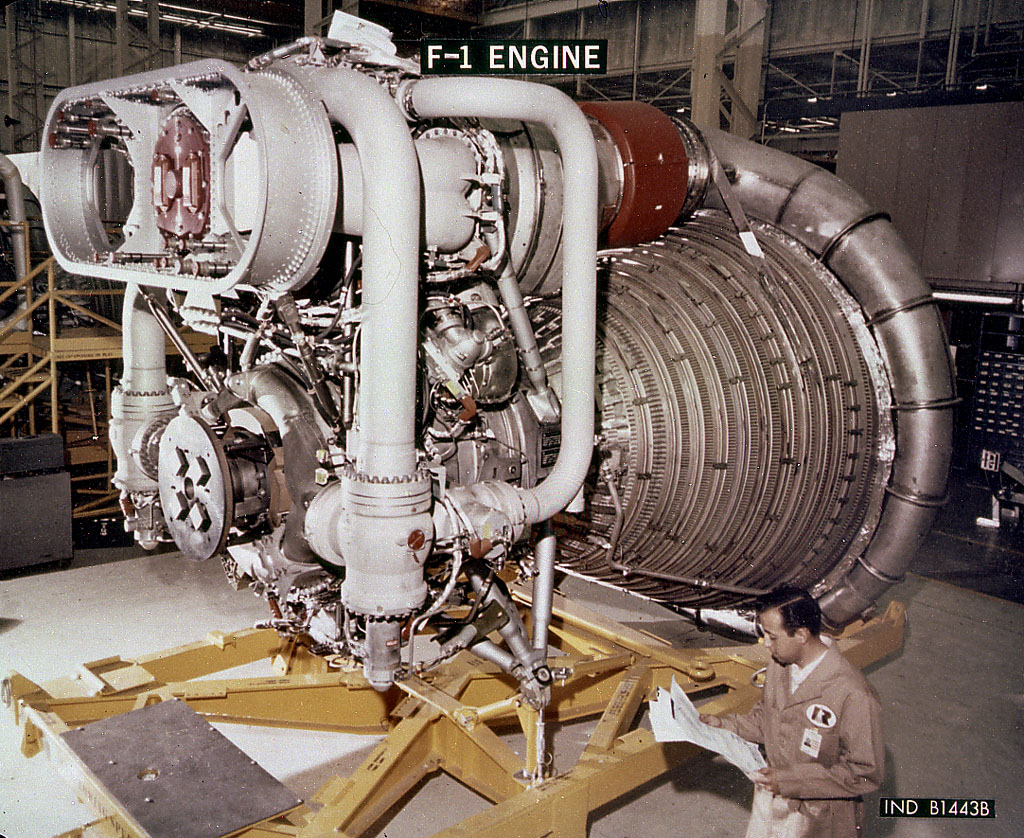
Of all the machines built for the Apollo program, none embodied the American approach to rocketry more completely than the F-1. Five of these Rocketdyne engines sat at the base of every Saturn V first stage, burning kerosene and liquid oxygen to hurl the moon rocket through the densest part of the atmosphere. According to Encyclopedia Astronautica, the F-1 suffered severe combustion-instability problems during development — problems that were eventually solved so thoroughly that the engine never failed in flight. This article, the first in SpaceRocket's Rocket Engine Evolution series, traces the F-1's development, its five-engine cluster philosophy, and the contrast with the Soviet Union's very different answer to the same problem: clustering large numbers of smaller engines on the N-1 moon rocket.
I. An Engine Built for a Moon Rocket
The F-1 was a Rocketdyne engine burning LOX and RP-1 — liquid oxygen and refined kerosene — in a gas-generator cycle with pump-fed propellant delivery, designed explicitly for booster applications, according to Encyclopedia Astronautica. In a gas-generator cycle, a small fraction of the propellant is burned separately to drive the turbopumps, and that exhaust is discharged rather than fed into the main combustion chamber. The arrangement trades some efficiency for relative simplicity and ruggedness — acceptable compromises for a first-stage engine whose job is brute-force lift-off rather than squeezing every second of specific impulse from its propellant.
The engine did not appear from nowhere. Its development drew on Rocketdyne's accumulated experience with the engines of the Navaho, Jupiter, Thor, Atlas, Titan I and Saturn I era — a decade and a half of American large-engine practice that culminated in a single chamber of unprecedented size. Where earlier programs had clustered multiple smaller engines to reach booster-class thrust, the F-1 bet on one very large chamber doing the work alone.
II. The Combustion-Instability Battle
That bet came with a price. Combustion instability — the tendency of pressure oscillations inside a large chamber to couple with the injection and burning process and amplify until they destroy the engine — scales with chamber size, and the F-1's chamber was the largest anyone had attempted. Encyclopedia Astronautica records that severe combustion-instability problems were encountered during development and were solved. The condensed reference material available to SpaceRocket does not detail the specific engineering fixes, so we will not speculate about them here; what matters for this series is the shape of the achievement itself.
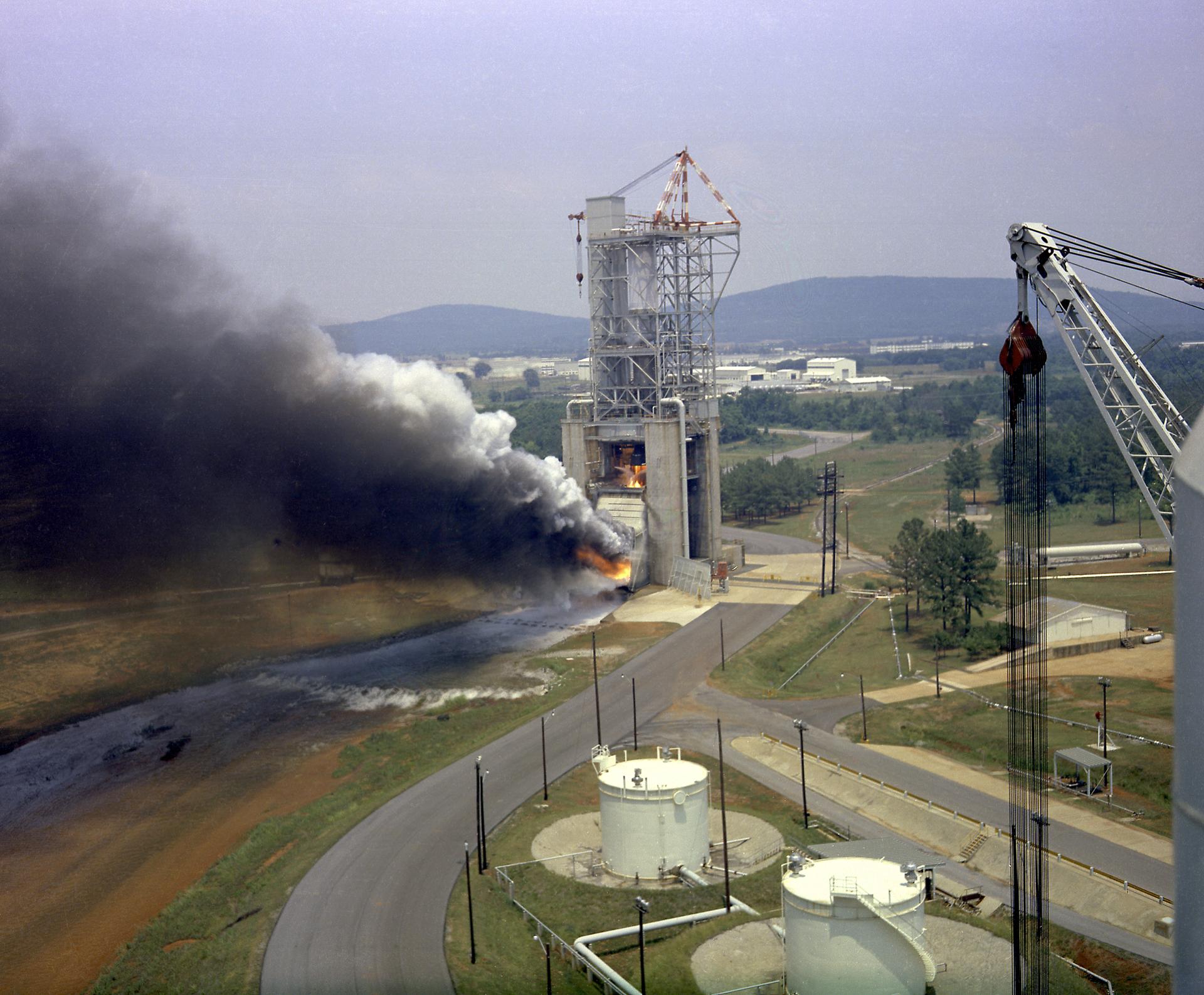
The outcome speaks in the starkest possible terms: the F-1 never failed in flight. An engine whose development was dominated by the hardest problem in liquid rocket engineering went on to a spotless operational record. For the Apollo program, this meant that the most mechanically violent phase of every mission — the first minutes of ascent, when five F-1s ran at full throttle — was carried by hardware that had been debugged on the test stand rather than in the air.
III. Five Engines on the S-IC
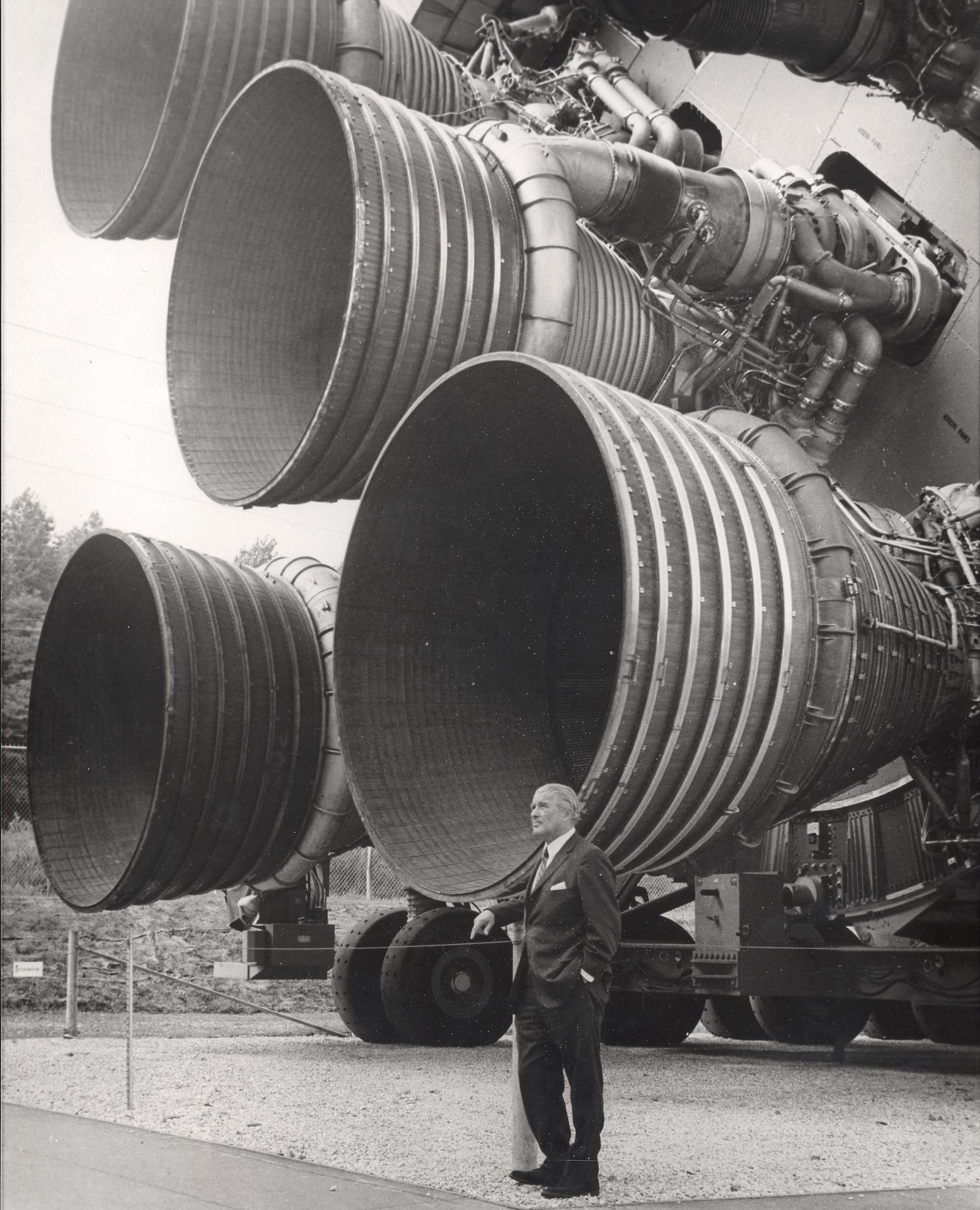
The F-1's operational home was the S-IC, the first stage of the Saturn V, which carried five of the engines. The same engine was also studied for a range of paper vehicles — the various Nova concepts and the Saturn MLV (Modified Launch Vehicle) studies — that never left the drawing board. The table below summarizes the verified core facts of the engine and its stage.
| Item | Verified fact | Source |
|---|---|---|
| Manufacturer | Rocketdyne | Encyclopedia Astronautica |
| Propellants | LOX / RP-1 (kerosene) | Encyclopedia Astronautica |
| Cycle | Gas-generator, pump-fed | Encyclopedia Astronautica |
| Role | Booster (first stage) applications | Encyclopedia Astronautica |
| Engines per Saturn V S-IC stage | Five | Encyclopedia Astronautica |
| Flight record | Never failed in flight | Encyclopedia Astronautica |
| First Saturn V flight | Apollo 4, 7 a.m., Nov. 9, 1967, KSC Pad 39A, uncrewed "all-up" test | NASA history office |
| Follow-on | F-1A (1968 design), paper study only, never built or flown | Encyclopedia Astronautica |
Apollo 4, the first Saturn V flight, lifted off at 7 a.m. on November 9, 1967, from Pad 39A at Kennedy Space Center, according to NASA's history office. It was an uncrewed "all-up" test — the philosophy of flying the complete stack on the first attempt rather than qualifying stages one at a time. That a vehicle of this complexity could be flown all-up owed much to the confidence placed in its propulsion: five engines that had already been through a punishing ground-test campaign.
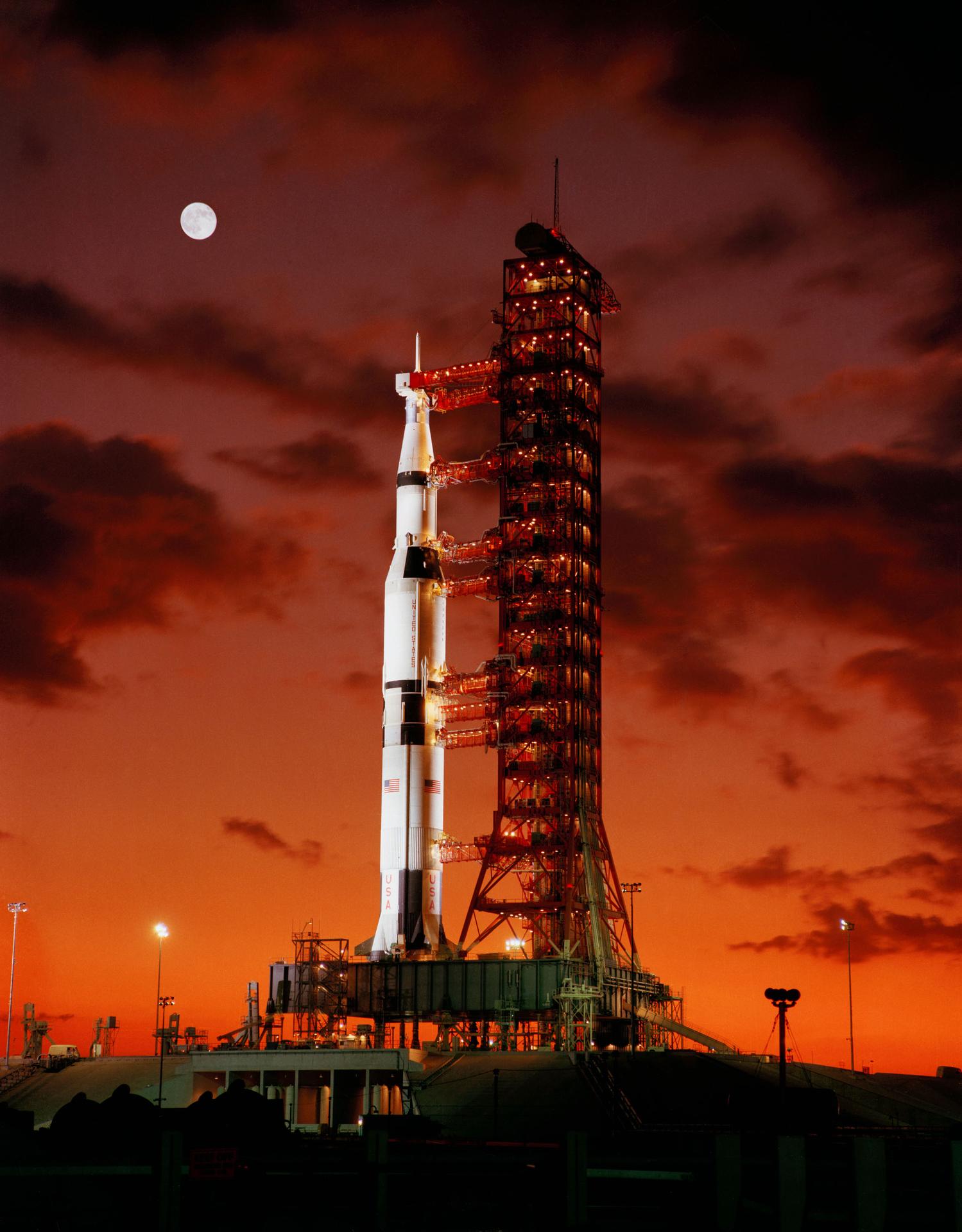
The five-engine cluster was itself a design philosophy. A small number of very large engines concentrates complexity into fewer units, each of which can be developed, tested and quality-controlled intensively. It reduces the number of turbopumps, valves and ignition events that must all work together at liftoff, and it simplifies the plumbing and thrust-structure problem at the base of the stage. The cost of the philosophy is that each engine becomes enormous — and enormous chambers are where combustion instability lives. The United States accepted that cost and paid it down on the test stand.
IV. The Soviet Counter-Route: Many Engines, One N-1
The Soviet Union answered the same question — how to build a moon-class first stage — with the opposite philosophy. The N-1 rocket clustered large numbers of smaller NK-15 engines on its first stage and relied on a control system called KORD to manage them. According to a Chinese-language technical history of the NK-33 engine family collected in SpaceRocket's reference library, the N-1 flew four times and failed four times. The reference material available to us documents the first two failures in detail; the figures below come from that secondary account and should be read with the caveat that at least one timing figure differs from other published chronologies.
| Flight | Date | Failure sequence (per the collected Chinese-language account) |
|---|---|---|
| 3L | 1969-02-21 | At roughly 70 seconds into flight, the KORD control system erroneously shut down engine No. 12 and, with it, the symmetrically opposite engine No. 24; a cascade of shutdowns followed and the vehicle crashed. (Note: some other chronologies put the failure at 68.7 seconds.) |
| 5L | 1969-07-03 | About 0.25 seconds after ignition, the liquid-oxygen pump of engine No. 8 burst; debris struck neighboring engines, KORD shut down 29 engines, and the rocket toppled back onto the pad. The explosion was estimated at roughly 1 kiloton TNT equivalent — one of the largest non-nuclear explosions in the history of rocketry. |
Both documented failures share a signature: the problem was not the individual engine but the system of engines. With dozens of units firing together, a single pump failure could throw debris into its neighbors, and the control system tasked with keeping the cluster alive became a failure source in its own right — shutting down healthy engines alongside sick ones. This is the structural weakness of the many-small-engines philosophy: reliability multiplies, but so do interactions. The American five-engine approach and the Soviet many-engine approach were, in effect, two different bets on where the risk should sit.
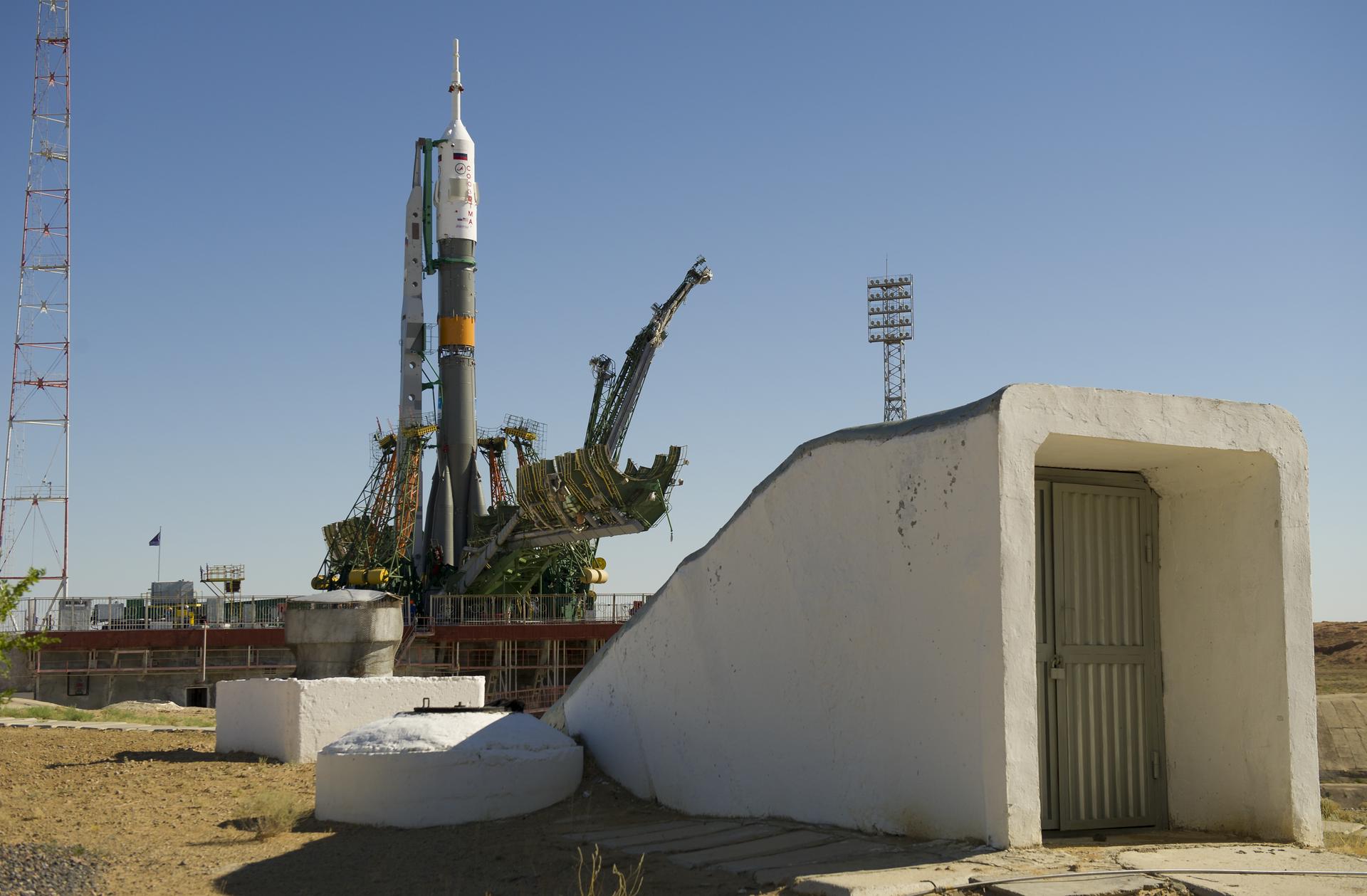
Apollo 4: first Saturn V flight — five F-1s, uncrewed all-up test
—
Rocketdyne designs the F-1A follow-on; never built or flown
—
—
N-1 flight 3L fails ~70 s in after KORD shutdown cascade
—
N-1 flight 5L destroyed on the pad after engine No. 8 pump burst
V. Two Philosophies, Measured
How did the hardware itself compare? The collected Chinese-language account of the NK-33 family — the closed-cycle sibling of the NK-15 developed for later N-1 versions — offers a set of comparative figures. It puts the NK-33's dry mass at about 1,222 kg and its thrust-to-weight ratio at roughly 137:1, the highest of its era, though not of all time: later engines such as SpaceX's Merlin 1D have been credited with still higher ratios. The same article credits the F-1 with a thrust-to-weight ratio of 83, the RD-107 with about 65, and the RS-25 with about 73.
A separate comparison published by Everyday Astronaut (2019) measures differently and lands on different absolute values: it credits the F-1 at 94, the RS-25 at 73, the RD-180 at 78, the BE-4 at roughly 80, the Raptor at roughly 107, and the Merlin 1D at about 198:1 — the highest of any operational engine in its comparison. The two references measure differently (gross versus dry mass, sea-level versus vacuum thrust), which is why we attribute each number rather than blending them. The table below lays both sources side by side.
| Engine | Thrust-to-weight ratio | Source / note |
|---|---|---|
| NK-33 | ~137:1 | Collected Chinese-language technical article; described as highest of its era, not all time |
| F-1 | 83 / 94 | 83 per the Chinese-language article; 94 per Everyday Astronaut (2019) — different measurement conventions |
| RD-107 | ~65:1 | Collected Chinese-language article |
| RS-25 | ~73:1 | Both references agree closely |
| RD-180 | 78:1 | Everyday Astronaut (2019) |
| BE-4 | ~80:1 | Everyday Astronaut (2019) |
| Raptor | ~107:1 | Everyday Astronaut (2019) |
| Merlin 1D | ~198:1 | Everyday Astronaut (2019); highest operational engine in that comparison |
On cycle efficiency, the gap between the two design schools is sharper. The Chinese-language account puts the NK-33's chamber pressure at 145 bar — about 2.07 times the F-1's 70 bar — and its vacuum specific impulse at 331 seconds, about 1.09 times the F-1's figure. The NK-33 achieved this with an oxygen-rich staged-combustion (closed) cycle, in which preburner gas drives the turbines and is then fed entirely into the main chamber rather than dumped. The F-1's open gas-generator cycle was simpler and more forgiving, at the cost of efficiency.
| Parameter | F-1 | NK-33 |
|---|---|---|
| Cycle | Gas-generator (open) | Oxygen-rich staged combustion (closed) |
| Chamber pressure | ~70 bar | 145 bar (~2.07× the F-1) |
| Vacuum specific impulse | Reference figure (NK-33 value is ~1.09× it) | 331 s |
| Dry mass | Not available in collected references | ~1,222 kg |
| Design philosophy | Few, very large engines per stage | Many smaller engines per stage, managed by KORD |
Read together, the numbers describe a genuine fork in engineering history rather than a simple winner and loser. The Soviet closed-cycle engine was the more advanced piece of thermodynamic machinery by the metrics of chamber pressure and specific impulse. The American engine was the more dependable system at the vehicle level, in part because five large engines presented fewer interacting failure modes than a dense cluster of small ones. The N-1's record — four attempts, four failures, two of them traceable to cluster-management problems — and the F-1's record of no in-flight failures show how those bets settled in the 1960s. It is worth noting, however, that the collected reference material itself flags a later twist: the many-engines-with-smart-control philosophy the N-1 pioneered would eventually be vindicated by modern computing, decades after the F-1's approach won the race to the Moon.
VI. The F-1A and the Road Not Taken
The F-1 story has a coda that never flew. In 1968 Rocketdyne designed the F-1A, an improved follow-on version intended for any further Saturn production. It remained a paper study: with Saturn V production ending, the F-1A was never built or flown. The same fate befell the Nova and Saturn MLV vehicles that would have carried F-1 derivatives — the entire big-single-chamber lineage ended with the Apollo era rather than evolving forward.
The Soviet side had its own road not taken, and it points forward in this series. According to secondary accounts in SpaceRocket's collected reference material, Soviet engineers built the RD-270 in the 1960s — described in those accounts as a 640-tonne-thrust engine and the first full-flow staged-combustion engine ever constructed, fired 27 times in testing. The accounts state that combustion instability was never resolved and the UR-700 project it served was cancelled, so the engine never flew. These figures come from secondary rather than official sources and are flagged for verification; we present them as a signpost, not a settled record. The pattern, though, is striking: on both sides of the Cold War, the limiting technology of the big-engine era was the same — making combustion behave inside ever larger, ever higher-pressure chambers.
VII. Legacy: From Five Beasts to Modern Clusters
The F-1's direct hardware lineage ended with Saturn, but the questions it answered kept being asked. The kerosene-first-stage architecture it proved remained attractive: as one Chinese-language discussion in our reference material puts it, the Saturn V combination — a kerosene first stage doing the heavy lift through the atmosphere, with hydrogen upper stages exploiting their high specific impulse further up — was close to an ideal division of labor for its time. The trade-offs between kerosene, hydrogen and methane for first stages remain a live debate in launch vehicle design today.
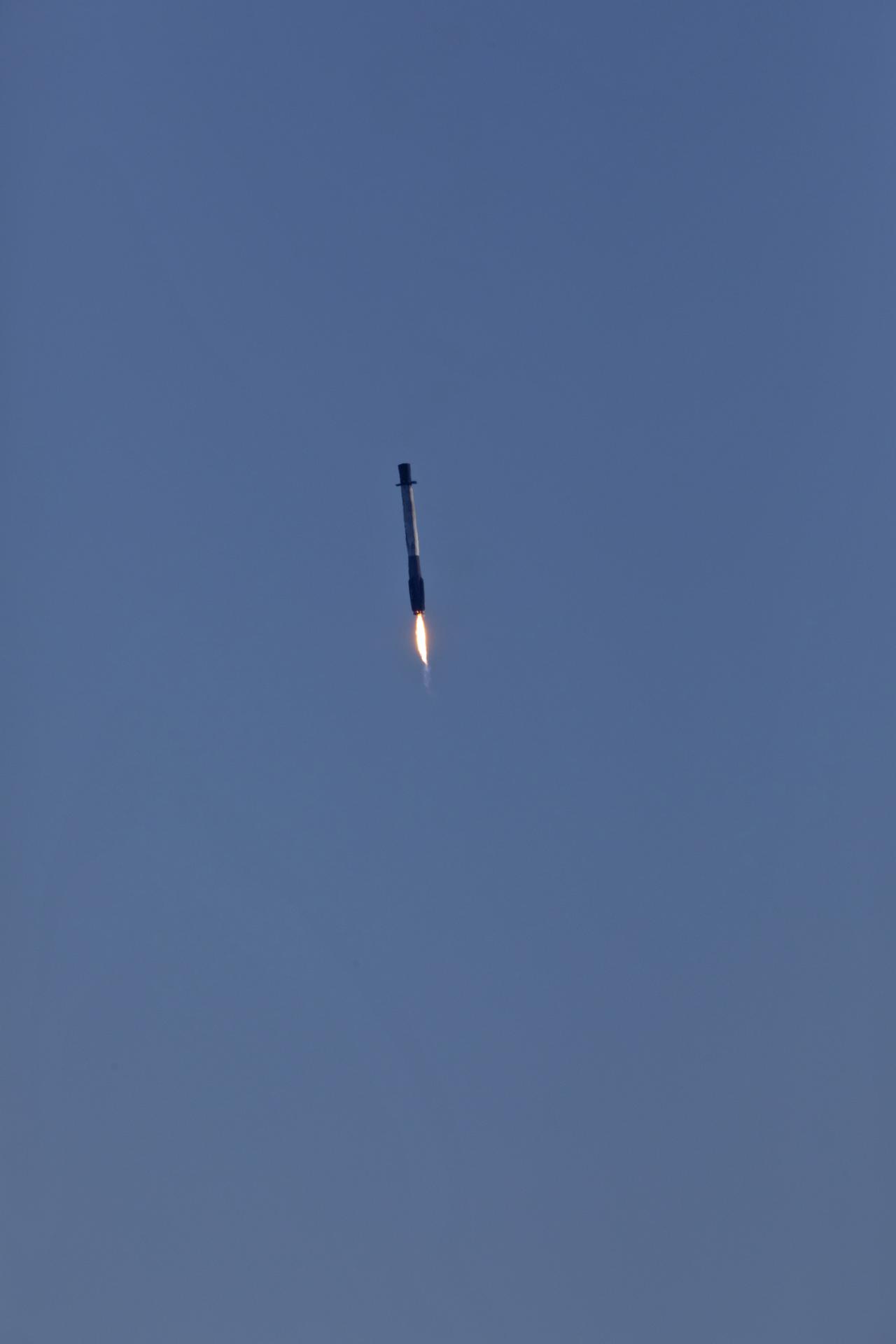
Meanwhile, the thrust-to-weight race that the NK-33 once led has moved on. The Everyday Astronaut comparison credits SpaceX's Merlin 1D at roughly 198:1, the highest of any operational engine in its survey — a figure reached with a kerosene gas-generator engine, the same basic architecture as the F-1, miniaturized and clustered. Nine Merlin 1Ds power every Falcon 9 first stage (with a vacuum variant on the second stage), and 27 power the Falcon Heavy. Per SpaceRocket's own launch database at the last ingest on August 1, 2026, the Falcon 9 Block 5 alone had accumulated 615 launches and 614 successes — evidence that the many-engines-with-fast-control philosophy, which defeated the N-1 in the 1960s, now works routinely. Secondary accounts in our reference material also credit SpaceX's Raptor with being the only full-flow staged-combustion engine to have flown, a milestone those accounts say eluded both the RD-270 and a later American demonstrator program.
VIII. Summary and Outlook
The F-1's legacy is a lesson in where to put complexity. America built one enormous chamber, fought combustion instability to a standstill on the ground, and clustered just five engines behind a first stage that never lost one in flight. The Soviet Union built cleverer engines — higher pressure, closed cycle, better specific impulse — and lost the race at the system level, where a control computer and a debris cloud defeated thirty engines working together. Both philosophies are alive today: the F-1's kerosene gas-generator architecture persists in modern workhorse engines, while the closed-cycle and full-flow ideas its Soviet rivals pioneered define the current frontier. The next entries in this series follow that fork: the RD-107/RD-170 staged-combustion empire, the NK-33's improbable second life, and the methane engines now rewriting the comparison tables above.
IX. FAQ
- Q: What engine powered the Saturn V first stage?
- A: Five Rocketdyne F-1 engines powered the Saturn V's S-IC first stage, according to Encyclopedia Astronautica. The engine was also studied for the Nova and Saturn MLV paper vehicles, which were never built.
- Q: What propellants and cycle did the F-1 use?
- A: The F-1 burned LOX and RP-1 (liquid oxygen and refined kerosene) in a gas-generator cycle with pump-fed propellant delivery — an open cycle chosen for booster simplicity and robustness rather than maximum efficiency.
- Q: Did the F-1 ever fail in flight?
- A: No. Encyclopedia Astronautica records that although severe combustion-instability problems were encountered and solved during development, the F-1 never failed in flight.
- Q: When did the Saturn V first fly?
- A: According to NASA's history office, Apollo 4 — the first Saturn V flight — lifted off at 7 a.m. on November 9, 1967, from Pad 39A at Kennedy Space Center, as an uncrewed "all-up" test of the full vehicle.
- Q: How did the F-1 compare with the Soviet NK-33?
- A: Per a Chinese-language technical account collected by SpaceRocket, the NK-33 used an oxygen-rich closed cycle with a 145-bar chamber pressure (about 2.07 times the F-1's ~70 bar) and a 331-second vacuum specific impulse (about 1.09 times the F-1's figure), at a dry mass of roughly 1,222 kg. The F-1 traded that efficiency for a simpler, open gas-generator cycle — and, unlike the N-1's engine cluster, its vehicle never suffered an engine failure in flight.
- Q: What was the F-1A?
- A: The F-1A was an improved follow-on version designed by Rocketdyne in 1968, intended for any further Saturn production. It remained a paper study and was never built or flown.