
From RD-107 to RD-170: The Soviet Oxygen-Rich Dynasty
August 10, 2026
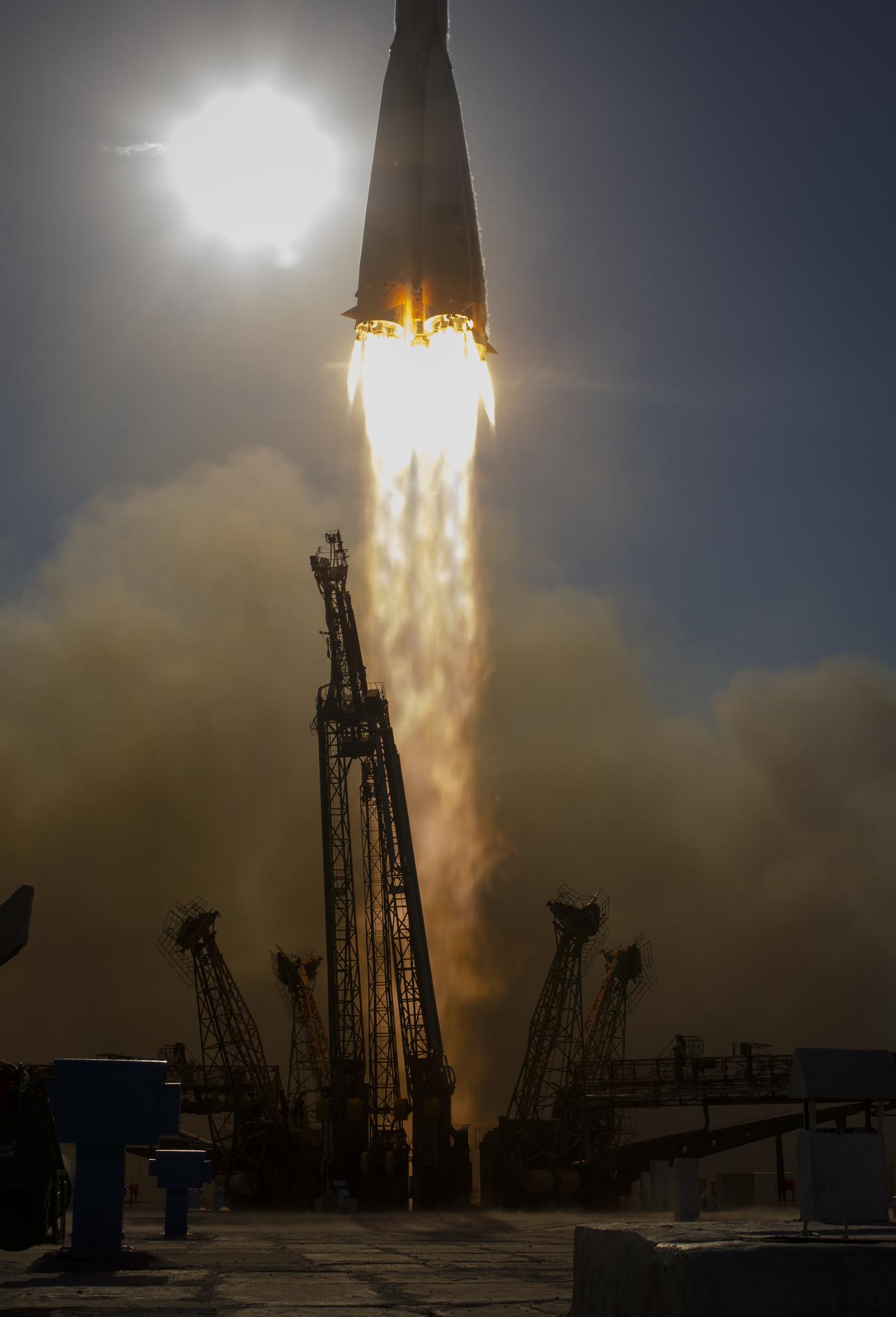
Ask which rocket engine has flown the most, and the answer is not American. It is the RD-107 family, the four-chamber kerosene engine that Sergei Korolev's R-7 carried into history in 1957 and whose descendants still power every Soyuz launch today. Ask which rocket engine is the most powerful ever flown, and the answer is arguably also Soviet: the RD-170, an oxygen-rich staged-combustion machine whose single turbopump develops power comparable to three nuclear icebreakers. These two engines bracket three decades of one design philosophy — the Glushko bureau's conviction that the path to reliable high-performance kerosene propulsion ran through multiple combustion chambers sharing common machinery, and ultimately through the technically brutal oxygen-rich closed cycle. This article traces that lineage: from the RD-107's improvised beginnings, through the Kuznetsov bureau's NK-15/NK-33 detour, to the RD-170 and its derivative family that now spans the Atlas V, the Angara, and — by design influence — China's Long March fleet.
I. The 1950s Problem: One Big Chamber or Several Small Ones
Every large rocket engine program of the 1950s collided with the same wall: combustion instability. As chamber diameter grows, the orderly burning of propellant becomes prone to destructive pressure oscillations that can destroy an engine in milliseconds. The United States eventually solved the problem inside single huge chambers — most famously in Rocketdyne's F-1, a gas-generator engine that reached a chamber pressure of 70 bar and a sea-level thrust of 6,747.5 kN, but only after a grueling development campaign that began in 1959. Valentin Glushko's OKB-456 took the opposite bet. After experimenting with large single chambers in the RD-110 and running into the same instability, the bureau settled on a modular answer: if one big chamber is unmanageable, build four small, well-understood chambers and feed them from a single shared turbopump. That architectural decision, made in 1954–1955, defined Soviet kerosene propulsion for the next half-century.
II. Anatomy of the RD-107 and RD-108
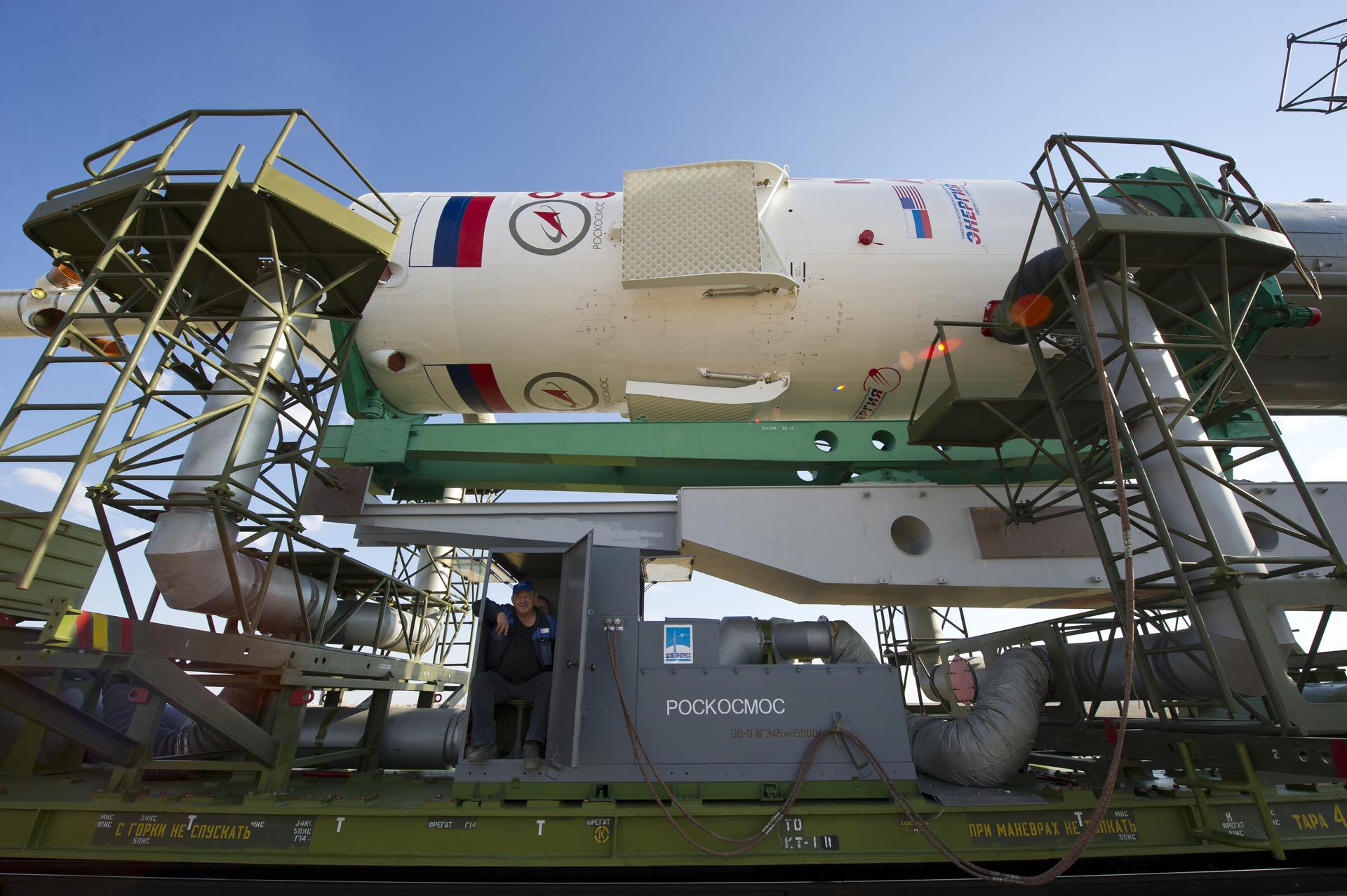
The RD-107 (booster) and RD-108 (core) engines that emerged from this work are frequently mislabeled as staged-combustion engines. They are not. According to the engine's reference specifications, the RD-107's turbine is driven by gas generated through catalytic decomposition of hydrogen peroxide, with the exhaust vented overboard — an open cycle, albeit an unconventional one that avoids burning propellant in a gas generator. Kerosene regeneratively cools the four main chambers, the propellants require igniters because they are not hypergolic, and steering is provided by small vernier chambers rather than by gimbaling the main engines. On the R-7, one RD-107 sat on each of the four strap-on boosters while an RD-108 powered the core stage; the strap-ons separated after roughly 120 seconds of flight. Five engines, twenty main chambers, one iconic launch vehicle shape that remains instantly recognizable nearly seven decades later.
III. The Production Record Nobody Has Matched
The measure of the RD-107 design is not any single specification but cumulative volume. The R-7 family — Vostok, Molniya, Soyuz and their derivatives — is the mass-production record holder among launch vehicles, with more than 1,700 flights. Multiply that by five engines per vehicle and four chambers per engine, plus acceptance and development articles, and the result is a production run of combustion hardware with no peer anywhere in the industry. Reliability at that scale becomes self-reinforcing: every flight is a data point, every failure an anomaly against an enormous baseline. The design has been modernized — the RD-117 and RD-118 for the Soyuz ST, first flown in 2001, largely substituted all-Russian components with little change in performance — but the core architecture of 1955 remains in service in the 21st century. For comparison, the entire F-1 program built 65 engines; the R-7 family consumes that many engines every thirteen launches.
IV. The Oxygen-Rich Detour: The NK-15 and NK-33
While the RD-107 accumulated flights, the next Soviet step came from an unlikely direction. When Glushko declined to build large LOX/kerosene engines for Korolev's N-1 moon rocket — he advocated storable propellants instead — the task passed in 1961 to the Kuznetsov design bureau, OKB-276, an aircraft-engine house with no prior rocket experience. The Kuznetsov team answered with the NK-15 and its improved successor, the NK-33: compact engines using oxygen-rich staged combustion, in which preburner gas — hot, high-pressure, oxygen-saturated — drives the turbine and is then fed into the main chamber, so no propellant is wasted overboard. The reported figures were remarkable for their era: a dry mass around 1,222 kg, a thrust-to-weight ratio near 137:1, vacuum specific impulse of 331 seconds, and a chamber pressure of 145 bar — roughly double the F-1's 70 bar. The caveat is well known: thirty NK-15s had to work together on the N-1's first stage, and across four launch attempts between 1969 and 1972 they never all did so long enough. After the lunar program was cancelled in 1974, the story takes a turn best labeled with 'reportedly': a stockpile of finished NK-33s survived destruction orders, was rediscovered by American engineers in the 1990s, and about 40 units were purchased by Aerojet, renamed AJ-26, and test-fired at NASA Stennis with results matching 1970s Soviet data. An AJ-26 pair first carried a payload to orbit on the Antares launch of April 21, 2013 — 53 years after the design work began — before a turbopump failure destroyed an Antares in October 2014 and ended the type's American career. Surviving NK-33s meanwhile flew on Russia's Soyuz-2.1v, first launched December 28, 2013. The episode proved the oxygen-rich closed cycle worked; it also proved that an engine is only as good as the vehicle and control system wrapped around it.
V. The Numbers in Context
Placing the three generations side by side shows where each design bet paid off. The RD-107 traded cycle efficiency for manufacturability and won on volume. The NK-33 traded everything for thrust-to-weight and specific impulse but never got a reliable vehicle. The F-1 traded chamber pressure for chamber size, betting that American industry could tame instability in one enormous chamber — which it did, at the cost of specific impulse (265 seconds at sea level versus the NK-33's far higher closed-cycle efficiency). The RD-170, examined next, attempted to have it all: closed-cycle efficiency at F-1-class thrust.
| Engine | Cycle | Propellants | Chamber pressure | Specific impulse (vac/SL) | Thrust-to-weight | First flight |
|---|---|---|---|---|---|---|
| RD-107/108 | Open (H2O2 gas generator) | LOX/kerosene | — (4 chambers, 1 turbopump) | — | ~65 (per secondary sources) | 1957 |
| F-1 | Open gas generator | LOX/RP-1 | 70 bar | 304 s / 265 s | ~94 | 1967 |
| NK-33 | Oxygen-rich staged combustion | LOX/kerosene | 145 bar | 331 s / — | ~137 (highest of its era) | Designed 1960s; first orbital payload 2013 |
| RD-170/171 | Oxygen-rich staged combustion | LOX/kerosene | 245 bar | 337 s / 309 s | ~82.7 | 1985 (RD-171, Zenit) |
VI. The RD-170: Closed-Cycle Kerosene at Maximum Scale
Development of what became the RD-170 began at NPO Energomash under Glushko in the mid-1970s — reference sources date the program 1973–1985 or 1976–1987 depending on what is counted — as the strap-on booster engine for the Energia super-heavy launcher. The architecture directly inherited the 1955 lesson: four combustion chambers, one turbopump, now with two preburners. The cycle, however, was the full oxygen-rich staged combustion the NK series had pioneered, pushed to extremes. The preburner gas is an oxygen-rich mixture at roughly 300 atmospheres and 400°C, an environment that destroys conventional metals and demanded the specialized alloys and coatings Soviet industry had spent decades developing — a capability Western engineers had largely concluded was impractical. The result: vacuum thrust of 7,903 kN and sea-level thrust of 7,550 kN, slightly exceeding the F-1; specific impulse of 337 seconds in vacuum and 309 at sea level, far above the F-1's 304/265; chamber pressure of 245 bar; an area ratio of 36.87; and throttling down to 56 percent. All of this in a dry mass of 9,750 kg — a thrust-to-weight ratio of about 82.7, lower than the F-1's paper figure only because the closed-cycle plumbing adds mass that efficiency more than repays. The single turbopump feeding four chambers develops approximately 170 MW, a figure RussianSpaceWeb compares to the power of three nuclear icebreakers; propellant flow rates of 432 kg/s of oxygen and 166.2 kg/s of kerosene give some sense of what that pump is moving every second.
VII. Qualification by Attrition
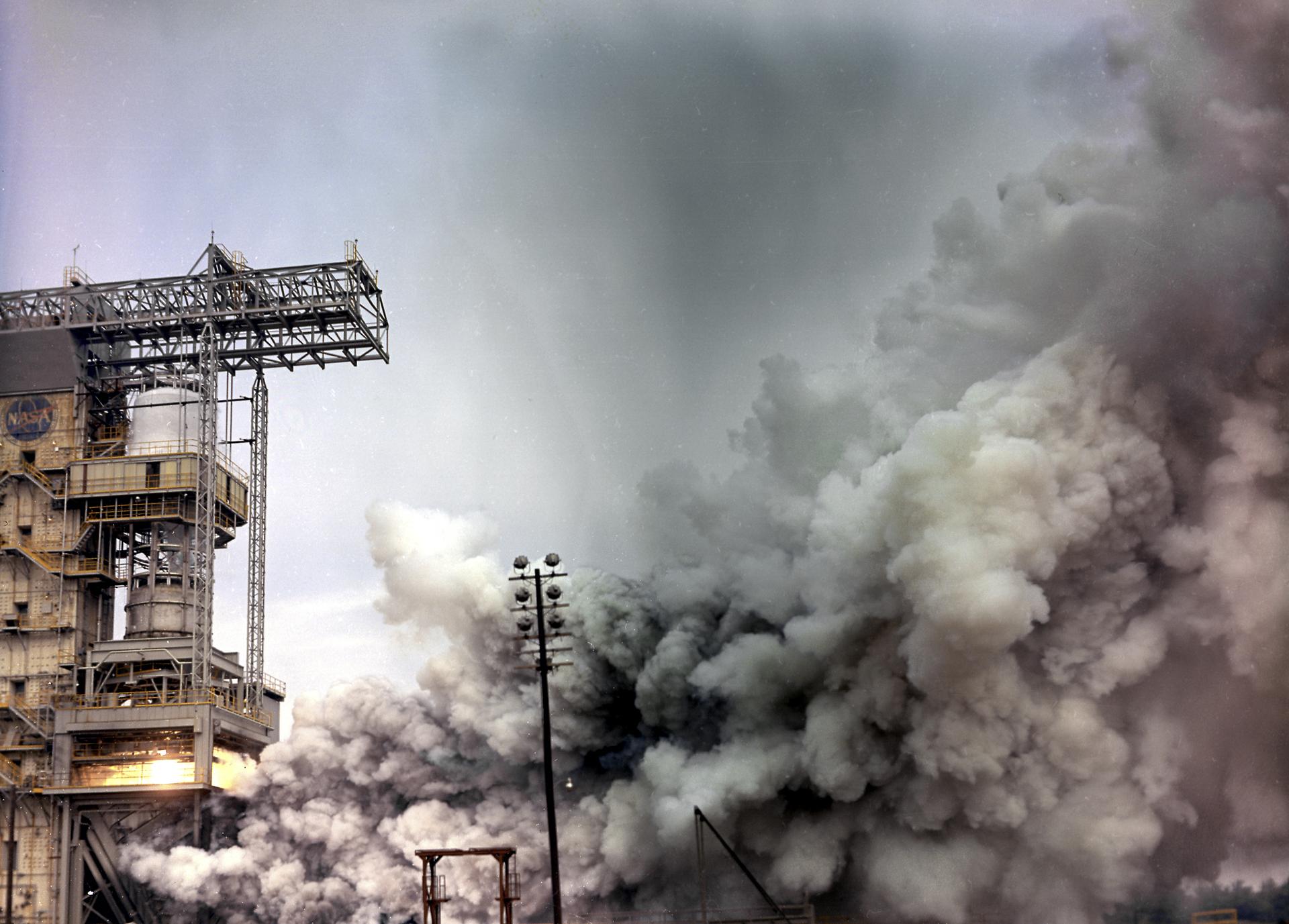
The RD-170's development was anything but smooth. The first test firing came on August 25, 1980. Between 1981 and 1983 the program suffered severe test failures; one explosion reportedly hurled the turbopump's heavy metal cover for miles, with debris coming down near a runway at Moscow's Sheremetyevo airport. At the program's low point, there were formal proposals to abandon the four-chamber giant in favor of single-chamber NK-derived engines from the N-1 program — a remarkable historical irony, given that the NK line had been the fallback created when Glushko refused the N-1 work. The proposals were rejected. Qualification instead proceeded the Soviet way: by accumulated firing time. One engine completed 18 full-duration firings totaling 2,520 seconds. The design first flew as the RD-171 on the Zenit booster in 1985 — the RD-170 itself gimbals in one plane for Energia's strap-ons, while the Zenit's RD-171 gimbals in two planes through a bellows arrangement, nominally 6 degrees — and then on Energia in 1987.
VIII. Built to Fly Ten Times
One aspect of the RD-170 program reads as strikingly modern: it was designed from the outset for reuse. The specification called for 10 firings per engine as part of a recoverable booster system, and Energia's strap-ons were indeed parachute-recovered and returned to Baikonur for examination. Ground testing suggested the margin was larger — engines withstood up to 20 burns, and one test article fired more than 20 times without ever leaving the stand. The operational reuse scheme died with the Soviet Union, but the durability remained demonstrable in the only currency rocket engineering accepts: the 1,000th firing of the uprated RD-171M occurred on December 5, 2013, and by early 2019 the family had accumulated roughly 900 tests totaling more than 100,000 seconds. The RD-171M itself, introduced in the early 2000s, added about 5 percent thrust with an upgraded supply system and reduced mass. Long before 'reusable rocket engine' became a Silicon Valley selling point, Energomash was certifying one — it simply never got a vehicle that asked for it.
Four-chamber bet
Glushko's OKB-456 settles on multiple small chambers sharing one turbopump
RD-107/108 first flight
The R-7 carries the four-chamber kerosene engines into service
N-1 engine work passes to Kuznetsov
OKB-276 begins the NK-15/NK-33 oxygen-rich staged-combustion line
Four N-1 attempts fail
Thirty NK-15s never all hold together on the first stage
Lunar program cancelled
NK-33 stockpile reportedly survives destruction orders
First RD-170 test firing
Severe test failures follow between 1981 and 1983
RD-171 first flight
Four-chamber derivative powers the Zenit booster
RD-170 flies on Energia
Closed-cycle kerosene at F-1-class thrust reaches orbit
RD-180 first flight on Atlas III
Half an RD-170 enters American service
RD-117/118 first flight
Modernized Soyuz ST engines, largely all-Russian components
AJ-26 orbits a payload
Renamed NK-33s power Antares, 53 years after design work began
NK-33 flies on Soyuz-2.1v
Surviving engines return to Russian service
Antares failure
An AJ-26 turbopump failure ends the type's American career
IX. The Derivative Tree
The RD-170's modular architecture — chambers around a common pump core — made it unusually easy to subdivide, and the post-Soviet Energomash did exactly that, selling slices of the design to whoever would pay. The family tree below summarizes the documented derivatives.
| Derivative | Configuration | Application | Status / first flight |
|---|---|---|---|
| RD-170 | 4 chambers, one-plane gimbal | Energia strap-on boosters | First flight 1987; designed for 10 reuses |
| RD-171 / RD-171M | 4 chambers, two-plane gimbal (6° nominal) | Zenit first stage | First flight 1985; RD-171M uprated early 2000s (+5% thrust) |
| RD-180 | 2-chamber derivative | Atlas III / Atlas V first stage | First flight 2000; in production |
| RD-191 / RD-191M | Single-chamber derivative | Angara family | Production derivative of the RD-170 line |
| RD-172 / RD-173 | Uprated concepts | Zenit growth studies | Paper projects |
| RD-192 | Methane-fueled variant studies | 1990s proposals | Not built |
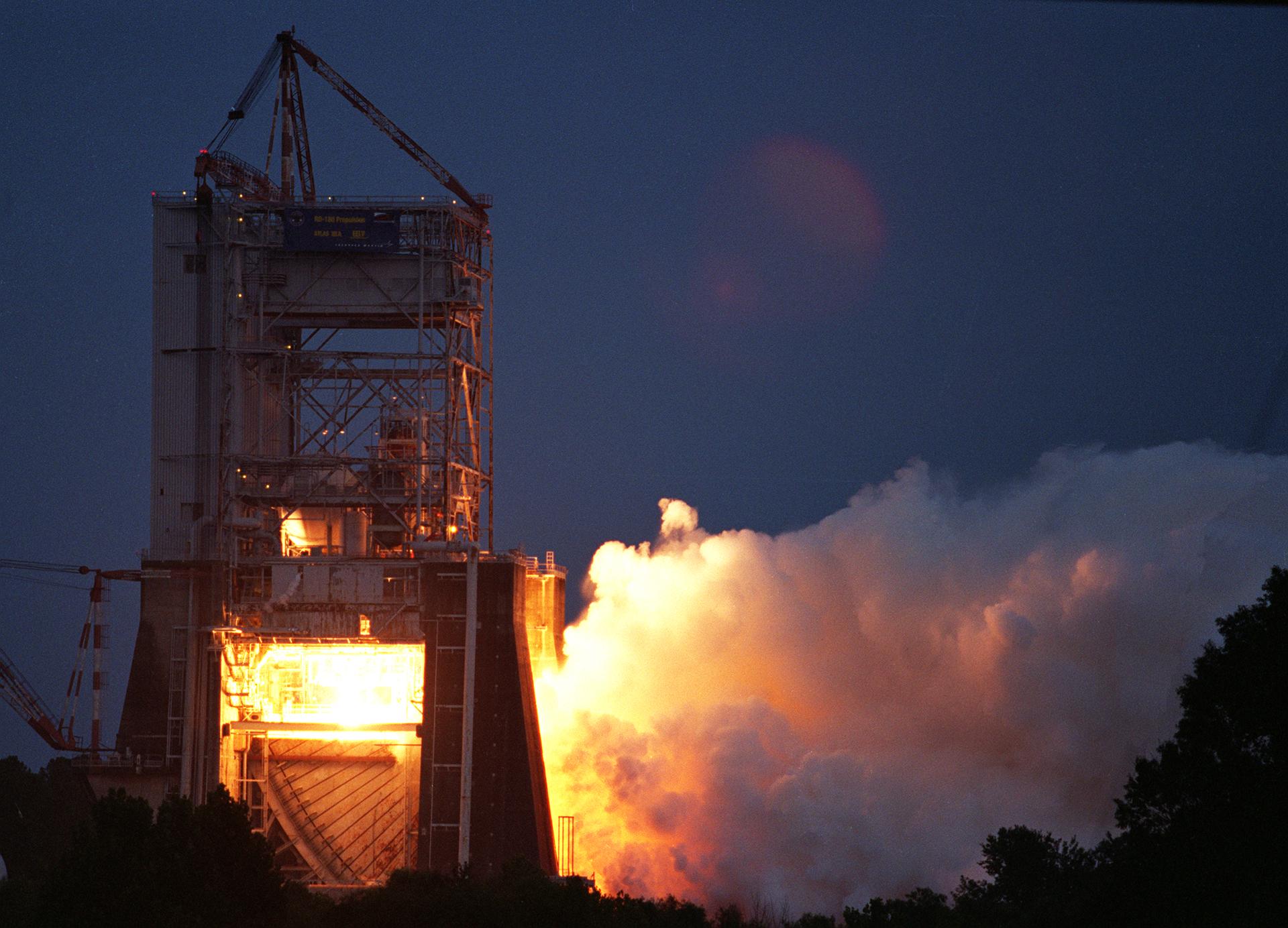
The commercial centerpiece is the RD-180: half an RD-170 — two chambers, one turbopump — first flown on the Atlas III in 2000 and then adopted as the first-stage engine of the Atlas V. For two decades, the most capable oxygen-rich staged-combustion engine in the American inventory was a Russian engine, purchased in quantity because nothing domestic matched its combination of thrust, efficiency, and flight-proven reliability. The RD-191 took the same logic to its limit — a single chamber with its own machinery — to power Russia's modular Angara family. The lineage that began with four small chambers because big ones could not be stabilized ended by selling its chambers one, two, or four at a time.
X. The Oxygen-Rich Idea Goes Global
The dynasty's influence now extends well beyond the engines Energomash actually builds. China's YF-100, the 120-tonne-class LOX/kerosene engine of the Long March 5, 6, and 7 families, is that country's first staged-combustion engine — and it is an oxidizer-rich staged-combustion design whose single-shaft arrangement (single-stage oxygen pump, dual-stage kerosene pump on one turbine) reference sources describe as very similar to the RD-170 design. Its quoted figures — 1,339 kN vacuum thrust, 335 seconds vacuum specific impulse, throttling to 65 percent — place it squarely in the Soviet school, reportedly developed with early-1990s access to RD-120 documentation but as an indigenous design. Even SpaceX's Raptor, often framed as the rupture with everything Soviet, depends on the same materials insight: its oxygen-rich preburner (one half of the full-flow cycle) required the in-house SX500 superalloy, which Elon Musk has said withstands more than 800 bar of hot oxygen-rich gas — precisely the environment the Soviets spent the 1960s through 1980s learning to survive for the NK and RD-170 families. The oxygen-rich closed cycle, once dismissed in the United States as impractical, has become the default answer for high-performance kerosene and methane propulsion worldwide. That is the real inheritance of the dynasty.
XI. Assessment: What the Lineage Proves
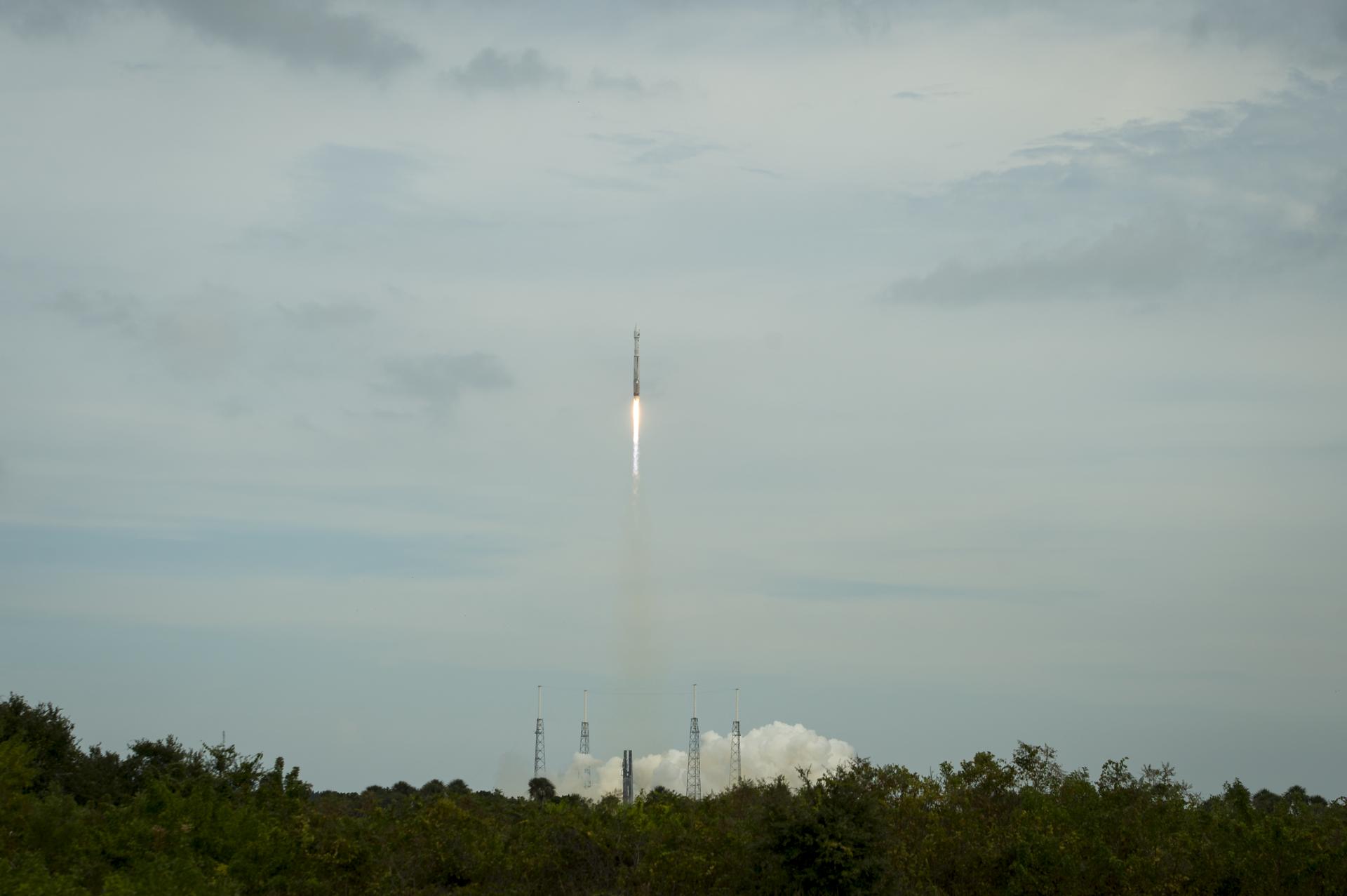
Three conclusions follow from the record. First, the 1955 multi-chamber decision, made as a workaround, turned out to be a strategy: it de-risked combustion stability at every scale, enabled a modular derivative family, and produced the most-flown engine line in history on one end and the most powerful on the other. Second, the oxygen-rich staged-combustion cycle was never the weak link — the NK-33's engines worked; the N-1's 30-engine integration did not, and the RD-170's qualification by brute accumulated firing time shows the cycle rewarding persistence rather than punishing the concept. Third, durability and reuse were baked into this lineage decades before the market valued them: an engine designed for ten flights and test-fired twenty times on one stand found its reuse business case only with the RD-180's twenty-year commercial run rather than with recovered boosters. The open questions now sit downstream: whether Angara and the RD-191 line achieve anything like R-7-class flight rates, whether the YF-100's reusable variants replicate the Energomash durability record, and whether full-flow engines like Raptor and LandSpace's 220-tonne-class Lanyan — which add a fuel-rich preburner to the oxygen-rich one the Soviets pioneered — define the next dynasty or simply extend this one.
FAQ
- Q: Is the RD-107 a staged-combustion engine?
- A: No. Despite frequent mislabeling, the RD-107's turbine is driven by gas from catalytic decomposition of hydrogen peroxide, vented overboard — an open cycle. Its defining feature is architectural instead: four combustion chambers fed by a single turbopump.
- Q: Why did Soviet engines use four chambers instead of one large chamber?
- A: To avoid combustion instability, the destructive pressure oscillations that plagued large chambers in the 1950s. Glushko's bureau hit the problem in the single-chamber RD-110 and settled on multiple smaller chambers sharing one turbopump — the opposite of the American F-1 approach, which solved instability inside one huge chamber.
- Q: What is oxygen-rich staged combustion and why is it hard?
- A: In this closed cycle, a preburner burns a small amount of fuel in all of the engine's oxygen flow, and the resulting hot oxygen-rich gas drives the turbine before entering the main chamber — wasting nothing. The difficulty is materials: the RD-170's preburner gas is around 300 atmospheres and 400°C of hot oxygen, which attacks ordinary metals and requires specialized alloys.
- Q: Is the RD-170 the most powerful rocket engine ever flown?
- A: By liquid-engine thrust, yes — it is frequently described that way, with 7,903 kN of vacuum thrust, slightly exceeding the F-1's 7,740.5 kN, at far higher efficiency (337 s vs 304 s vacuum specific impulse). Both are single-turbopump, multi- or single-chamber kerosene engines; the Soviet solid boosters and some solids exceed them in thrust but are a different category.
- Q: Does the United States still fly a descendant of the RD-170?
- A: Yes. The RD-180, a two-chamber derivative, first flew on the Atlas III in 2000 and powers the Atlas V first stage, remaining in production.
- Q: What happened to the NK-33 engines built for the Soviet moon rocket?
- A: Reportedly, a stockpile survived a destruction order and was rediscovered in the 1990s; Aerojet bought about 40, renamed them AJ-26, and flew them on Antares beginning in 2013. After a 2014 launch failure traced to the AJ-26 turbopump, Antares switched to the RD-181, while remaining NK-33s flew on Russia's Soyuz-2.1v from 2013 onward.