
RS-25: The Hydrolox Masterpiece and Its Price
August 10, 2026
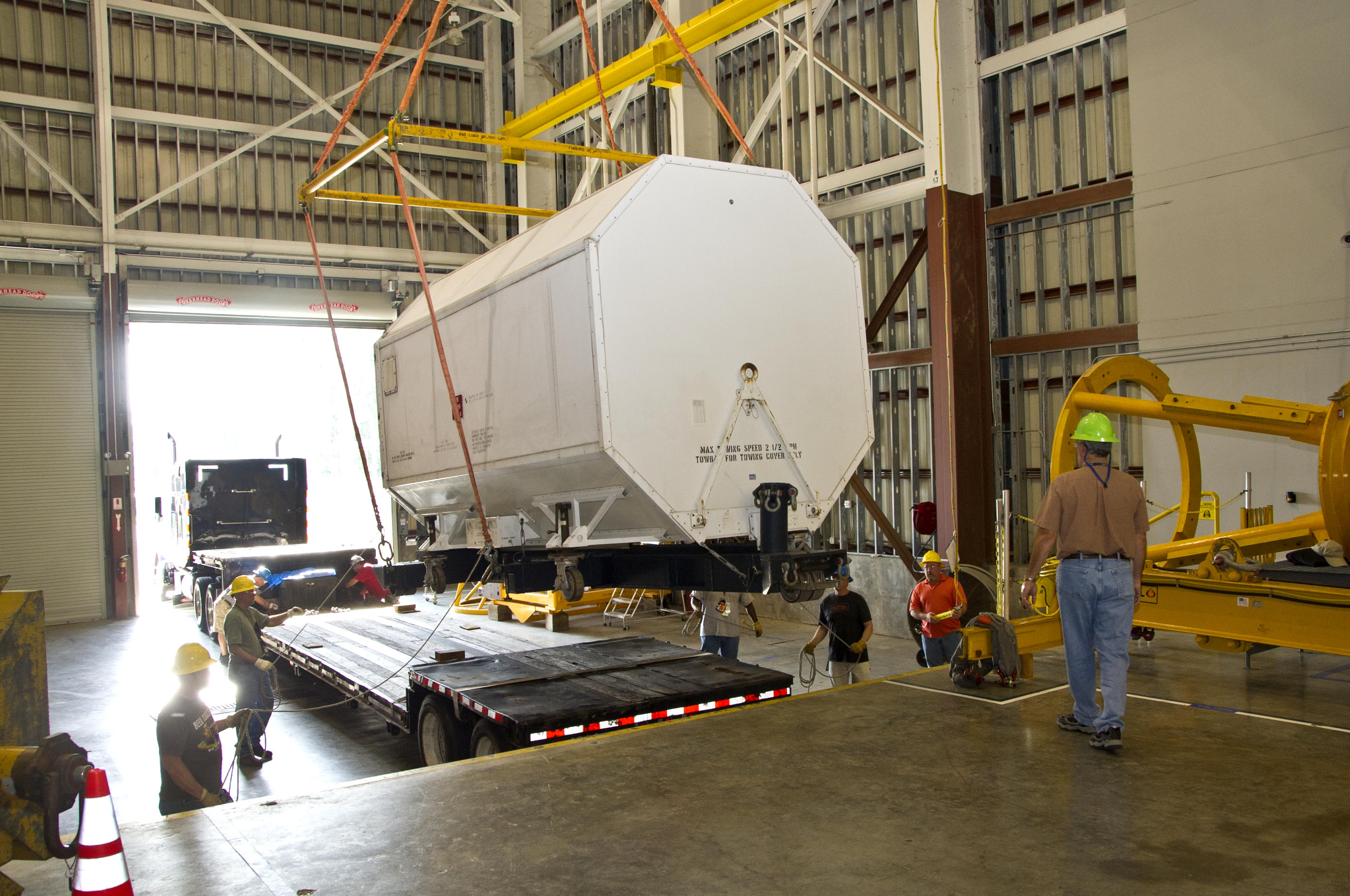
Liquid hydrogen paired with liquid oxygen offers the highest specific impulse of any practical chemical propellant combination — and the harshest engineering penalties. Hydrogen is sparse, cryogenic, prone to leaking through almost any seal, and punishing to turbomachinery. Only a handful of programs have ever attempted to build a high-pressure, closed-cycle hydrolox engine, and only one has flown such an engine repeatedly as a reusable asset: the RS-25, better known for three decades as the Space Shuttle Main Engine (SSME). In this fourth installment of our Rocket Engine Evolution series, we examine what the RS-25 achieved, what it cost, and how the Soviet Union's RD-0120 — built for the Energia super-heavy launcher — reached nearly the same performance by a different road.
I. The Apex of Hydrolox
The RS-25 was developed by Rocketdyne as the main propulsion of the Space Shuttle orbiter, with its first flight on STS-1 in 1981. According to Encyclopedia Astronautica, it is the only high-pressure closed-cycle (staged combustion) reusable cryogenic engine ever flown. In a staged-combustion cycle, preburner exhaust is not dumped overboard but fed into the main combustion chamber, so nearly all propellant contributes to thrust at full efficiency — at the price of far higher internal pressures and temperatures than simpler open cycles demand.
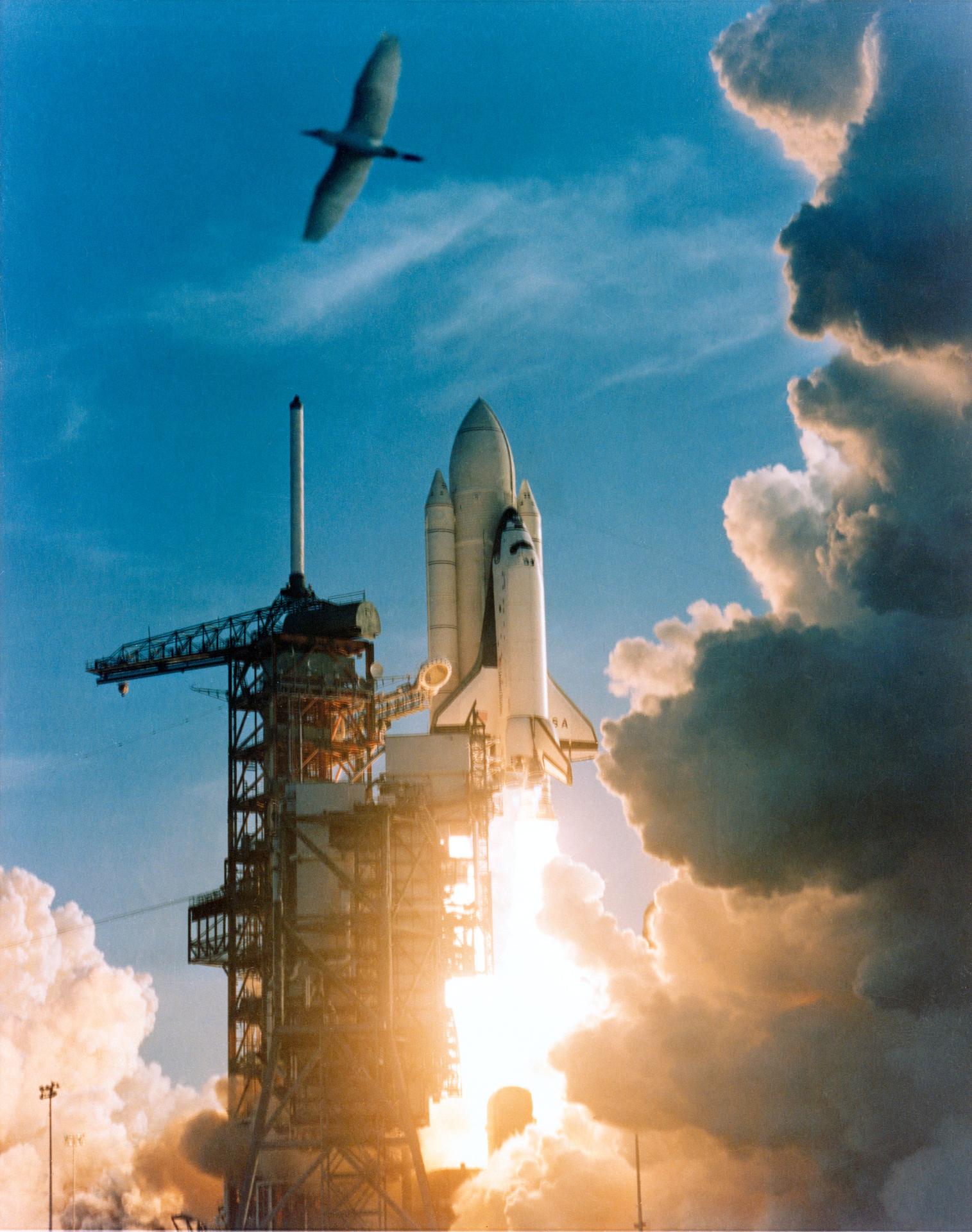
Three RS-25s were mounted on each shuttle orbiter, fed with propellant from the large external tank, and — critically — returned to Earth with the orbiter for reuse. Across the program, the engine flew on all 135 shuttle missions between 1981 and 2011, according to NASA. A total of 351 engines were built, per Encyclopedia Astronautica's production count. No other reusable liquid engine of its class has accumulated a comparable flight record, which is why the RS-25 remains the reference point against which every subsequent hydrolox design — and every claim about reusable propulsion economics — is measured.
II. RS-25 by the Numbers
The RS-25's specifications, as recorded by Encyclopedia Astronautica, define the state of the art for its era. Its 453-second vacuum specific impulse remains near the practical ceiling for an operational staged-combustion hydrolox engine, and its 204-bar chamber pressure was extraordinary for a hydrogen engine of its size.
| Parameter | RS-25 / SSME |
|---|---|
| Propellants | LOX / LH2 (hydrolox) |
| Cycle | Closed-cycle staged combustion, reusable |
| Vacuum thrust | 2,278 kN |
| Sea-level thrust | 1,817 kN |
| Specific impulse | 453 s (vacuum) / 363 s (sea level) |
| Chamber pressure | 204 bar |
| Nozzle area ratio | 77.5 |
| Dry mass | 3,177 kg |
| Thrust-to-weight ratio | ~73 |
| Burn time | 480 s |
| Dimensions | 4.24 m height, 1.63 m diameter |
| Oxidizer-to-fuel ratio | 6 |
| Throttle range | 67% to 109% of rated thrust |
| First flight | 1981 (STS-1) |
| Engines built | 351 |
| Flights | All 135 shuttle missions, 1981–2011 |
Two numbers in this table deserve emphasis. First, the throttle range: the engine could operate from 67 percent up to a notional 109 percent of its original rated thrust. Nominal shuttle launches used 104 percent (about 2,170 kN) as the working maximum, with 109 percent (2,280 kN) held in reserve for abort emergencies — a reflection of how thoroughly the design's margins were understood and exploited over the program's life. Second, the thrust-to-weight ratio of roughly 73 is modest by modern standards: for context, Everyday Astronaut's 2019 engine comparison puts the RS-25 at 73 against roughly 78 for the RD-180 and about 107 for the early Raptor. The RS-25 traded mass efficiency for efficiency of propellant — a deliberate choice for an engine whose job was to burn for eight and a half minutes and then come home.
III. Inside the Machine
The RS-25's architecture illustrates why closed-cycle hydrolox is so demanding. The engine uses high-pressure oxidizer and fuel turbopumps, backed by separate low-pressure boost pumps on both sides to prevent cavitation — hydrogen's extremely low density means the fuel turbopump must spin at extraordinary speed to generate the required pressure rise. Hydrogen is also used to regeneratively cool the chamber and nozzle before injection, doing double duty as coolant and propellant. Ignition is handled by a dual-redundant igniter system.
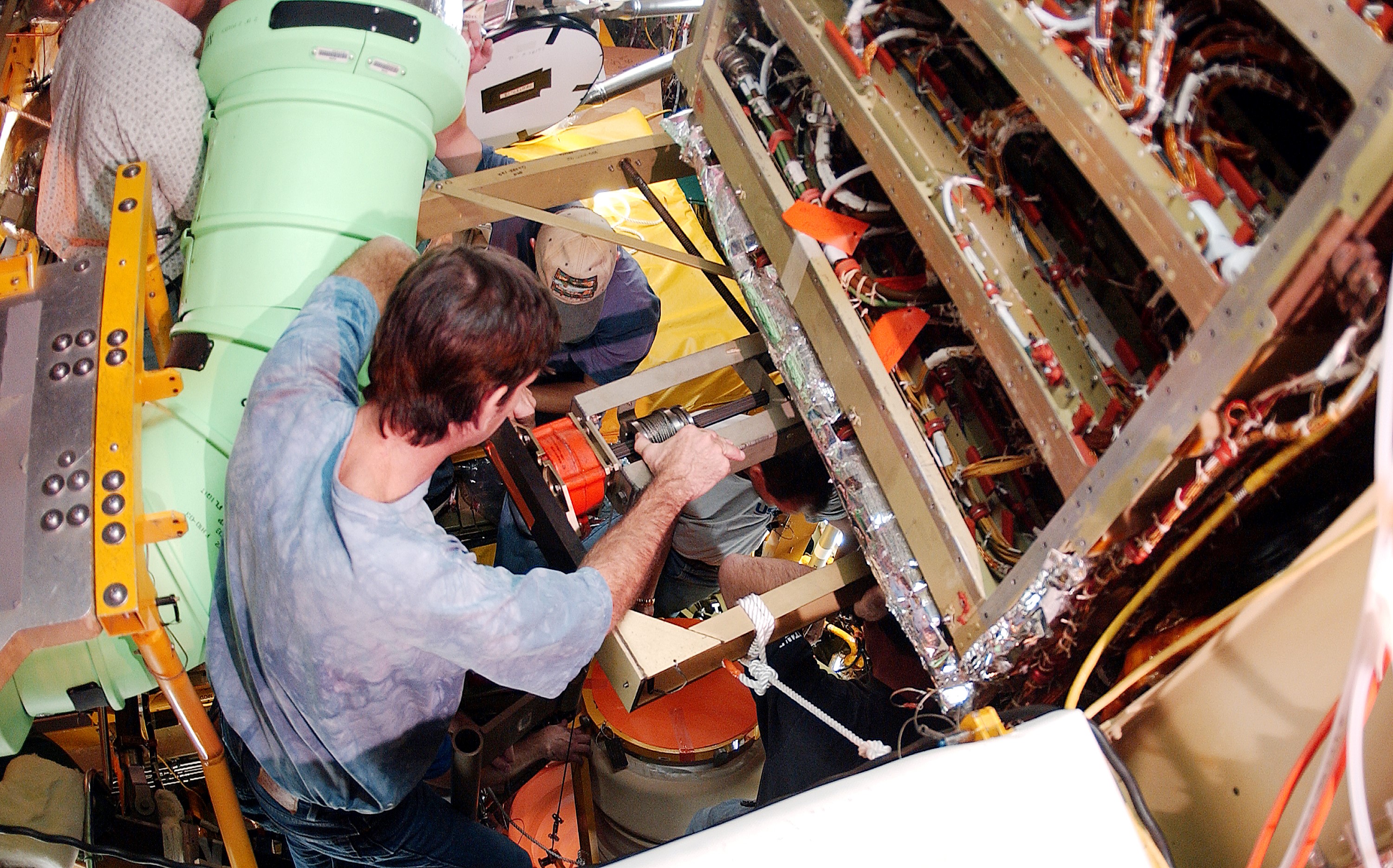
The nozzle alone encapsulates the program's cost structure. According to Encyclopedia Astronautica, the SSME nozzle is regeneratively cooled by 1,080 individual tubes, takes about 2.5 years to build, costs roughly $7 million, and was flown no more than 12 to 15 times because of concerns about hydrogen leaks. When a single component carries that kind of price tag and manufacturing timeline, the meaning of the word 'reusable' becomes heavily qualified.
IV. The Reusability Paradox
The RS-25 was designed with explicit reusability targets: 10 flights between overhauls and a 455-second vacuum specific impulse. According to Encyclopedia Astronautica, neither goal was met. The delivered specific impulse was 453 seconds — a trivial shortfall — but the maintenance goal was missed entirely: engines had to be removed, inspected, and refurbished after each flight rather than every ten.
The consequence was a paradox at the heart of the shuttle program. The RS-25s were recovered and reflown, but the shuttle proved a very expensive way of recovering reusable engines — Encyclopedia Astronautica's assessment is that it perhaps cost more than simply building expendable ones. The engine was reusable in fact but not in economic effect. This is the central lesson the RS-25 offers to the current generation of reusable launchers: reuse only pays when the hardware is designed for minimal refurbishment from the start, not adapted to it after the fact.
V. The Soviet Answer: RD-0120
The Soviet Union's counterpart emerged a few years later. The RD-0120, built by the Kosberg design bureau (KBKhA), powered the core stage of the Energia super-heavy launcher and in 1987 became the first operational Soviet LOX/LH2 engine. According to Encyclopedia Astronautica, it was built to the same overall performance specification as the SSME but using Soviet technology — an independent solution to the same problem rather than a copy.
| Parameter | RD-0120 |
|---|---|
| Propellants | LOX / LH2 (hydrolox) |
| Application | Energia core stage |
| Vacuum thrust | 1,961 kN |
| Sea-level thrust | 1,517 kN |
| Specific impulse | 455 s (vacuum) / 359 s (sea level) |
| Chamber pressure | 218 bar |
| Nozzle area ratio | 85.7 |
| Dry mass | 3,450 kg |
| Thrust-to-weight ratio | ~58 |
| Burn time | 600 s |
| First operational use | 1987 |
| Engines built | 10 |
VI. Two Philosophies, One Specification
Placed side by side, the two engines reveal how differently the superpowers approached the same target. The RD-0120 actually exceeded the RS-25 on the two headline performance metrics: 455 seconds of vacuum specific impulse against 453, and a 218-bar chamber pressure against 204. But the American engine delivered roughly 16 percent more vacuum thrust from an engine about 8 percent lighter, giving it a substantially better thrust-to-weight ratio — about 73 versus about 58.
| Metric | RS-25 (USA) | RD-0120 (USSR) | Edge |
|---|---|---|---|
| Vacuum thrust | 2,278 kN | 1,961 kN | RS-25 |
| Sea-level thrust | 1,817 kN | 1,517 kN | RS-25 |
| Vacuum specific impulse | 453 s | 455 s | RD-0120 (marginal) |
| Sea-level specific impulse | 363 s | 359 s | RS-25 (marginal) |
| Chamber pressure | 204 bar | 218 bar | RD-0120 |
| Dry mass | 3,177 kg | 3,450 kg | RS-25 |
| Thrust-to-weight | ~73 | ~58 | RS-25 |
| Burn time | 480 s | 600 s | RD-0120 |
| Nozzle area ratio | 77.5 | 85.7 | RD-0120 (altitude-optimized) |
The differences map directly onto the two programs' missions. The RS-25 was a reusable orbiter engine that had to light at sea level, throttle across a wide range, and survive return and refurbishment — every kilogram of engine mass was mass the orbiter had to carry to orbit and back. The RD-0120 was an expendable core-stage engine for a heavy-lift booster, optimized for a longer 600-second burn and a larger expansion ratio. Only ten RD-0120s were ever built, and according to Encyclopedia Astronautica the original engines remain mothballed at Baikonur. Where the RS-25 accumulated 135 missions of flight heritage, the Soviet engine's operational story ended with the Energia program itself — a reminder that engineering excellence alone does not guarantee a program's survival.
First flight on STS-1
—
—
First operational Soviet hydrolox engine powers Energia
135th and final shuttle mission
—
Stennis test series passes 10,000 cumulative seconds
—
Engine No. 2063 hot-fired, cleared for Artemis IV
—
VII. After the Shuttle: Rejection and Resurrection
The RS-25's post-shuttle career illustrates how institutional inertia and economics pull in opposite directions. During the Constellation era, the engine was considered for the Ares I upper stage and the Ares V booster — and dropped as uneconomical. Ares I moved to the J-2X, and Ares V to the simpler, expendable RS-68. The verdict of that period was blunt: even with hundreds of flight-proven RS-25s in inventory, the engine was too expensive to operate in an expendable architecture.
Yet the engine returned. The Space Launch System adopted the RS-25 for its core stage — four engines per vehicle. According to NASA, 16 flight engines plus 2 development engines were recovered from the shuttle program to support the first four SLS/Artemis flights. The reasons were pragmatic: no other existing engine combined the required thrust, efficiency, and flight heritage, and the shuttle-era inventory was essentially paid for. The RS-25 thus became simultaneously the best and the most awkward choice available — a reusable masterpiece flying on an expendable rocket, discarded in the ocean after each launch.
VIII. RS-25 in the Artemis Era
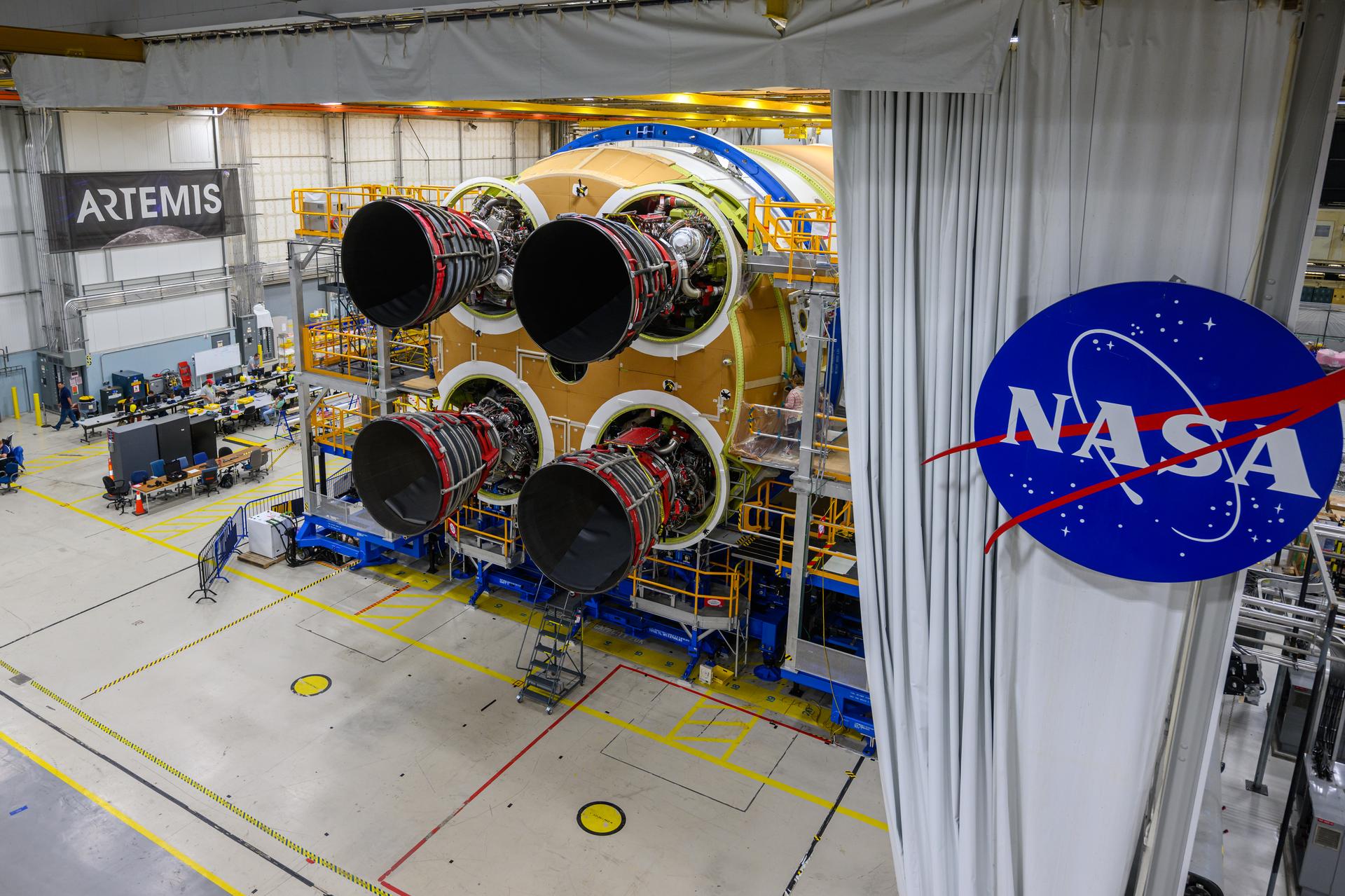
On SLS, the four RS-25s contribute roughly 2 million pounds of the vehicle's 8.8 million pounds of maximum liftoff thrust, according to NASA. The engines start in a staggered sequence about six seconds before solid booster ignition. Initial SLS flights run the shuttle-heritage engines at 109 percent of rated power — the level once reserved for shuttle abort emergencies — and later Block 1B flights will use modified engines at 111 percent.
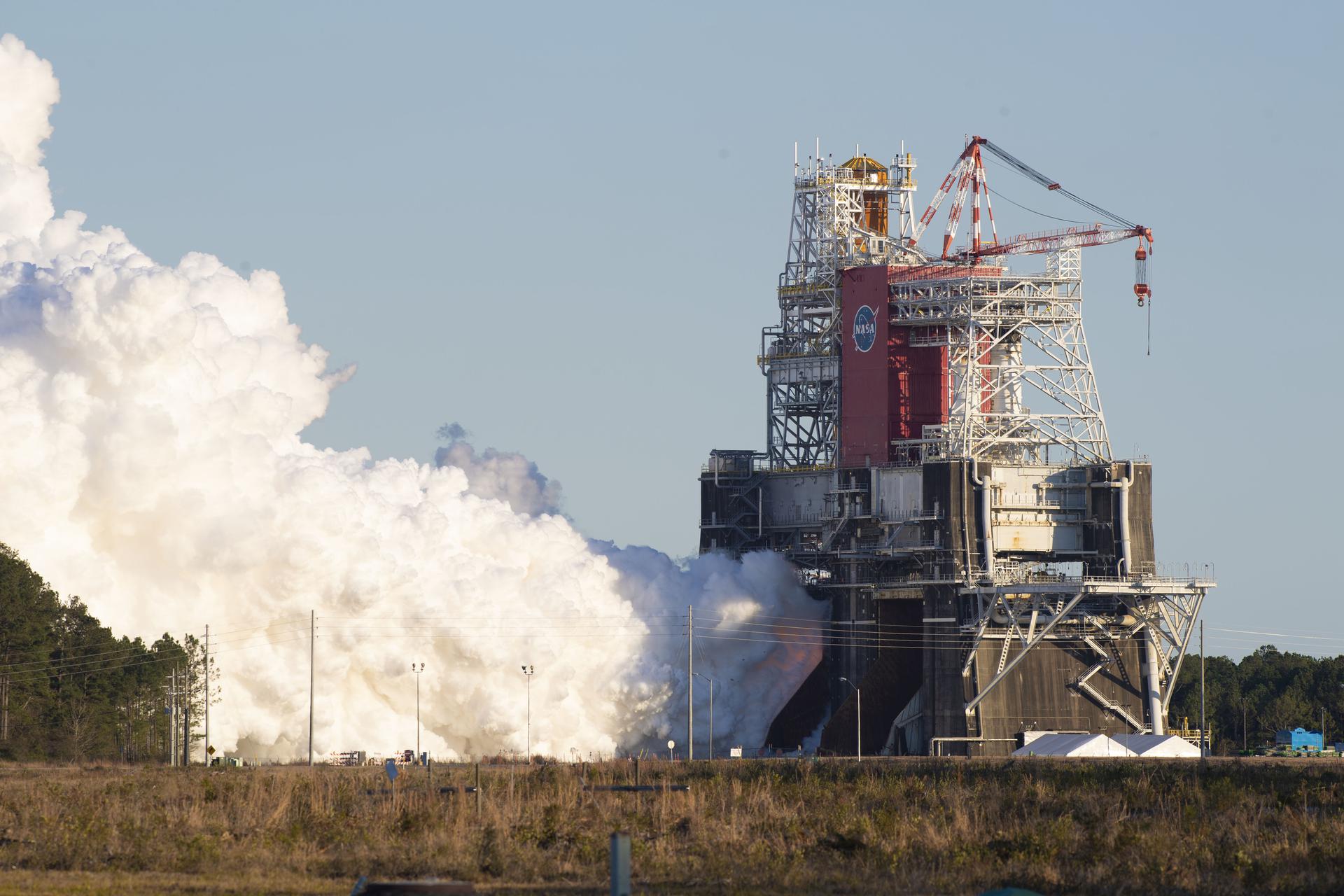
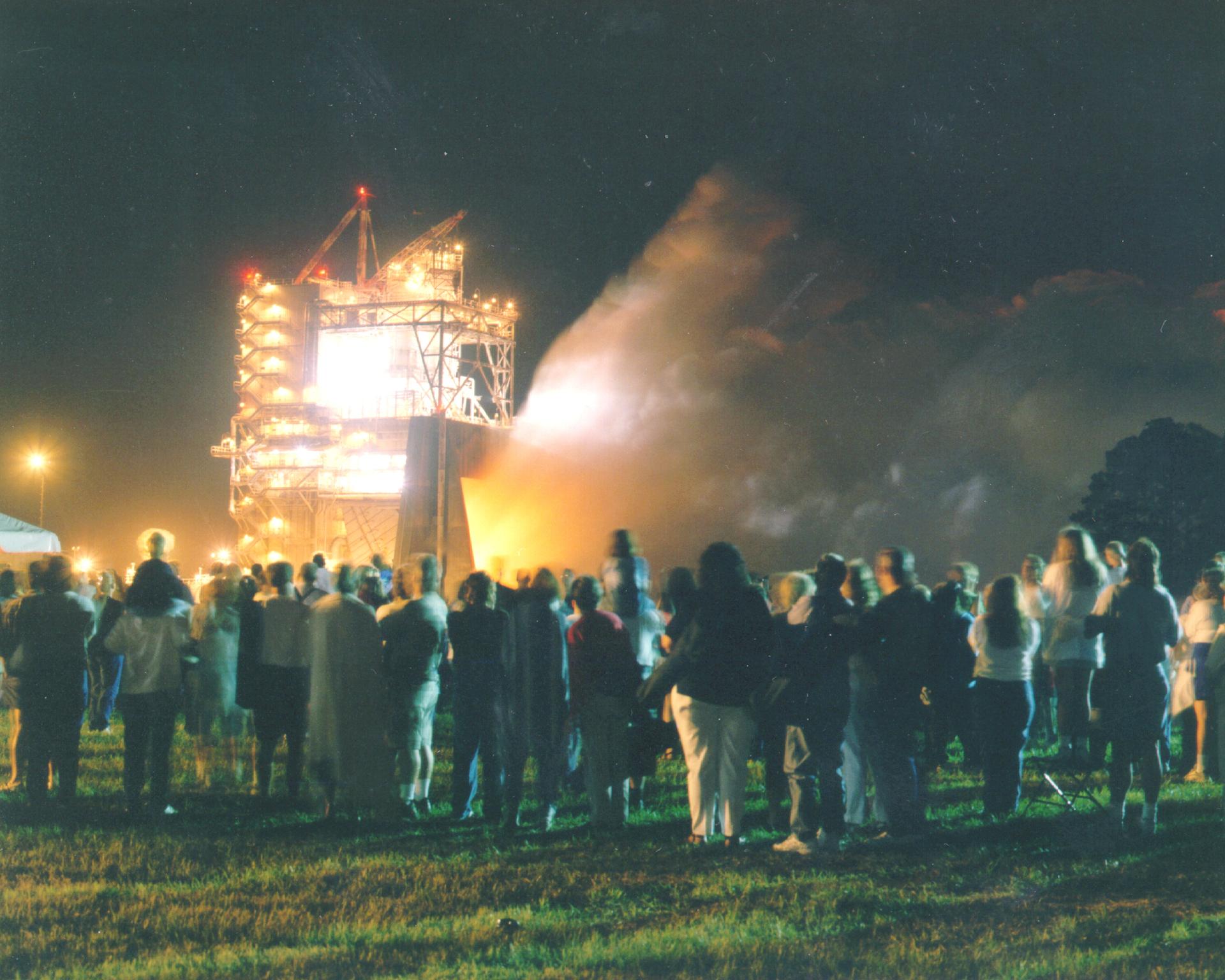
Test and production activity remains ongoing. NASA's Stennis test campaigns had accumulated 22 tests and more than 10,000 cumulative seconds in one series by 2023. On January 22, 2026, NASA hot-fired RS-25 engine No. 2063 for 300 seconds at up to 109 percent power on the Fred Haise Test Stand at Stennis, clearing it for Artemis IV following an actuator replacement. Meanwhile, new-build RS-25s from Aerojet Rocketdyne are in a production restart for post-Block-1 flights, with affordability as a stated driver — the program's own acknowledgment that the original manufacturing approach could not continue.
IX. What the Numbers Mean
Read together, the RS-25 and RD-0120 tell a consistent story about hydrolox propulsion. Both programs proved that a high-pressure staged-combustion hydrogen engine could be built and flown; neither proved that it could be done cheaply. The RS-25's 453-to-455-second specific impulse class remains the efficiency benchmark decades later, but it was bought with four-turbopump architectures, thousand-tube nozzles, per-flight teardowns, and multi-year component production. The RD-0120 matched the performance on paper and then vanished with its launcher after only ten engines were built.
The contrast with later design philosophies is instructive. As covered elsewhere in this series, the NK-33 pursued extreme thrust-to-weight with an oxygen-rich kerosene cycle, and the current generation — Raptor's full-flow staged combustion on methane, and China's YF-100 family on oxygen-rich kerosene — pursues reuse through propellants that burn cleaner than hydrogen-free alternatives while tolerating simpler operations. The RS-25 sits at the opposite pole: maximum propellant efficiency, maximum mechanical complexity, maximum cost. Whether the new-build RS-25 production line can finally bend that cost curve will determine whether the engine is remembered as a bridge to affordable hydrolox or as the magnificent dead end of the expendable era.
X. Summary and Outlook
The RS-25 is a genuinely singular artifact: the only reusable, high-pressure, closed-cycle hydrolox engine ever flown, with 135 missions of heritage and performance figures that still anchor the top of the efficiency charts. Its Soviet rival, the RD-0120, matched or slightly exceeded it on specific impulse and chamber pressure but flew only within a program that did not survive. The price of this class of performance was, in both cases, steep — measured in refurbishment labor for the American engine and in program fragility for the Soviet one. As SLS continues through the Artemis campaign and new-build engines come off the restarted line, the RS-25's final chapter will test whether the masterpiece can also become economical.
XI. FAQ
- Q: What is the RS-25 rocket engine?
- A: The RS-25 is a liquid oxygen/liquid hydrogen staged-combustion rocket engine built by Rocketdyne, originally flown as the Space Shuttle Main Engine from 1981 to 2011 and now used, four at a time, on the SLS core stage. It is the only high-pressure closed-cycle reusable cryogenic engine ever flown.
- Q: What is the specific impulse of the RS-25?
- A: According to Encyclopedia Astronautica, the RS-25 achieves 453 seconds in vacuum and 363 seconds at sea level — near the practical ceiling for an operational hydrolox engine.
- Q: How does the RS-25 compare to the Soviet RD-0120?
- A: The RD-0120 slightly exceeded the RS-25 in vacuum specific impulse (455 s vs 453 s) and chamber pressure (218 bar vs 204 bar), but the RS-25 delivered more thrust (2,278 kN vs 1,961 kN vacuum) at lower mass, giving it a far better thrust-to-weight ratio (~73 vs ~58). Only ten RD-0120s were built, versus 351 RS-25s.
- Q: Was the RS-25 actually reusable?
- A: Mechanically yes — engines returned with the orbiter and were reflown across 135 missions. Economically, the picture is poor: the design goal of 10 flights between overhauls was never met, engines required inspection and refurbishment after every flight, and Encyclopedia Astronautica assesses that recovering them may have cost more than expendable engines would have.
- Q: How many RS-25 engines are on the SLS rocket?
- A: Four. Together they provide roughly 2 million pounds of SLS's 8.8 million pounds of maximum liftoff thrust, starting in a staggered sequence about six seconds before booster ignition.
- Q: Are new RS-25 engines still being built?
- A: Yes. Aerojet Rocketdyne has restarted production of new-build RS-25s for SLS flights beyond the initial Block 1 vehicles, which use 16 flight engines recovered from the shuttle program; affordability is a stated driver of the restart.