
China's Long March 7A rocket suffers launch anomaly, investigation underway
August 10, 2026
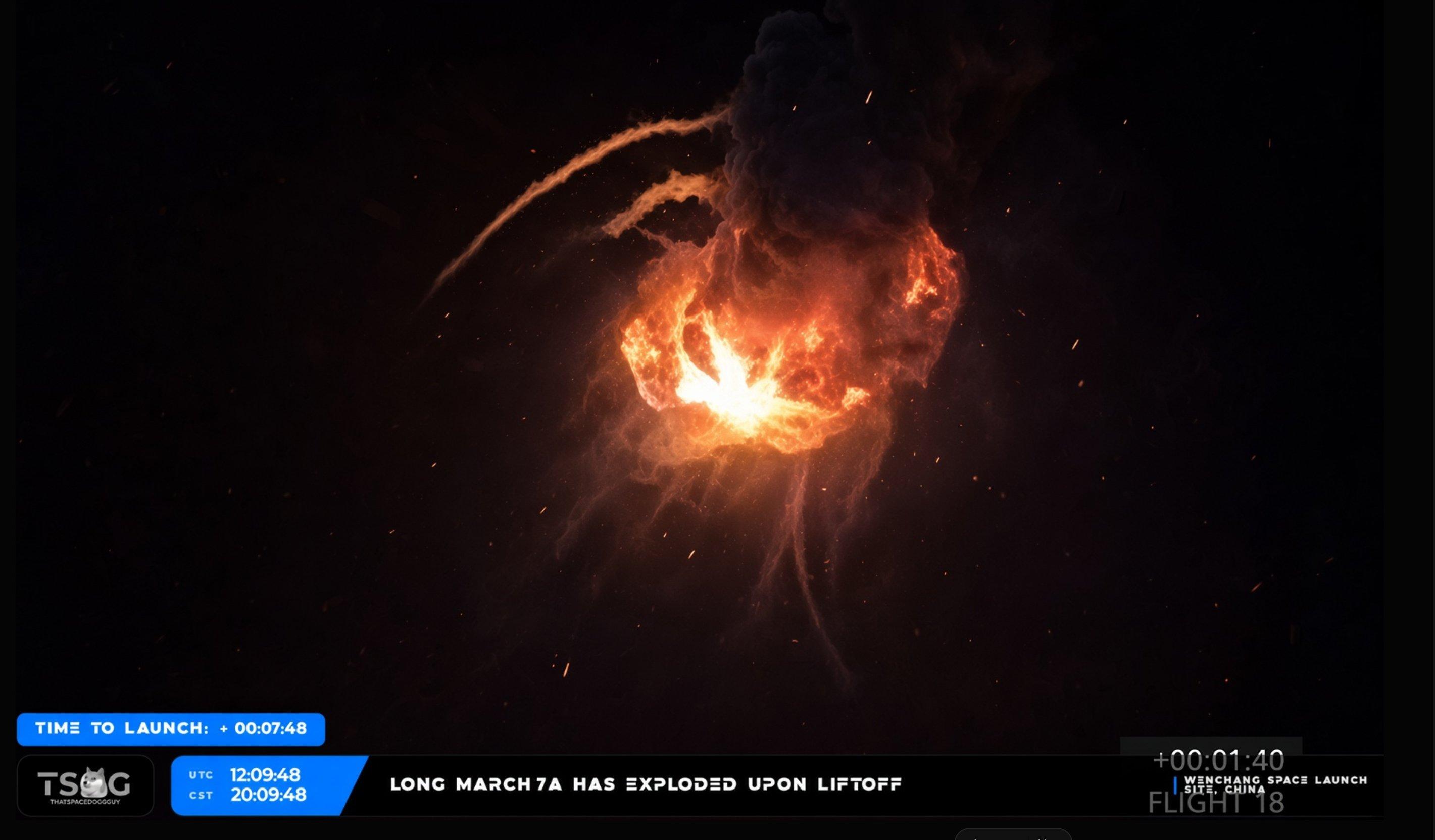
A Long March 7A carrier rocket launched from the Wenchang Spacecraft Launch Site in Hainan at 20:02 local time on August 10, 2026, experienced an apparent anomaly during its ascent, according to footage circulating online. The rocket appeared to break apart in the sky, with visible fireball-like flashes and falling debris trails.
The cause of the failure has not yet been determined. Authorities are expected to analyze telemetry data and conduct a full investigation before releasing an official assessment.
The Long March 7A, also known as the upgraded version of the Long March 7, is designed primarily for high-orbit missions. The rocket features an additional cryogenic upper stage powered by liquid hydrogen and liquid oxygen, giving it enhanced capability for launching payloads into geostationary transfer orbit.
The rocket made its maiden flight in March 2020, which ended in failure after an issue believed to have involved cavitation in the liquid oxygen system of one of its boosters. Following an investigation and corrective measures that lasted nearly a year, the Long March 7A returned to service and had since completed a series of successful missions, including the launch of the Tianlian-3 01 satellite at the end of last month.
Based on publicly available video footage, the anomaly appears to have occurred approximately 88 seconds after liftoff. The rocket would normally pass through the maximum aerodynamic pressure point, known as **Max-Q**, at around 74 seconds into flight. This suggests the incident may have occurred shortly after the vehicle passed through this critical phase, when aerodynamic forces and structural loads remain among the most challenging during ascent.
During this period, any abnormalities involving propulsion systems, structural integrity, or flight control could potentially become amplified due to the demanding flight environment. However, the exact failure mechanism remains unknown pending further analysis.
Observers noted that a propulsion-related failure would be a particularly significant concern, as the rocket's first stage uses the **YF-100 liquid-fuel engine**, a propulsion system also used across several other Long March rocket families, including the Long March 5, 6, 7, and 8 series. If the investigation were to identify an engine-related issue, it could potentially lead to additional reviews or temporary adjustments for related launch programs.
Nevertheless, engine failure is only one of several possible causes, and no conclusions can be drawn until detailed flight data and official findings become available.