
China’s Long March 7A Rocket Suffers Apparent Failure During Ascent
August 12, 2026
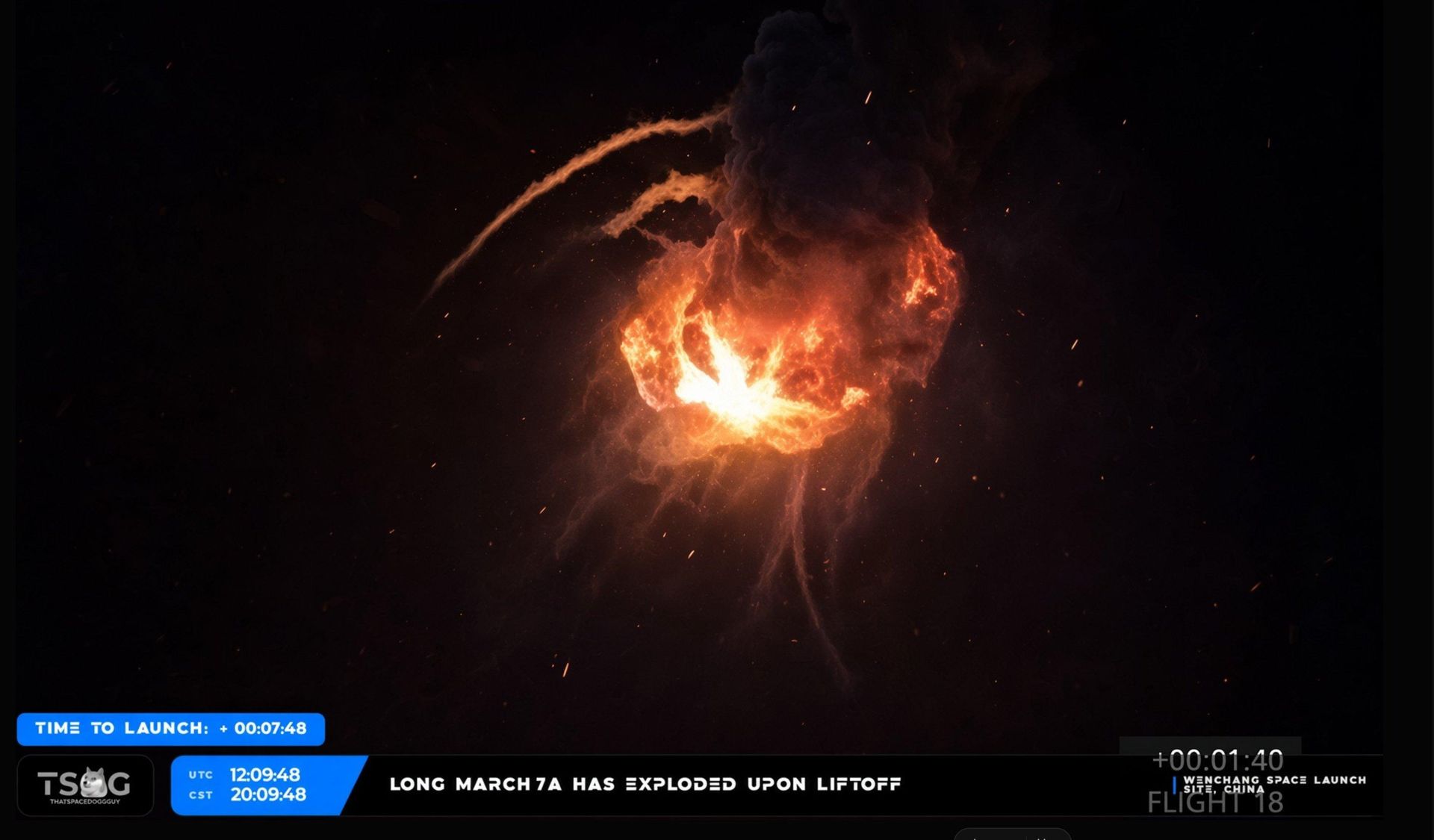
China’s Long March 7A carrier rocket experienced an apparent anomaly during ascent after launching from the Wenchang Spacecraft Launch Site in Hainan at 20:02 local time on August 10, 2026.
Footage circulating online shows the rocket ascending normally before what appears to be a sudden structural breakup, followed by a large fireball and multiple fragments falling through the sky.
The cause of the incident has not yet been officially determined. A detailed analysis of telemetry and other flight data will be required before investigators can establish the precise failure mechanism.
Maiden flight
Ends in failure — LOX-system cavitation later identified as a key factor
Tianlian-3 01
Successful launch, extending a post-return-to-flight success streak
20:02 Beijing time
Apparent in-flight anomaly at ~T+88s, shortly after Max-Q (~T+74s)
Apparent structural breakup seen in infrared footage
Infrared footage of the launch appears to provide additional clues about the sequence of events.

In the footage, the rocket’s upper-stage section appears to suffer a sudden structural break during ascent. The vehicle then rapidly loses its structural integrity, with a large flash or explosion occurring immediately afterward and fragments spreading along different trajectories.
Based on the available imagery, the preliminary sequence appears to be **an apparent structural failure of the upper-stage section, followed by breakup of the vehicle and a subsequent explosion**.
It is important to stress, however, that this is an assessment based solely on publicly available video footage and should not be regarded as an official determination of the cause.
If the apparent structural break is confirmed by telemetry and other flight data, investigators will need to determine what triggered it. Possible areas of investigation could include excessive aerodynamic loading, a structural or manufacturing defect, a propulsion-system abnormality, guidance or control problems, or other unforeseen failures.
The video itself cannot determine which of these possibilities was responsible.
Timing of the incident
Based on publicly available footage, the anomaly appears to have occurred approximately **88 seconds after liftoff**.
Under a nominal Long March 7A ascent profile, the rocket would normally pass through **Max-Q**, or maximum aerodynamic pressure, at roughly 74 seconds after launch. This means the apparent failure occurred shortly after the vehicle passed through this particularly demanding portion of the ascent.
Max-Q is the point at which the combination of atmospheric density and vehicle velocity produces the highest aerodynamic pressure on the rocket. The vehicle is subjected to significant aerodynamic forces and structural loads during this phase.
That does not, however, mean that Max-Q itself caused the failure. A failure occurring shortly after Max-Q could have a wide range of potential causes, and determining whether aerodynamic loading played any role will require detailed flight data.
Background of the Long March 7A
The Long March 7A, also known as the upgraded Long March 7, is a derivative of the Long March 7 family developed primarily for higher-energy missions, including launches requiring greater performance toward geostationary transfer orbit.
Compared with the basic Long March 7 configuration, the Long March 7A incorporates an additional cryogenic upper stage using liquid hydrogen and liquid oxygen. This gives the vehicle greater capability for placing payloads into higher-energy orbits.
The Long March 7A made its maiden flight on March 16, 2020, but the mission ended in failure.
The failure was subsequently associated with an issue involving the liquid-oxygen system of the rocket’s booster stage, with cavitation identified as a key factor in the investigation. Following the incident, the Long March 7A program underwent a lengthy review and corrective process before returning to flight.
The rocket subsequently established a successful launch record, completing a series of missions without a reported major failure. As recently as late July, a Long March 7A successfully launched the **Tianlian-3 01** satellite.
The latest incident therefore represents a significant setback for the launch vehicle program after several consecutive successful missions.
Potential implications for the YF-100 engine
One particular concern would be the possibility of a propulsion-system failure, although there is currently no evidence that the YF-100 engine was responsible for the incident.

The Long March 7A’s first stage is powered by the **YF-100 liquid-fuel rocket engine**, a major engine family used across several Chinese launch vehicles, including members of the Long March 5, Long March 6, Long March 7 and Long March 8 families.
Because the YF-100 is used across multiple launch-vehicle configurations, a confirmed systemic engine problem could have implications beyond the Long March 7A program.
Such a finding could potentially lead to additional inspections, data reviews or temporary delays for other launch vehicles using the same engine family, depending on the nature and severity of the problem.
At the same time, there is currently no basis for concluding that the YF-100 was involved in the accident. A structural failure, flight-control problem, upper-stage malfunction or another issue could produce a similar visual outcome.
What investigators will need to determine
The most important task now will be to reconstruct the final seconds of the flight using telemetry and other evidence.
Investigators will likely examine the vehicle’s propulsion parameters, chamber pressures, turbopump performance, tank pressures, structural loads, guidance and navigation data, attitude-control inputs, stage-separation systems and other flight parameters.
The timing of the apparent breakup will also be important. By comparing the vehicle’s actual flight trajectory and structural loads with the nominal flight profile, investigators may be able to determine whether the vehicle encountered an abnormal aerodynamic condition or whether the failure originated within the propulsion, structural or control systems.
The infrared footage could also help establish the **sequence** of the failure. If further analysis confirms that the upper-stage section broke apart before the large explosion occurred, the explosion may have been a consequence of the initial structural failure rather than the initiating event itself.
That distinction will be important in determining the root cause.
No definitive conclusion yet
At this stage, it would be premature to attribute the accident to any particular component or system.
The available video provides valuable visual evidence, but it cannot replace the rocket’s telemetry and engineering data. The apparent breakup seen in the footage may help investigators establish what happened, but not necessarily why it happened.
The key questions are therefore whether the apparent structural failure was the initiating event, what caused that failure, and whether the incident was an isolated vehicle-specific problem or indicative of a broader issue affecting a particular subsystem or component.
Until the relevant telemetry has been analyzed and an official investigation has been completed, the cause of the Long March 7A failure remains uncertain.
For now, the available evidence indicates that the rocket suffered a major anomaly during ascent, with infrared footage appearing to show an upper-stage structural breakup followed by the rapid disintegration of the vehicle and a subsequent explosion.
Further conclusions will depend on the results of the official investigation and the release of additional flight data.