
The Four Titans: Saturn V vs. Soviet N1 vs. SpaceX Starship vs. Long March 9
August 7, 2026
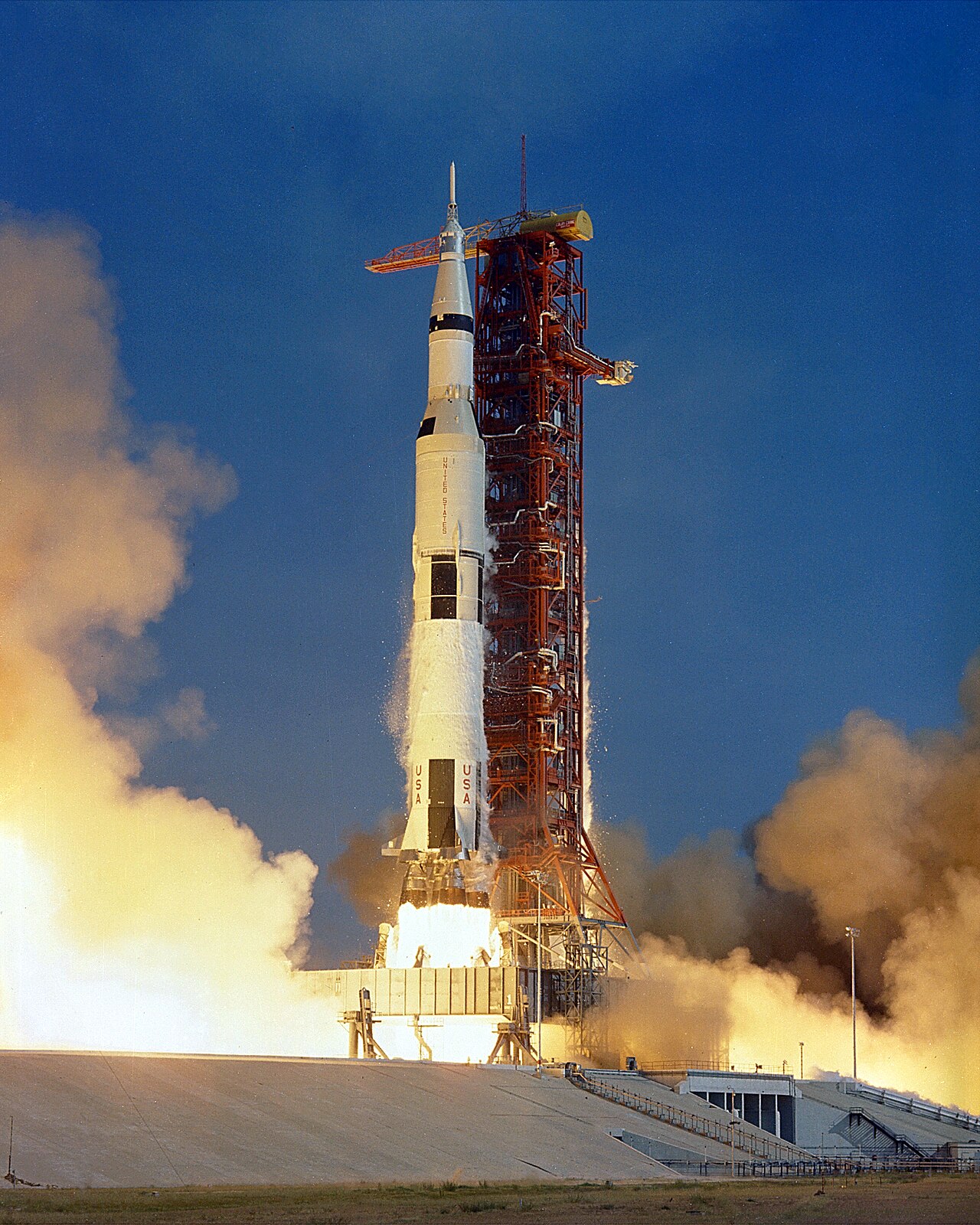
Which is the most ambitious rocket ever built? This article compares four super heavy-lift launch vehicles on technical data, design choices, test flight results and mission capability. The first two represent the peak of the US–Soviet Moon race in the 1960s; the third is the disruptive 21st-century commercial attempt at full reusability; the fourth, China's Long March 9, is a next-generation super heavy-lifter still in development, its design now converging on reusability and high-thrust methalox propulsion. Launch figures cited below come from the Launch Library 2 (TheSpaceDevs) database.
1. Basic Parameter Comparison
| Parameter | Saturn V | Soviet N1 (final config.) | SpaceX Starship (current design) | Long March 9 (in development) |
|---|---|---|---|---|
| **Status** | Retired | Cancelled | Flight testing | In development, design being refined |
| **Height** | 110.6 m | 105 m | ~120–125 m (stack) | ~110–115 m |
| **Max. stage diameter** | 10.1 m (S-IC) | 17 m (spherical tank base) | 9 m | ~10.6 m (core stage) |
| **Liftoff mass** | ~2,950 t | ~2,750 t | ~5,000 t | ~4,200–4,500 t |
| **Liftoff thrust** | ≈34.5 MN | ≈45 MN (30 NK-15) | ≈75 MN (33 Raptor 2) | ≈52 MN (26 × YF-215) |
| **LEO payload** | ~140 t (expendable) | ~95 t (design, never achieved) | 100–150 t (reusable); >200 t (expendable) | ~100–150 t (booster reuse mode) |
| **Stages** | 3 | 3 | 2 (booster + ship) | 2 |
| **Engine cycle** | Gas generator (F-1, J-2) | Oxygen-rich staged combustion (NK-15/NK-33) | Full-flow staged combustion (Raptor) | Full-flow staged combustion (methalox); hydrolox upper stage |
| **Propellant** | RP-1/LOX + LH2/LOX | RG-1/LOX (all stages) | LCH4/LOX (all stages) | LCH4/LOX + LH2/LOX |
| **Reusability** | None | None | Designed for full reuse | First stage vertical landing; second stage expendable |
2. The Vehicles in Detail
2.1 Saturn V (United States)
**Background and mission objective**: Developed by NASA in the 1960s with the sole purpose of sending a crewed spacecraft to the Moon and fulfilling the Apollo programme.
**Key data and configuration**:
- First stage (S-IC): 5 F-1 kerosene/liquid-oxygen engines, each producing ~6.7 MN of sea-level thrust — the story of those five beasts is told in our F-1 engine profile.
- Second stage (S-II): 5 J-2 hydrogen/oxygen engines, each with ~1.0 MN vacuum thrust.
- Third stage (S-IVB): 1 J-2 engine, used for Earth-orbit insertion and trans-lunar injection.
- Total payload: ~140 tonnes to low Earth orbit; ~48.5 tonnes to trans-lunar injection.
**Testing and flight record**:
- 15 vehicles manufactured; 13 flights conducted between 1967 and 1973.
- All 13 launches accomplished their primary missions, with no total payload loss. Apollo 6 experienced interstage instability and a premature engine shutdown but still met its objectives.
- All crewed flights (Apollo 8, 10, 11–17) were free of catastrophic failure — a record no other super heavy-lifter has matched.
**Design philosophy**: highly conservative, waterfall-style development with extensive full-stage ground testing; a small number of high-thrust fixed engines with gimballing for steering; cost compression was not a priority.
**Subsequent fate**: production halted after Apollo; tooling destroyed; three complete vehicles survive as museum exhibits. See the Saturn V entry in our rocket directory.
2.2 Soviet N1
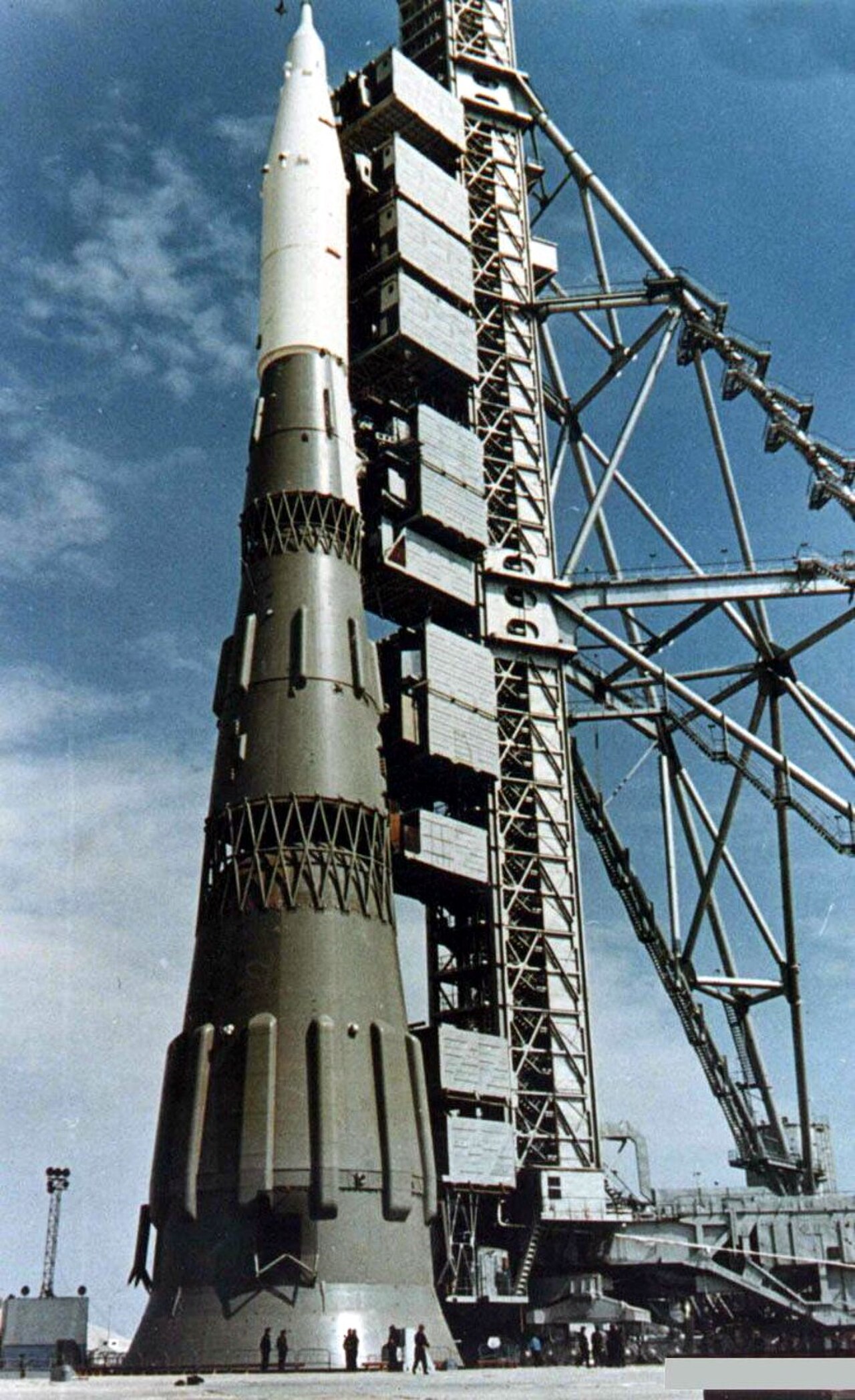
**Background and mission objective**: the Soviet heavy-lift rocket for crewed lunar missions, led by OKB-1 under Sergei Korolev, intended to place the Soyuz 7K-LOK orbiter and LK lander into orbit for a Soviet Moon landing.
**Key data and configuration**:
- First stage (Block A): 30 NK-15 engines (later NK-33), total sea-level thrust ~45 MN.
- Second stage (Block B): 8 NK-15V; third stage (Block V): 4 NK-21. All stages burned RG-1 kerosene/LOX.
- Design LEO payload ~95 tonnes; trans-lunar injection ~23.5 tonnes.
**Engine technology**: the NK-15/NK-33 pioneered oxygen-rich staged combustion, reaching a vacuum specific impulse of ~331 s versus ~304 s for the F-1 — the closed cycle's thermodynamic advantage. A single NK-15 made only ~1.5 MN, forcing the 30-engine cluster.
**Testing and flight record**: four launch attempts between 1969 and 1972, all lost before first-stage burnout — February 1969 (fire, KORD shutdown, crash at T+69 s), July 1969 (foreign object in an oxidiser pump; the explosion destroyed the pad), June 1971 (loss of roll control), November 1972 (pogo oscillations). No full-duration static fire of the complete first stage was ever conducted.
**Subsequent fate**: cancelled in 1974; the leftover NK-33 stock was later sold and flown — successfully — on the US Antares and Russia's Soyuz-2-1v, vindicating the engine design. The full story is in our N1 and NK-33 profile, and the N1 entry carries its flight record.
2.3 SpaceX Starship

**Background and mission objective**: a fully reusable super heavy-lift system spanning LEO deployment, NASA's Artemis Human Landing System, Mars transport, and point-to-point travel — with the central goal of cutting cost per kilogram to orbit by orders of magnitude.
**Key data and configuration**:
- Super Heavy booster: 33 Raptor 2 engines (Raptor 3 planned), ~75 MN total sea-level thrust.
- Starship upper stage: 6 Raptors (3 sea-level, 3 vacuum). Stack height ~120–125 m; liftoff mass ~5,000 t.
- Propellant: deeply chilled liquid methane/LOX. LEO payload 100–150 t reusable; >200 t expendable.
**Engine technology**: Raptor is a full-flow staged-combustion engine with ~300 bar chamber pressure, sea-level Isp ~330 s and vacuum Isp ~380 s — see our Merlin vs Raptor analysis. Methane was chosen for low coking (reuse) and because it can be synthesised on Mars.
**Testing and flight record (as of August 2026)**: an open, iterative campaign — IFT-1 (April 2023) lost control before staging; IFT-2 (November 2023) demonstrated hot staging; 2024 flights reached orbital velocity and soft booster splashdowns; IFT-5 (October 2024) achieved the first tower catch of the booster. Follow the ongoing campaign on the Starship entry.
**Design philosophy**: "failure as learning" — rapid flight iteration over exhaustive ground simulation; everything subordinate to full reuse and launch cadence.
2.4 Long March 9 (China, In Development)
**Background and mission objective**: led by CASC, the Long March 9 (CZ-9) targets a 100-tonne-class lift capability for crewed lunar landings, deep-space exploration, Mars sample return, and construction of a lunar research station. First flight is targeted around 2030.
**Current configuration**: a two-stage vehicle with a ~10.6 m core and ~4,200–4,500 t liftoff mass. The first stage mounts 26 methalox engines of ~2,000 kN each — the **YF-215**, a full-flow staged-combustion design with a ~300 bar-class chamber pressure, ~330 s sea-level and ~380 s vacuum specific impulse, and deep throttling for vertical landing. The second stage uses a large hydrolox engine (likely the YF-90 or a derivative, ~2,200 kN vacuum thrust, Isp above 450 s) and is expendable.
**Payload targets**: ~100–150 t to LEO in reuse mode; 50–60 t to trans-lunar injection; a future goal of 30–40 t onto a Mars transfer trajectory.
**Development progress (as of August 2026)**: the YF-215 has completed multiple long-duration hot-fire, throttling, and multi-start tests; a 10-metre tank prototype has passed hydraulic strength tests; recovery technologies are being flight-proven on medium-lift vehicles like the Long March 10B, feeding data directly into the CZ-9 design. The full vehicle has not yet been assembled.
**Design philosophy**: the concept has evolved from an expendable booster-heavy architecture to a simplified two-stage methalox design with first-stage reuse — shifting the focus from raw payload to a balance of economy and cadence. It remains the most dynamically defined super heavy-lifter in development anywhere.
3. Timeline: Two Eras of Giant Rockets
First flight (Apollo 4)
—
Apollo 8 — first crewed lunar orbit
—
—
1st launch fails at T+69 s
Apollo 11 lands humans on the Moon
2nd launch explodes, destroys pad
—
3rd launch fails (roll control)
Apollo 17 — final Moon landing
4th launch fails (pogo)
Final flight (Skylab), 13/13 missions
—
Retired
Programme cancelled
IFT-1 / IFT-2: hot staging proven
—
IFT-5: first tower catch of booster
YF-215 long-duration hot-fire tests
V2 flights; ship re-entry work
10-m tank prototype passes strength tests
V3 flights; propellant transfer demo
Subsystem ground verification continues
Operational cadence target
First flight target
4. Comparative Analysis
**Thrust and payload**: liftoff thrust ranks Starship (75 MN) > Long March 9 (~52 MN) > N1 (45 MN) > Saturn V (34.5 MN). In reusable configuration, Starship and Long March 9 sit in a similar 100–150 t LEO class; Starship's expendable variant takes the overall payload crown.
**Engine technology**: the F-1 was reliable but inefficient (gas generator); the NK-33 pioneered oxygen-rich staged combustion but never matured; Raptor and YF-215 both use full-flow staged combustion — the current peak of chemical propulsion — but Raptor is in large-scale flight testing while the YF-215 is still in ground qualification. The CZ-9's methalox first stage plus hydrolox upper stage mirrors Starship's propellant choice while keeping high-Isp hydrogen for deep-space energy.
**Reliability**: Saturn V is the only proven crewed super heavy-lifter (13/13 missions); the N1 never matured (0/4); Starship's success rate is climbing through its test campaign; the CZ-9's reliability case is still being built on the ground.
**Reusability and cost**: Saturn V and N1 were expendable and ruinously expensive per flight; Starship aims for single-digit-million-dollar internal launch costs through full reuse; the CZ-9 targets first-stage reuse, with economics to be proven in operations.
5. Ambition in Different Dimensions — Conclusion
Measured by the **gap between the engineering goal and the technology of its time**, the N1 was arguably the most radical. Measured by **milestones actually achieved**, the Saturn V remains the only super heavy-lifter that has sent humans to the Moon and brought them home. Measured by **restructuring the launch business model**, Starship is turning full reusability into engineering reality through rapid iteration. And the Long March 9 is the only one still defining its final form — its fate tied to the maturity of the YF-215 and to the pace of China's deep-space mission requirements.
Four programmes, four answers to the same question. The data will keep accumulating in our rocket directory — you can line these vehicles up side by side any time in the compare tool.
FAQ
- Q: Was the Saturn V more powerful than Starship?
- A: No — on paper Starship's Super Heavy booster produces about 75 MN of liftoff thrust against the Saturn V's 34.5 MN, more than double. The Saturn V remains unmatched in a different category: it is the only super heavy-lifter with a perfect 13-for-13 mission record and the only one to have carried humans to another world.
- Q: Why did the N1 fail while its engines were technically excellent?
- A: The NK-15/NK-33 engines were ahead of their time, but the system around them was not: 30 engines were never test-fired together before flight (no large enough test stand), and the KORD analogue computer that managed engine health was primitive and error-prone. All four failures were propulsion-system integration failures, not fundamental engine-design flaws — the surviving NK-33s later flew successfully in America and Russia.
- Q: Is the Long March 9 a Starship clone?
- A: Not exactly. It adopts the same proven ingredients — methalox full-flow staged-combustion engines, first-stage vertical recovery — but keeps a high-performance hydrogen upper stage, which Starship lacks. That gives the CZ-9 better efficiency for demanding deep-space injections at the cost of a more complex two-propellant architecture.